

Follow the latest updates on Afghanistan here
The Taliban's return to power in Afghanistan has dented the image of the United States as a reliable partner to Middle Eastern governments and sparked fears that the insurgents' triumph could energise Islamist extremist groups in the region, analysts told The National.
The US military pulled its last soldier from Afghanistan on Monday night, ending a war that began in 2001 when America led an alliance that toppled the Taliban regime that harboured the Al Qaeda leaders who plotted the September 11 terrorist attacks.
Two decades, $2 trillion and thousands of casualties later, the Taliban are back in power after a chaotic and desperate airlift in which thousands of Afghans thronged Kabul airport to flee the country.
US President Joe Biden on Tuesday defended his decision to end America's longest war, saying Washington needed to focus on developing threats.
“I refuse to open another decade of warfare in Afghanistan. We've been a nation too long at war. If you're 20 years old today, you've never known an America at peace.”
It was the US leader’s first detailed public response to criticism of his country's disorderly departure from Afghanistan, scenes of which will likely remain for years etched on the minds of many across the world.
-
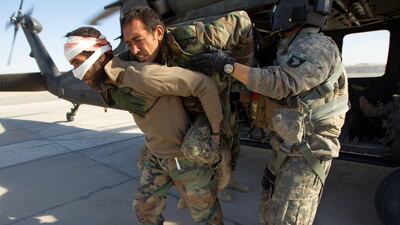
Sergeant Jay Kenney, 26, with the 101st Airborne Division, Task Force Destiny, assists wounded Afghan National Army (ANA) soldiers off the Blackhawk UH-60A helicopter after they were rescued in an air mission in Kandahar on December 12, 2010 in Kandahar province, Afghanistan. Getty Images -
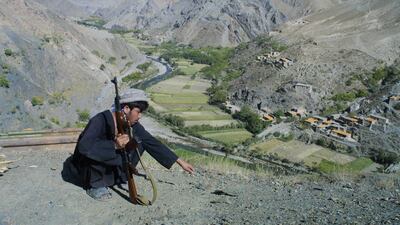
An Afghan Northern Alliance fighter mans the front line against the Taliban on October 2, 2001 near Jabul os Sarache, 30 miles north of Kabul. Getty Images -
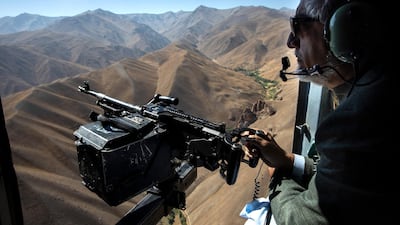
Abdullah Abdullah, chief executive of Afghanistan travelling via helicopter for the final campaign rally in Bamiyan, Afghanistan on September 25, 2019. Afghans will head to the polls on Saturday, September 28th. Getty Images -
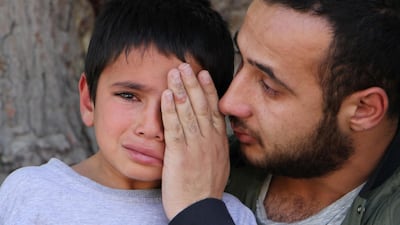
Mustafa Tamanna, 10, son of Afghan reporter Zabihullah Tamanna, weeps during the funeral ceremony in Kabul, Afghanistan on June 7, 2016. Tamanna was killed by a rocket-propelled grenade fired by the Taliban. Getty Images -
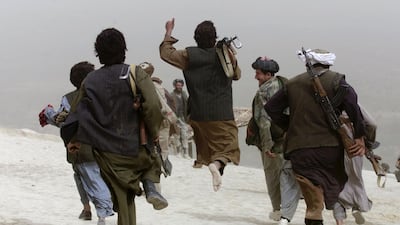
Northern Alliance soldiers come back from the front line after a battle near Charatoy town in the north of Afghanistan on October 10, 2001. REUTERS -
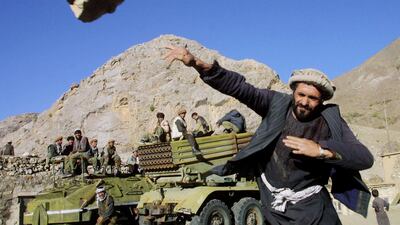
A Northern Alliance fighter throwing rocks as part of a popular national game yards away from a multiple Grad missile launcher in October 12, 2001 in the Salang Gorge in Northern Afghanistan. Getty Images -
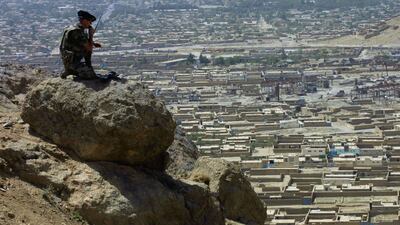
A French soldier from the 7th Mountain Regiment, part of the International Security and Assistance Force (ISAF) stands on a boulder overlooking Kabul during a patrol August 3, 2002 in Afghanistan. The ISAF has been patrolling Kabul since January 2002, working with the government and a new police force to prevent the violence and lawlessness that threatened to engulf the city after a U.S.-led coalition forced the Taliban from power. Getty Images -
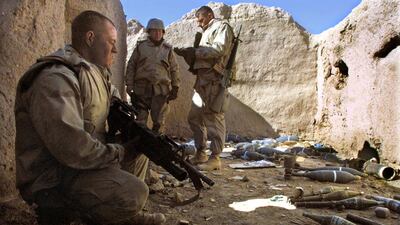
US Marine Sgt. Jerry Brown (L) of Jacksonville, North Carolina watches over a weapons cache found during a patrol near the American military compound at Kandahar Airport in January 16, 2002 in Kandahar, Afghanistan. The Marines recovered mortars, rockets, rocket-propelled grenades and artillery rounds discovered in various caches near the base while on the patrol. Getty Images) -
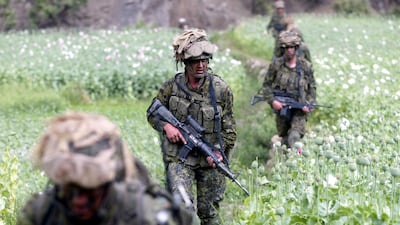
Members of the Princess Patricia's Canadian Light Infantry patrol through poppy fields in the village of Markhanai in May 6, 2002 in the Tora Bora valley region of Afghanistan. Getty Images -
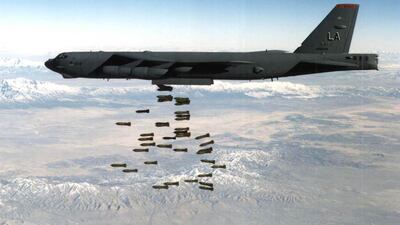
The United States and Britain on October 7, 2001 launched a first wave of air strikes against Afghanistan. President George W. Bush said the action heralded a "sustained, comprehensive and relentless" campaign against terrorism. REUTERS -
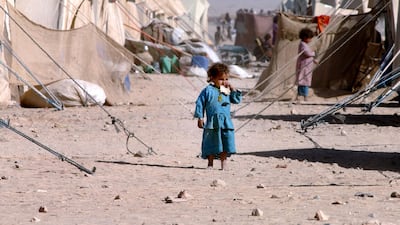
A young Afghan girl eats a piece of bread at the Chaman refugee camp on November 8, 2001 on the Pakistan border with Afghanistan. The UNHCR has estimated that since September 11, 2001 over 135,000 Afghans have crossed the border into Pakistan, adding to the already millions of refugees living in the country. Getty Images -
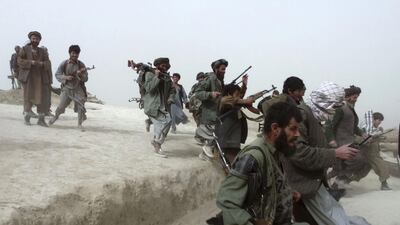
Afghan opposition Northern Alliance soldiers leap over a trench as they return from front line positions after battle near the town of Charatoy in the north of Afghanistan October 10, 2001. REUTERS -
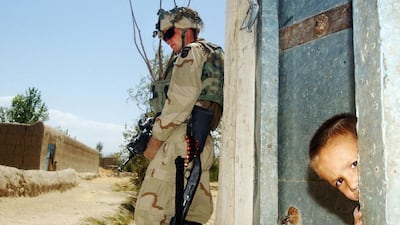
An Afghan child peeks out from the doorway of his family's home as a US Army soldier from the 101st Airborne stands guard in the eastern Afghan village of Hesarak on July 16, 2002 during what the Army refers to as a 'sensitive site exploitation' mission or 'SSE'. Getty Images -
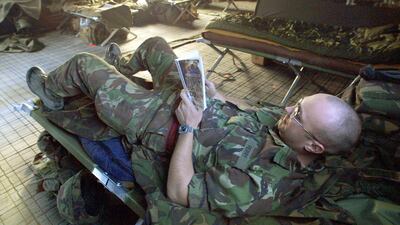
Fred Perry, a British Royal Engineer soldier, reads the book "Black Hawk Down" inside his tent after a day of work on January 29, 2002 at the International Security Assistance Force (ISAF) barracks at the Kabul airport in Kabul, Afghanistan. Getty Images -
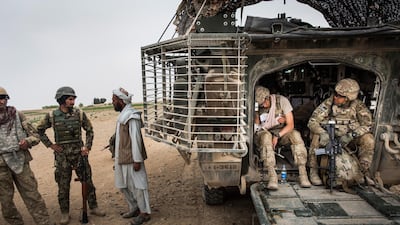
Afghan soldiers (L) speak to a local Afghan, while a medic in the U.S. Army's 1st Battalion, 36th Infantry Regiment, Charlie Company (R) monitors a soldier who has just survived a blast from an improvised explosive device (IED) while driving a vehicle during a mission near Command Outpost Pa'in Kalay, on March 19, 2013 in Kandahar Province, Maiwand District, Afghanistan. Getty Images -

Marines on a light armored vehicle prepare for patrol as an AH1W "Super Cobra" helicopter flies by on December 28, 2001 at the U.S. Marine Corps Base in Kandahar, Afghanistan. Getty Images -
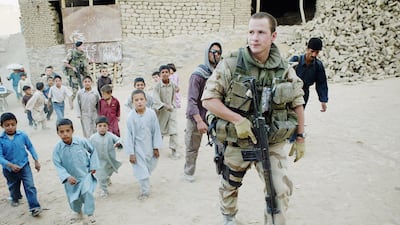
A Norwegian ISAF (International Security Assistance Force)soldier from Recce Squadron 3 patrols on October 4, 2004 in Kabul, Afghanistan as election officials get ready for the Presidential elections. Getty Images -
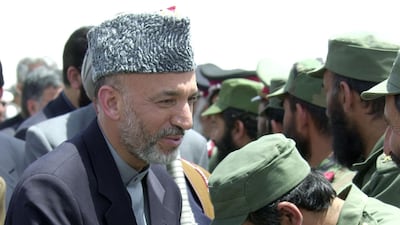
Interim Afghan leader Hamid Karzai (L) is greeted by a group of Afghan military officers on his arrival to Kandahar airbase on May 04, 2002 in Southern Afghanistan. Getty Images -
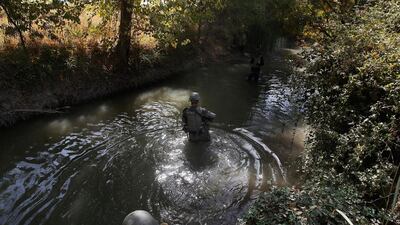
Soldiers in the U.S. Army's 101st Airborne Division wade though a creek to avoid buried insurgent bombs while on patrol October 16, 2010 in Zhari district west of Kandahar, Afghanistan. Getty Images -

British commandos descend from a mountain observation post overlooking the beginning of the Helmand River at the Kajaki hydroelectric dam on March 13, 2007 in Afghanistan's southern Helmand province. Getty Images -
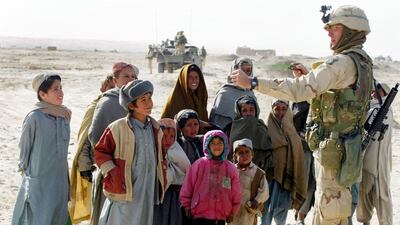
101st Airbornes 1st Sgt. Kerry Black from Westmoreland, Tennessee uses an Afghan child's sling shot on February 6, 2002 as children crowd around him while he patrols on the outskirts of Kandahar, Afghanistan. Getty Images -

Marine Cpl. Jonathan Eckert of Oak Lawn, IL attached to India Battery, 3rd Battalion, 12th Marine Regiment works his improvised explosive device (IED) sniffing dog Bee as they secure a compound during a patrol near Forward Operating Base (FOB) Zeebrugge on October 11, 2010 in Kajaki, Afghanistan. Getty Images -
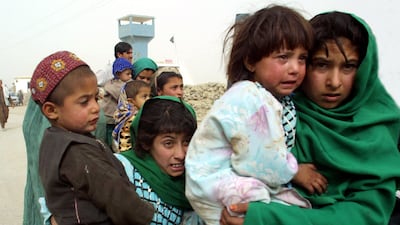
Afghan refugees walk across the border into Pakistan on October 11, 2001 as they leave Afghanistan at the Chaman crossing point on the 4th day of U.S.-led air strikes against the ruling Taliban and terrorist networks in the country. Getty Images -

Anti-Taliban Afghan fighters watch several explosions from U.S. bombings in the Tora Bora mountains in Afghanistan on December 16, 2001. -
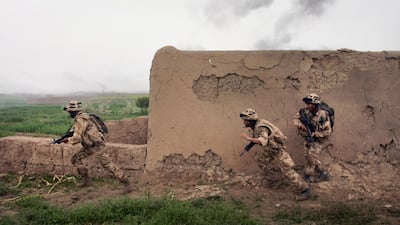
British Marines run under fire from the Taliban during a morning operation on March 18, 2007 near Kajaki in the Afghan province of Helmand. Getty Images -

Afghan Army troops prepare to board a British chinook helicopter from their base at Shorabak on March 12, 2007 in Southern Helmand province, Afghanistan. Getty Images -
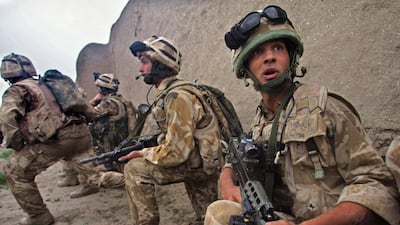
British Marine Joe Harvey from Stafford, England (R), watches as British forces come under fire by Taliban insurgents on March 18, 2007 near Kajaki in the Afghan province of Helmand. Getty Images -

U.S. Army 101st Airborne 3-187 "Bravo" company soliders pass through a corn field while conducting a sensitive site exploitation (SSE) mission July 23, 2002 near the town of Narizah in Southeastern Afghanistan. Getty Images -
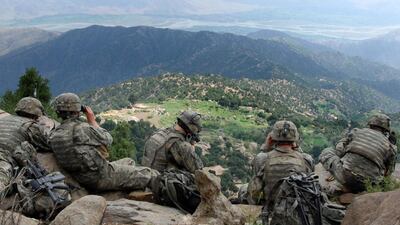
Scouts from 2nd Battalion, 503rd Infantry Regiment (Airborne), pull overwatch during Operation Destined Strike while 2nd Platoon, Able Company searches a village below the Chowkay Valley in Kunar Province, Afghanistan on August 22, 2006. US Army


In the Middle East, however, the image of an America in retreat will be more than a mere memory.
Analysts say the withdrawal has strengthened regimes hostile to Washington in Iran and Syria, along with groups like Lebanon’s Hezbollah, Iraq's Iran-backed militias and the Iranian-backed Houthi rebels in Yemen.
Moreover, they say, a Taliban-ruled Afghanistan could again become a sanctuary for militant groups like Al Qaeda and ISIS where they can train, recruit and plan major attacks in the Middle East and beyond.
“The Taliban takeover is a shot in the arm for political Islamists like the Muslim Brotherhood and extremists like Al Qaeda and ISIS. It provides motivation and inspiration,” said Fawaz Gerges, professor of international relations at the London School of Economics.
"The lesson for militant Islamists is crystal clear: If you persevere, if you sacrifice, if you shed blood, you will prevail, God willing. Islamists [extremists] feel the Taliban triumph can be imitated and reproduced elsewhere.”
What lies ahead for the region, however, may not be as grim as some predict, given how close to the US some countries in the region have become.

Still, there are undoubtedly legitimate reasons for concern, says Michael Hanna, director of the US programme at the International Crisis Group.
“It’s not a good moment for the United States and there is no getting around that,” he said. “The swiftness of the fall of Afghanistan in Taliban hands and the way the Americans pulled out is a black eye. But it’s not going to be irreparable.”
Mr Hanna, an Egyptian-American and an expert on the Middle East, believes America’s failure in Afghanistan will be used for propaganda purposes by enemies of the US in the region. But the effect of that, he explained, would be relatively short-term.
“The US will still be a partner and a major security player in the region. Its alliances are stable although the search is already ongoing for new partners like Russia, France and China,” he said.
Still, the fallout from Afghanistan may already be giving some regional players reason to be confident, if only rhetorically.
“By their own admission, what we are witnessing today in Afghanistan is a complete American defeat, a complete failure,” Hassan Nasrallah, Hezbollah leader and long-time enemy of the US, gloated in a televised address last week. "Those who bet on the US should draw lessons from the way it dealt with its allies in Afghanistan."
-
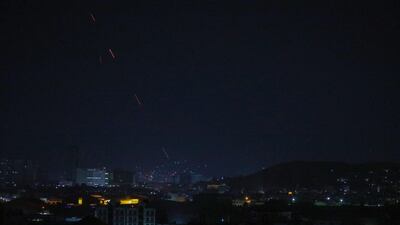
Celebratory gunfire light up part of the night sky after the last US aircraft took off from the airport in Kabul early on August 31, 2021. AFP -
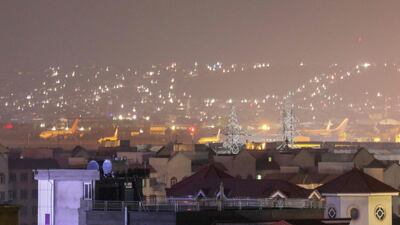
Planes are seen on the tarmac at the airport in Kabul late on August 30, 2021, hours ahead of a US deadline to complete its frenzied withdrawal from Afghanistan. AFP -
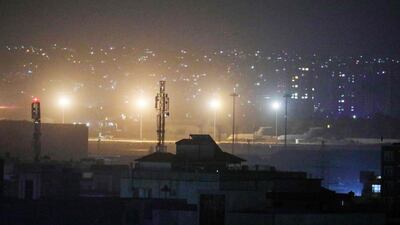
Planes are seen on the tarmac at the airport in Kabul late on August 30, 2021, hours ahead of a US deadline to complete its frenzied withdrawal from Afghanistan. AFP -
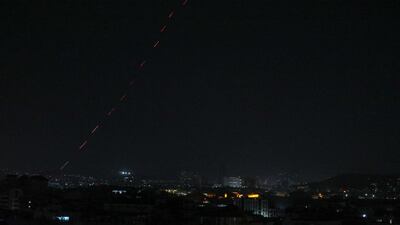
Celebratory gunfire light up part of the night sky after the last US aircraft took off from the airport in Kabul early on August 31, 2021. AFP -
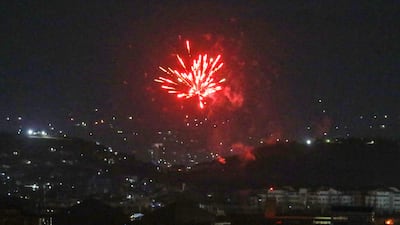
Celebratory gunfire light up part of the night sky after the last US aircraft took off from the airport in Kabul early on August 31, 2021. AFP -
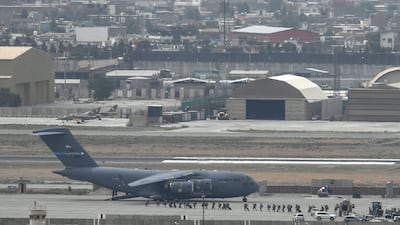
US soldiers arrive board an US Air Force aircraft at the airport in Kabul on August 30, 2021. AFP -
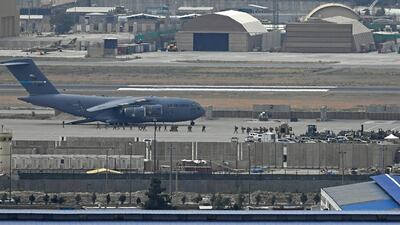
US soldiers arrive to board an US Air Force aircraft at the airport in Kabul on August 30, 2021. AFP -
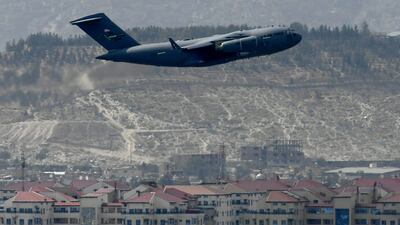
An US Air Force aircraft takes off from the airport in Kabul on August 30, 2021. AFP -

An US Air Force aircraft takes off from the airport in Kabul on August 30, 2021. AFP


In the Gaza Strip, news of the Taliban victory was publicly welcomed by Hamas, the militant group that has ruled that coastal enclave since 2007. Several militant groups fighting the government in Syria also celebrated the Taliban victory in online communications.
In Iraq, where the US continues to maintain a military presence nearly two decades after it invaded the country, the Taliban victory unleashed a debate that raised questions about the nation’s fate after the final withdrawal of US troops planned for the end of this year.
“Afghanistan is the straw that broke the camel's back,” said Hadi Jalo Marie, director of the Political Decision think tank in Baghdad.
“The US withdrawal from Afghanistan after all these years is a sign of its weakness … its ramifications will be felt beyond Afghanistan, mainly in Iraq,” he said.
The absence of America from Iraq, he said, will likely weaken the country’s pro-US camp, while its rivals – mainly Iran – will rush to fill the void. Iraq’s government must move quickly to strengthen ties with other global players like Russia, China and France, he said.
Significantly, US interests in Iraq come under almost daily attacks by Iranian-backed militias, whose political leverage and military machine now pose a potent threat to stability in the war-fatigued nation.
“The Afghanistan scenario can be easily repeated in Iraq,” said Ahmed Khaldoon, a pro-reform activist in Iraq’s protest movement that lists reducing Iranian influence in the country among its top priorities.
Mr Khaldoon fears for Iraq after the planned US pullout.
“We’re afraid that we wake up one day and find ourselves under the banner of [firebrand Shiite cleric and politician] Moqtada Al Sadr or any other militia leader.”

In Jordan, for decades a staunch US ally and the recipient of millions of dollars a year in American aid, analysts sought to play down the significance of the withdrawal from Afghanistan.
“It left a negative image in a tactical sense,” said Hassan Al Momani, professor of international studies at the University of Jordan. “But it was an important strategic decision in the interests of the United States."
The withdrawal, he said, saved US resources “that could be employed somewhere else” and created a security vacuum that could “burden” Iran and China.
Sinan Mahmoud in Baghdad, Khaled Yacoub Oweis in Amman and Elias Sakr in Beirut contributed to this report.

