


Follow the latest updates on Afghanistan here
Iraqis are watching the Taliban’s takeover of Afghanistan with dismay amid concern their country could face a similar fate if the US withdraws its troops this winter.
The group’s lightning sweep into Kabul and the Afghan government’s fall took the world by surprise.
It occurred two weeks before US forces had been due to complete their withdrawal from the country, and some prominent Iraqis say the hasty departure has eroded trust in Washington.
“After all that happened in Afghanistan, anyone among us still considers the US training and consultancy camps [in Iraq] as a gain?” said Izzat Al Shabandar, an Iraqi Shiite politician.
“Of course, some will say the situation in Iraq is different [from the one in Afghanistan], but we see that America is America and that its goals are not different.”
In 2003, the US led an international coalition to invade Iraq and topple Saddam Hussein’s regime, claiming it was developing and stockpiling weapons of mass destruction. None were ever found in Iraq and the country was plunged into chaos after the invasion.
After nearly nine years, the US withdrew from Iraq, leaving behind a small number of troops to protect the US Embassy and to train and assist Iraqis.
-
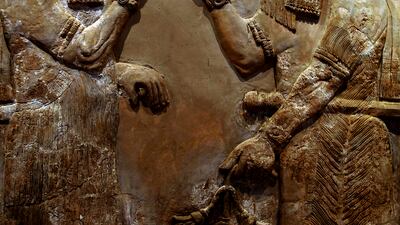
Mesopotamian treasures on display at the Iraqi Museum in Baghdad. The National Museum, known as the Cradle of Civilisation Museum, reopened at the end of February 2009 after its ancient treasures were looted in the aftermath of the US-led invasion in 2003. -
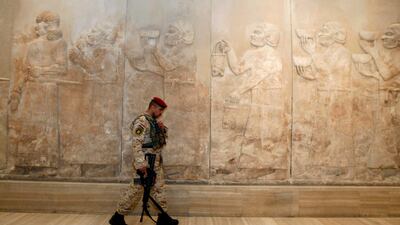
An Iraqi security officer in the Assyrian hall at the Iraqi Museum. The museum, the pride of the nation, reopened in 2009, almost six years after its ancient treasures were looted after the US-led invasion. -
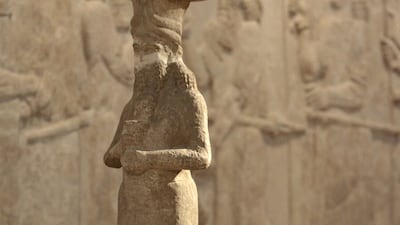
Mesopotamia treasures on display at the opening ceremony of the Iraqi Museum in Baghdad in 2009. -
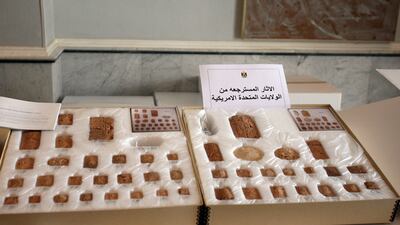
Relics retrieved from the US on display. Theses are some of the 500 archaeological treasures returned to Baghdad by the Iraqi Foreign Ministry from the US, Lebanon, Saudi Arabia and Germany in 2010. -
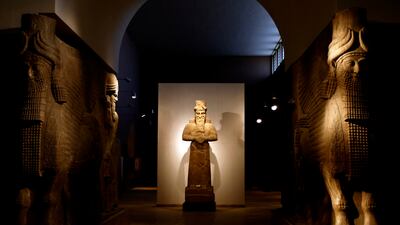
Treasures on show Iraqi Museum in Baghdad after the museum's reopening. -
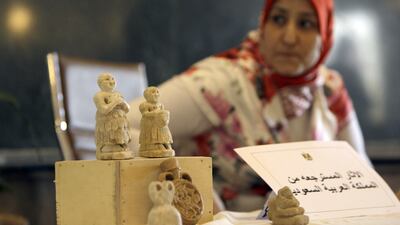
Statuettes returned to Baghdad by the Iraqi Foreign Ministry from the US, Lebanon, Saudi Arabia and Germany. -
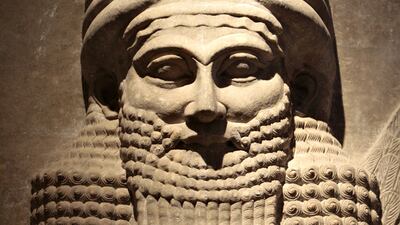
An artefact in the Assyrian hall at the Iraqi Museum in Baghdad.


But in late 2014, combat troops returned to fight ISIS, which then controlled about a third of the country, as the US-trained Iraqi security forces melted away.
Despite the defeat of ISIS by the end of 2017, about 5,000 troops remained, along with others from the international coalition to suppress the terrorist group.
Since then, Iran-linked Shiite politicians and militias have called for US troops to leave.
Tension has risen since Iran’s top military commander, Qassem Suleimani, was assassinated soon after arriving in Baghdad. He was killed in a US drone strike alongside influential Iraqi militia leader Abu Mahdi Al Muhandis near the city’s airport.
Militias have since staged rocket and bomb attacks against American troops, the US embassy and convoys supplying international coalition bases.
Last year, former US President Donald Trump decided to reduce the number of soldiers in Iraq to 2,500. In July, both countries agreed to end the US combat mission in December, shifting the role to an advisory and educational one.
Some have sounded warnings a withdrawal of US troops could lead to the resurgence of ISIS or a scenario akin to the current situation in Afghanistan.
The writer Tariq Jawhar Sarmami, who lives in Erbil, said the developments “must not go unnoticed or to be seen as isolated or small event, especially by the leaders in the Kurdistan region and Iraq generally”.
“So, it is not inconceivable that the United States follow the same approach with Iraq next year,” Mr Sarmami said. “Whenever it finds a suitable alternative it will abandon its partners.”
But Kifah Mahmoud, an independent political researcher, disagreed.
“The situation in Iraq is different,” he said. “Iraq is a strategic project for America that is associated with the New East Project and spreading democracy in the region.”
“I believe that the circumstances that led to 2014’s events do not exist now and Iraqi security forces, Popular Mobilisation Forces [an umbrella group composed largely of Iran-backed Shiite militias], and Kurdish peshmerga are more capable and experienced.”
Washington’s failure to prevent the Taliban’s resurgence has fuelled anti-American conspiracy theories by Iran-backed Shiite militias in Iraq. They have accused the US of orchestrating the rise of ISIS.
“What’s happening in Afghanistan reminds us of what happened here in 2014,” said Adham Al Bahadly, who runs one of the many PMF news platforms on social media.
“But the difference is that our martyrs shed their blood to save Iraq.” He was referring to the PMF, which was established in 2014 to fight ISIS.
“Without that blood we would have seen the same pictures in Iraq.”
Some pro-Shiite militias platforms shared the images of desperate Afghans clinging to a departing US military plane. They sounded a warning to the pro-US camp in Iraq that it faced the same fate.
“Americans evacuated their dogs from Afghanistan but not Afghan contractors and those co-operated with them, [American] agents [in Iraq] take note," one post says.

