


Tunisia on Sunday set another record for vaccinations delivered in a single day, according to the Health Ministry, when 594,141 were given to people under 40 in a second successful mass vaccination drive.
The campaign took place a week after more than 500,000 people over the age of 40 received their first inoculation in a slightly chaotic effort led to success by volunteers.
-
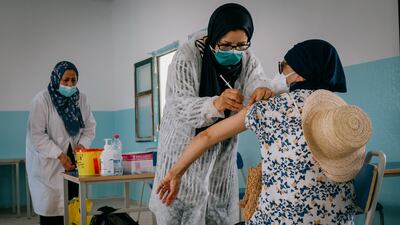
Tunisians over 40 were welcomed at 335 centres around the country for the vaccine. -

The Tunisian Scouts and others volunteered to help the process go smoothly. -
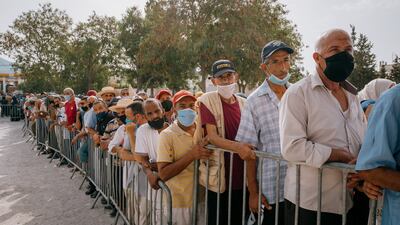
Tunisia suffered a deadly fourth wave of Covid-19 in June and July, prompting many to come for vaccines they' had previously been hesitant about. -
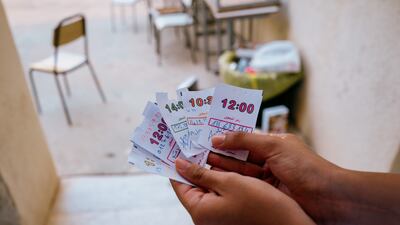
Each patient received a slip with their Evax confirmation number and the brand of vaccine they received, which would later be logged in government systems. -
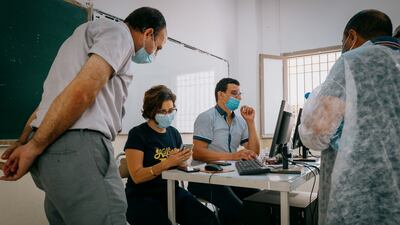
Spotty internet and a sluggish government system threatened to derail the drive, but resourceful volunteers found work arounds. -
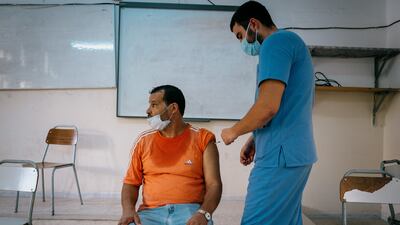
Nursing student Farouk Damak, 20, volunteered to administer jabs for the walk-in drive after spending the spring treating covid patients in hospital. -

People rest in the shade after receiving their first dose of AstraZeneca on Sunday. -
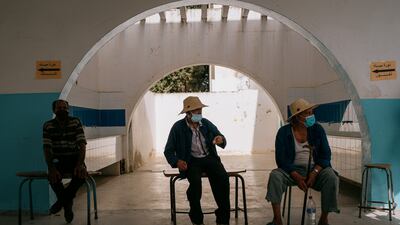
Hundreds of people from remote rural communities made the trek to the more than 300 walk-in vaccine centres across Tunisia. -
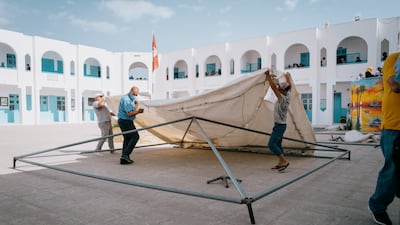
Volunteers from organisations including the Red Crescent and the Tunisian Scouts came together to keep vaccine centres running smoothly. -

Nurses volunteered for the 12-hour shift, which they endured in 36° heat without air conditioning. "We have each other's backs," one of them said. -
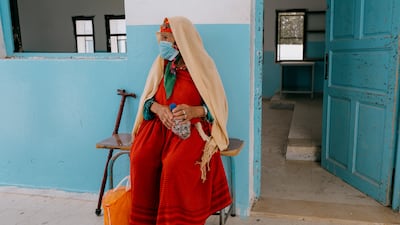
Many of Tunisia's most vulnerable were able to receive their first jab after months of sluggish vaccination campaigns. -
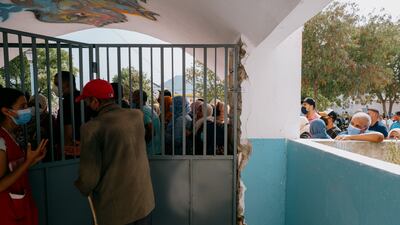
Technical troubles meant hundreds of people waited in the heat to get into the vaccine centre in Mornag. -
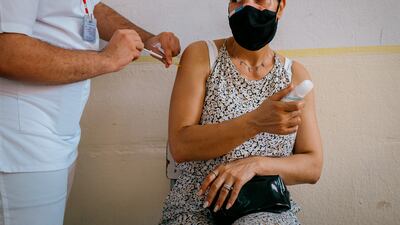
A nursing student administers the coronavirus vaccine at a high school in Sfax, Tunisia, during the country's open vaccine drive. -

Ahmed Nursutlan, 78, said his family persuaded him to overcome his fear of needles to get the vaccine. "It was time," he said. -
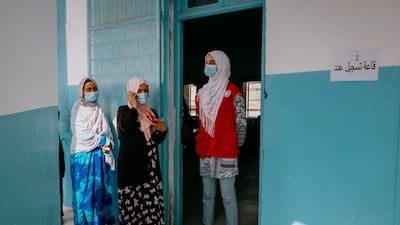
Volunteers from the Red Crescent helped control the crowds. -
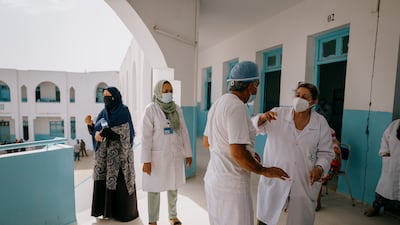
Doctors and nurses discuss another internet outtage as they wait for their patients at the vaccine centre in Mornag.


"It was one of the smoothest government-related campaigns I have ever seen," said Janet Sebri, an arts administrator who was one of nearly a million young people who received an invitation to get their vaccine shot at one of more than 400 centres.
"The nurses and doctors were cheerful, and the volunteers were on their toes, guiding us in and out of the centre," she said, noting that the volunteers had learnt from the week before.
The orderly queues and quick processing on Sunday were in contrast with events last month, when Tunisia attempted an open vaccination drive during the Eid Al Adha holiday.
Thousands of people, particularly those under 50 who had not previously been eligible, stood in kilometre-long queues in the scorching heat and crammed into vaccine centres for what turned out to be only a few hundred doses.
Fistfights broke out and medical staff were injured.
The outcry that followed spurred many young people to take to the streets on July 25.
Their protests fuelled President Kais Saied's decision to take emergency measures, sack the government and suspend parliament.
"We feel a huge difference compared to how the [prime minister Hichem] Mechichi government handled the vaccine campaign," said Henda Fella, who described the process on Sunday as orderly and quick.
Many view the latest vaccine drives as an encouraging sign of how Mr Saied will move the country forward.
"I think it's good he's doing work that the government before couldn't and wouldn't do," said Ashref Zeed, a wedding planner in Tunis who had his first vaccine on Sunday.
Mr Zeed was one of many who overcame hesitancy about the vaccine.
Initially he was sceptical about the inequities between the global north and global south in vaccination and the privileges it afforded.
"I thought, why is being vaccinated a political requirement to be able to have access to some privileges like getting into some of the countries in the EU?" he said.
But, in the end, he said he felt "pushed to do it" and that the mass vaccination campaign would help his business in the long run.
Weddings have often been hotspots for virus transmission, and people have been planning smaller parties as a precaution.
For Ms Sebri, vaccination was a moment of great relief.
"I definitely feel safer and closer to where the rest of the vaccinated world is," she said.
"There came a time this summer when I felt like there was no way I would be getting the vaccine this year and I will just have to live dodging bullets until they reached my age category.
"Now that my family is fully vaccinated, I feel more reassured and less anxious."
Most of Sunday's patients received a first doses of the Moderna vaccine, but thousands of students beginning their studies abroad were given the one-shot Janssen vaccine.
The Ministry of Health is to continue mass vaccination in the weeks ahead.

