


A legal battle lasting more than a decade over Palestinian homes in occupied East Jerusalem reaches Israel’s Supreme Court on Monday, when a ruling may be issued that will have a lasting impact far beyond the city’s Sheikh Jarrah neighbourhood.
The Sheikh Jarrah case has captured global attention in recent months due to a campaign launched by the Palestinian residents, who risk being evicted and having their homes handed to Israeli settlers.
Protests ahead of the Supreme Court hearing initially scheduled for May were met with an intense response by Israeli police, whose forces used mounted officers, rubber bullets, tear gas and foul-smelling “skunk” liquid against demonstrators.
Some protesters threw stones at police officers during the rallies in April and May, a period in which hundreds of Palestinians and dozens of Israeli police officers were hurt in clashes around East Jerusalem.
-
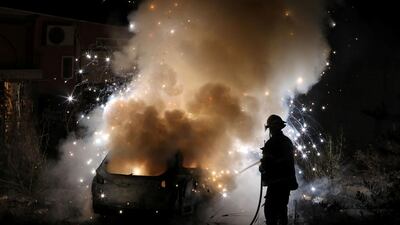
A firefighter tackles a burning car belonging to Jewish settlers in Sheikh Jarrah, East Jerusalem, on May 6, 2021. Tension is rising over a bid to evict Palestinian families from homes on land claimed by the settlers. Reuters -
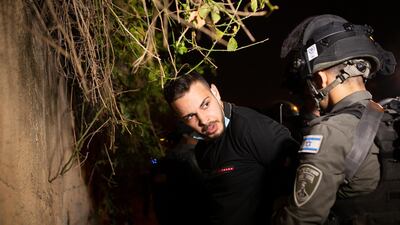
A Palestinian man is detained by Israeli police at a protest against the eviction of families from their homes in Sheikh Jarrah, East Jerusalem. Protesters and Jewish settlers hurled rocks and chairs at one another. AP -
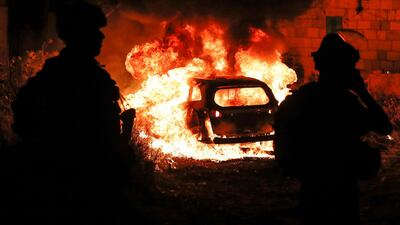
Israeli security forces stand near the burning car of an Israeli settler in the Sheikh Jarrah district of East Jerusalem. AFP -

Palestinian protesters chant slogans before Israeli border guards on May 6, 2021. They were demonstrating in solidarity with local residents of the Sheikh Jarrah district of Israeli-annexed East Jerusalem who face eviction. AFP -

Israeli Knesset member Itamar Ben-Gvir, left, head of the Otzma Yehudit (Jewish Power) party, arrives in Sheikh Jarrah, East Jerusalem on May 6, 2021. AFP -
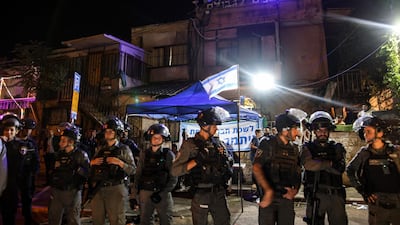
Israeli border guards stand in front of a house in the Sheikh Jarrah neighbourhood of East Jerusalem after Knesset member Itamar Ben-Gvir of the Jewish Power party has set up a make-shift office there on May 6, 2021. AFP -
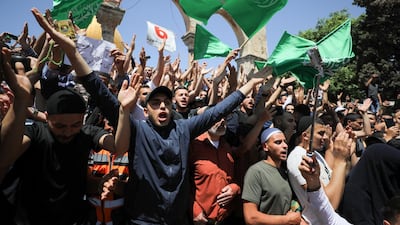
People hold Hamas flags as Palestinians gather after the last Friday prayers of Ramadan to protest over the possible eviction of several Palestinian families from homes on land claimed by Jewish settlers in the Sheikh Jarrah neighbourhood, in Jerusalem's Old City. Reuters -
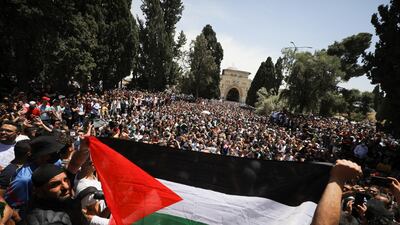
Palestinians gather after performing the last Friday prayers of Ramadan to protest over the possible eviction of several Palestinian families from homes on land claimed by Jewish settlers in the Sheikh Jarrah neighbourhood, in Jerusalem's Old City. Reuters -

Protesters wave Hamas flags outside Dome of the Rock in east Jerusalem to protest against the planned eviction of Plestinian families in the Sheikh Jarrah neighbourhood of the Old City. Reuters -
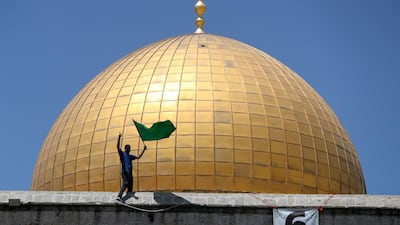
A man holds a Hamas flag while standing on the Dome of the Rock in Jerusalem. Reuters -

A Palestinian Hamas militant takes part in a protest in the northern Gaza Strip over the possible eviction of several Palestinian families from homes in the Jerusalem's Sheikh Jarrah neighbourhood. Reuters


The violence was followed by the 11-day Israel-Gaza war, the worst fighting between Israel and Palestinian militants since 2014.
While the rallies have since subsided, there have been renewed protests in the run-up to the hearing which was rescheduled to August 2.
Police officers have, meanwhile, kept up their presence in the neighbourhood, setting up checkpoints at the entrances to the street where residents are under eviction orders.
resident
“My son, 11 years old, when he wants to go to school or come back, they want to check him,” said Saleh Diab, whose family is facing an eviction order in a separate case.
The 51-year-old, who was born in Sheikh Jarrah, described the past three months as “a very difficult life” in the neighbourhood.
Living along the street, Mayar Mazen recounted her brother’s encounters at a checkpoint.
“Now when he’s coming to open the door, from here, they’re saying: ‘no, no, you don’t live here, give me your ID',” the 31-year-old said on Saturday, while police officers checked the IDs of boys entering the street.
Close to Jerusalem’s Old City, the area now dotted with consulates and hotels had swathes of open land in the 1950s when the residents’ descendants arrived in Sheikh Jarrah.
East Jerusalem was then under the control of the Jordanian authorities, who built properties for Palestinians who had fled their homes following the establishment of Israel in 1948.
The families’ future was upended by the 1967 Arab-Israeli War, which saw the Jordanians routed from East Jerusalem by the Israeli military.
Israeli law grants those who owned land in East Jerusalem before 1948 the right to reclaim it, while Palestinians are banned from recovering their properties in what became Israel.
Israeli courts have repeatedly ruled in favour of settler organisations that have obtained property deeds, though the high-profile Sheikh Jarrah case has drawn attention to such proceedings.
“Everything is possible in the case of Sheikh Jarrah,” said lawyer Sami Irsheid. He is representing the four families whose case will be heard on Monday.
Israel’s highest court must decide whether to hear the families’ appeal against the eviction orders.
“The court has three options. The first is to reject the application to appeal,” said Mr Irsheid, upholding the lower court’s ruling and paving the way for the families’ eviction.
It could alternatively accept the Palestinians’ case and begin hearing their appeal, or delay such procedures to a later date.
Just days ahead of the hearing, Mr Irsheid and Husni Abu Hussein, another lawyer representing the families, submitted a new legal opinion which they hope will influence the outcome.
It argues that Israeli law does not supersede Jordanian legislation, under which the homes were built and given to the Palestinian residents.
Even if the Supreme Court rules against the Palestinians and gives them a deadline to leave their homes, the Cabinet could delay the police in enforcing the evictions.
“The government can say, ‘right now we cannot send the forces because it’s too delicate’. So they can buy more time, even after a ruling,” said Hagit Ofran, the settlements expert at Israeli NGO Peace Now, at Friday’s protest in the neighbourhood.
Israel’s new government came into office in June and will be wary of a repeat of the violence and unrest seen in Sheikh Jarrah earlier this year.
Opposite a house strewn with Israeli flags, where settlers now live, Mr Diab sat in his home and considered the upcoming hearing.
“All the world is speaking about Sheikh Jarrah,” he said.
“Maybe, they want to give you [a delay of] another six months, to be quiet, and for everyone to forget what happened in Sheikh Jarrah.”

