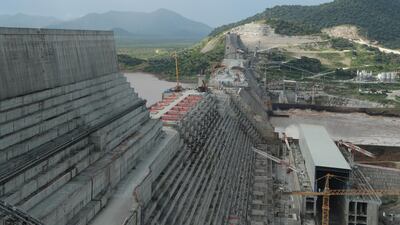
Ethiopia's Grand Renaissance Dam undergoes construction work in Guba Woreda, Benishangul Gumuz Region on September 26, 2019. Reuters

Egypt's El Sisi sets out red line over Ethiopia's Nile dam


Hamza Hendawi
  • English
  • Arabic

Egypt's President Abdel Fattah El Sisi called again on Ethiopia to enter an agreement on the operation of its dam on the Nile while assuring Egyptians that he would not allow their country's share of the river's water to be affected.

"Harming Egypt's national security is a red line that cannot be crossed regardless of what anyone thinks," Mr El Sisi told a crowd of about 50,000 flag-waving supporters in Cairo late on Thursday.

"Embracing wisdom and preferring peace does not in any way mean allowing harm to come to this nation's interests."

Egyptian president Abdel Fattah El Sisi. Reuters

The president's latest remarks on the contentious Grand Ethiopian Renaissance Dam come less than two weeks after the UN Security Council met to discuss the issue at the request of Egypt and fellow downstream nation Sudan. No decision has been made by the council, but consultations behind closed doors have continued since the July 8 meeting.

Egypt is alarmed that the dam will significantly reduce its share of the Nile waters on which it depends for nearly all its fresh water needs. Such a reduction, it argues, would wipe out hundreds of thousands of jobs and upend its food security.

Mr El Sisi assured the crowd at the Cairo International Stadium that he would not allow this to happen.

“Your concern is legitimate, but things will be fine and our plans are going great. Don’t worry about a thing. Please, live your lives. It is unbecoming for us to worry so much,” he said.

“I and the army will have to perish first before any harm comes to Egypt.”

Sudan is also worried about its water share and says it needs Addis Ababa to fully co-ordinate with it on the operation and filling of the dam to guard against flooding and ensure that its own power-generating dams on the Nile operate smoothly.

  • Ethiopia's Grand Renaissance Dam under construction on September 26, 2019. Reuters
    Ethiopia's Grand Renaissance Dam under construction on September 26, 2019. Reuters
  • Ethiopia's Grand Renaissance Dam under construction on September 26, 2019. Reuters
    Ethiopia's Grand Renaissance Dam under construction on September 26, 2019. Reuters
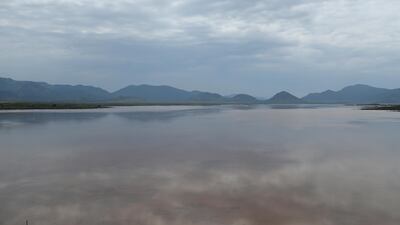
  • A water basin near Ethiopia's Grand Renaissance Dam. Reuters
    A water basin near Ethiopia's Grand Renaissance Dam. Reuters
  • Turbine housings at Ethiopia's Grand Renaissance Dam powerhouse. Reuters
    Turbine housings at Ethiopia's Grand Renaissance Dam powerhouse. Reuters

Ethiopia, for its part, has repeatedly assured Cairo and Khartoum that no harm would come to them from the dam, but it refuses to enter a legally-binding agreement on the filling of the dam and has rejected proposals for the United States, UN and the EU to join negotiations over its $5 billion hydroelectric project.

“We in Egypt have expertise that is available not only for Sudan and Ethiopia but to the whole of Africa on condition that no one comes near Egypt’s water,” Mr El Sisi said.


“Let us reach a legally binding agreement that will bring us goodness, so that we all live in peace and security, shielded from all kinds of threats. I am saying this to all those interested in peace and security,” he said.

Mr El Sisi, an army general elected president seven years ago, has hinted previously that Egypt could resort to military action to resolve the decade-old dispute with Ethiopia. He said Egypt preferred a diplomatic solution to the dispute but was not prepared to indefinitely negotiate over the dam. No one should assume to be beyond the reach of his military, he said in late March.

His comments on Thursday night were made at a ceremony to mark the launch of an ambitious, three-year programme to improve services and facilities available to 58 million Egyptians – more than half the population – in rural areas at the cost of 700 billion Egyptian pounds ($44.6 billion).


TEACHERS' PAY - WHAT YOU NEED TO KNOW

Pay varies significantly depending on the school, its rating and the curriculum. Here's a rough guide as of January 2021:

- top end schools tend to pay Dh16,000-17,000 a month - plus a monthly housing allowance of up to Dh6,000. These tend to be British curriculum schools rated 'outstanding' or 'very good', followed by American schools

- average salary across curriculums and skill levels is about Dh10,000, recruiters say

- it is becoming more common for schools to provide accommodation, sometimes in an apartment block with other teachers, rather than hand teachers a cash housing allowance

- some strong performing schools have cut back on salaries since the pandemic began, sometimes offering Dh16,000 including the housing allowance, which reflects the slump in rental costs, and sheer demand for jobs

- maths and science teachers are most in demand and some schools will pay up to Dh3,000 more than other teachers in recognition of their technical skills

- at the other end of the market, teachers in some Indian schools, where fees are lower and competition among applicants is intense, can be paid as low as Dh3,000 per month

- in Indian schools, it has also become common for teachers to share residential accommodation, living in a block with colleagues

Winners

Best Men's Player of the Year: Kylian Mbappe (PSG)

Maradona Award for Best Goal Scorer of the Year: Robert Lewandowski (Bayern Munich)

TikTok Fans’ Player of the Year: Robert Lewandowski

Top Goal Scorer of All Time: Cristiano Ronaldo (Manchester United)

Best Women's Player of the Year: Alexia Putellas (Barcelona)

Best Men's Club of the Year: Chelsea

Best Women's Club of the Year: Barcelona

Best Defender of the Year: Leonardo Bonucci (Juventus/Italy)

Best Goalkeeper of the Year: Gianluigi Donnarumma (PSG/Italy)

Best Coach of the Year: Roberto Mancini (Italy)

Best National Team of the Year: Italy 

Best Agent of the Year: Federico Pastorello

Best Sporting Director of the Year: Txiki Begiristain (Manchester City)

Player Career Award: Ronaldinho

Disposing of non-recycleable masks
    Use your ‘black bag’ bin at home Do not put them in a recycling bin Take them home with you if there is no litter bin
  • No need to bag the mask
Ten tax points to be aware of in 2026

1. Domestic VAT refund amendments: request your refund within five years

If a business does not apply for the refund on time, they lose their credit.

2. E-invoicing in the UAE

Businesses should continue preparing for the implementation of e-invoicing in the UAE, with 2026 a preparation and transition period ahead of phased mandatory adoption. 

3. More tax audits

Tax authorities are increasingly using data already available across multiple filings to identify audit risks. 

4. More beneficial VAT and excise tax penalty regime

Tax disputes are expected to become more frequent and more structured, with clearer administrative objection and appeal processes. The UAE has adopted a new penalty regime for VAT and excise disputes, which now mirrors the penalty regime for corporate tax.

5. Greater emphasis on statutory audit

There is a greater need for the accuracy of financial statements. The International Financial Reporting Standards standards need to be strictly adhered to and, as a result, the quality of the audits will need to increase.

6. Further transfer pricing enforcement

Transfer pricing enforcement, which refers to the practice of establishing prices for internal transactions between related entities, is expected to broaden in scope. The UAE will shortly open the possibility to negotiate advance pricing agreements, or essentially rulings for transfer pricing purposes. 

7. Limited time periods for audits

Recent amendments also introduce a default five-year limitation period for tax audits and assessments, subject to specific statutory exceptions. While the standard audit and assessment period is five years, this may be extended to up to 15 years in cases involving fraud or tax evasion. 

8. Pillar 2 implementation 

Many multinational groups will begin to feel the practical effect of the Domestic Minimum Top-Up Tax (DMTT), the UAE's implementation of the OECD’s global minimum tax under Pillar 2. While the rules apply for financial years starting on or after January 1, 2025, it is 2026 that marks the transition to an operational phase.

9. Reduced compliance obligations for imported goods and services

Businesses that apply the reverse-charge mechanism for VAT purposes in the UAE may benefit from reduced compliance obligations. 

10. Substance and CbC reporting focus

Tax authorities are expected to continue strengthening the enforcement of economic substance and Country-by-Country (CbC) reporting frameworks. In the UAE, these regimes are increasingly being used as risk-assessment tools, providing tax authorities with a comprehensive view of multinational groups’ global footprints and enabling them to assess whether profits are aligned with real economic activity. 

Contributed by Thomas Vanhee and Hend Rashwan, Aurifer

INFO

What: DP World Tour Championship
When: November 21-24
Where: Jumeirah Golf Estates, Dubai
Tickets: www.ticketmaster.ae.

Mercer, the investment consulting arm of US services company Marsh & McLennan, expects its wealth division to at least double its assets under management (AUM) in the Middle East as wealth in the region continues to grow despite economic headwinds, a company official said.

Mercer Wealth, which globally has $160 billion in AUM, plans to boost its AUM in the region to $2-$3bn in the next 2-3 years from the present $1bn, said Yasir AbuShaban, a Dubai-based principal with Mercer Wealth.

Within the next two to three years, we are looking at reaching $2 to $3 billion as a conservative estimate and we do see an opportunity to do so,” said Mr AbuShaban.

Mercer does not directly make investments, but allocates clients’ money they have discretion to, to professional asset managers. They also provide advice to clients.

“We have buying power. We can negotiate on their (client’s) behalf with asset managers to provide them lower fees than they otherwise would have to get on their own,” he added.

Mercer Wealth’s clients include sovereign wealth funds, family offices, and insurance companies among others.

From its office in Dubai, Mercer also looks after Africa, India and Turkey, where they also see opportunity for growth.

Wealth creation in Middle East and Africa (MEA) grew 8.5 per cent to $8.1 trillion last year from $7.5tn in 2015, higher than last year’s global average of 6 per cent and the second-highest growth in a region after Asia-Pacific which grew 9.9 per cent, according to consultancy Boston Consulting Group (BCG). In the region, where wealth grew just 1.9 per cent in 2015 compared with 2014, a pickup in oil prices has helped in wealth generation.

BCG is forecasting MEA wealth will rise to $12tn by 2021, growing at an annual average of 8 per cent.

Drivers of wealth generation in the region will be split evenly between new wealth creation and growth of performance of existing assets, according to BCG.

Another general trend in the region is clients’ looking for a comprehensive approach to investing, according to Mr AbuShaban.

“Institutional investors or some of the families are seeing a slowdown in the available capital they have to invest and in that sense they are looking at optimizing the way they manage their portfolios and making sure they are not investing haphazardly and different parts of their investment are working together,” said Mr AbuShaban.

Some clients also have a higher appetite for risk, given the low interest-rate environment that does not provide enough yield for some institutional investors. These clients are keen to invest in illiquid assets, such as private equity and infrastructure.

“What we have seen is a desire for higher returns in what has been a low-return environment specifically in various fixed income or bonds,” he said.

“In this environment, we have seen a de facto increase in the risk that clients are taking in things like illiquid investments, private equity investments, infrastructure and private debt, those kind of investments were higher illiquidity results in incrementally higher returns.”

The Abu Dhabi Investment Authority, one of the largest sovereign wealth funds, said in its 2016 report that has gradually increased its exposure in direct private equity and private credit transactions, mainly in Asian markets and especially in China and India. The authority’s private equity department focused on structured equities owing to “their defensive characteristics.”


Updated: July 16, 2021, 7:13 AM