

Algeria's new prime minister, Aymen Benabderrahmane, faces an uphill struggle against economic uncertainty, social unrest, and questions over the legitimacy of his government and the position of his ally, President Abdelmadjid Tebboune.
Mr Benabderrahmane’s first task after taking office on June 30 is deciding whether to form a political or technocratic government, with his choice of candidates including members of parliament elected in a vote where boycotts and protests led to only slightly more than a quarter of the electorate taking part.
The turnout for June's legislative poll maintained the declining trend of electoral participation.
Mr Tebboune was elected in December 2019 on the back of less than 60 per cent turnout. Shortly thereafter, one of the main planks of his managed reform programme, a constitutional referendum, drew less than a quarter of the electorate to the polls.
Irrespective of concerns over his government's legitimacy, Mr Benabderrahmane, who was born in Algiers, must deal with looming economic collapse, continued social unrest and the ongoing coronavirus pandemic, which continues to spread through the country.
Mr Benabderrahmane's route to power has been largely unremarkable. After rising to governor of the National Bank, he was appointed finance minister in the cabinet of his predecessor, Abdelaziz Djerad, in June 2020. That economic background might come to be as much of a curse as a blessing. While his past positions give him the experience to manage the challenges ahead, voters are unlikely to forget his role in shaping and maintaining a system that is almost entirely reliant on oil and gas exports to support one of the most generous subsidy systems among Opec countries. Despite rallying in recent months, hydrocarbon prices remain far short of the approximately $135 per barrel threshold that most analysts agree Algeria needs to break even.
With decades of official resistance to the development of a private sector free from government control, Mr Benabderrahmane, 54, must now navigate a course between cutting state subsidies that many Algerians view as a given and maintaining the social stability that governments since the civil war of the 1990s have valued.
How that might be achieved is open to question. Algeria's foreign reserves are reaching critical levels. In 2014, with oil and gas at a high, reserves stood at $200 billion; last year, they had fallen to just $47bn. Analysts generally agree that they have only a year – two at the most – before they run dry and the economy hits the wall.
Irrespective of how Mr Benabderrahmane addresses the country's financial difficulties, he must do so in the face of the continued opposition, both from the street and Islamist factions seeking to take advantage of whatever difficulties his government finds itself in.
Already, the financial impact of coronavirus lockdowns and dwindling reserves are being felt on the street.
“I have a family of seven to support, but the construction company for which I worked has shut down,” Samir Yefsa, an unemployed 50-year-old, told the Financial Times. “The state was our only client, but the government now has no construction programme. I don’t know what to do. I have problems feeding my family. I can only borrow from family and friends who are retired and live on pensions, because others who are younger are in a situation similar to mine.”
The demographic factor is significant. Almost one third of Algeria's population of about 43 million are thought to be under 30 years old, according to Worldometer. Politically restless, frustrated by the status quo and too young to fully recall the horrors of the country's brutal decade of civil war, it was this generation that provided the initial spark for the mass protest movement, or Hirak, that have roiled the country to varying degrees since February 2019.
-
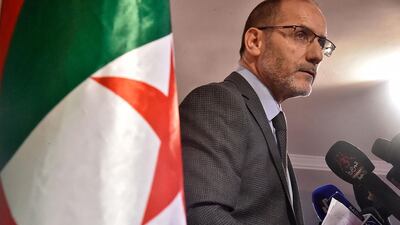
Leader of Algeria's Islamist party, the Movement of Society for Peace (MSP), Abderrezak Mokri holds a press conference at the party's headquarters in the capital Algiers. AFP -
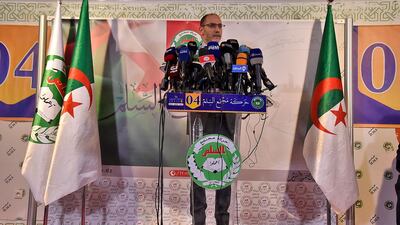
Leader of Algeria's Islamist party, the Movement of Society for Peace (MSP), Abderrezak Mokri holds a press conference at the party's headquarters in the capital Algiers. AFP -
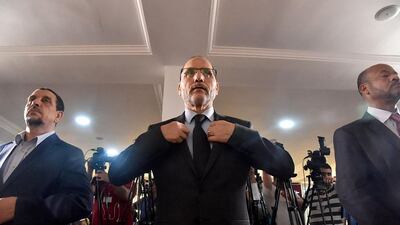
Leader of Algeria's Islamist party, the Movement of Society for Peace (MSP), Abderrezak Mokri holds a press conference at the party's headquarters in the capital Algiers. AFP -
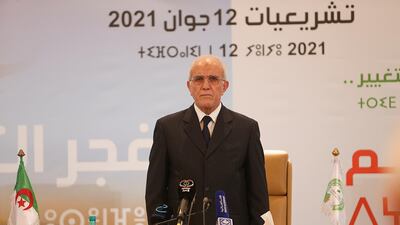
Algeria's election authority head Mohamed Chorfi stands before the announcement of the results for the country's legislative elections in Algiers. Reuters -
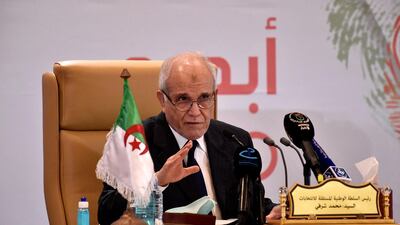
President of Algeria's National Independent Elections Authority Mohamed Chorfi holds a press conference to announce the results of parliamentary elections, in the capital Algiers. AFP


Overseeing all this is a president who looks increasingly isolated from his own electorate and from the opaque cabal of military officers, trade union officials and businessmen, known collectively as the Pouvoir, or power, who surround him.
“I don't think he was ever supposed to serve a full term,” Zine Labidine Ghebouli, a political analyst specialising in Algeria, told The National. “He was a temporary fix, after [former President Abdelaziz] Bouteflika went.”
Moreover, the president's lukewarm programme of reform has done little to please anyone while alienating all. “Tebboune has failed to create any kind of consensus at any level,” Mr Ghebouli said. “The legislative elections have only highlighted that,” he said, pointing to the low turnout and the president's ill-judged overtures to the country's moderate Islamists in the run to the vote.
“People don't have money. Political issues are becoming socio-economic issues and, with the Hirak having mostly become irrelevant, it's unclear what might happen next. We don't have the money to buy the kind of peace we did in the past and, without that, violence remains a possibility.”

