As someone who has always felt younger than my age, and enjoyed a life focused on career, travelling, friends and family, having children was never at the top of my to-do list.
However, as my 37th birthday approached, it suddenly dawned on me that my biological clock was ticking.
So, I decided to explore the possibility of freezing my eggs, or oocyte cryopreservation as it’s known in the medical world.

Legalised for unmarried women in the UAE since 2021, the procedure involves undergoing various blood tests and ultrasounds, eight to 12 days of hormone injections and, at the end, surgical egg retrieval.
I completed the above a month ago at Art Fertility Clinics Abu Dhabi under the care of Dr Laura Melado.
Despite having read up on egg freezing beforehand, I found every day was a learning experience. In some ways it was easier than I expected, but in other ways it was one of the hardest things I've done.
Here are some things I wish I had known before I began.
1. Prices vary and some clinics offer seasonal deals
The price of egg freezing in the UAE differs from clinic to clinic.
The package I completed at Art Fertility Clinics (also available at its branches in Dubai and Al Ain) cost Dh15,500 ($4,220), including all medication, laboratory fees, counselling, freezing and one year of storage. A similar package at First IVF Fertility Centre Abu Dhabi is listed at Dh25,500 (although it was offering a discounted price during the month I inquired), while Bourn Hall Fertility Clinic offers packages ranging from Dh15,000 to Dh20,000 or more, depending on individual medication requirements.

Of course, the eventual price can be double or even triple this if you decide to complete the cycle a second or third time.
Plus, to extend the storage of your eggs (they can be frozen for up to five years in the UAE and for up to 10 years with further approval), you will need to pay an additional Dh1,500 to Dh2,625 per year.
I recommend visiting a few doctors before deciding which clinic to go with. Many offer free consultations, while others charge about Dh500. Dr Melado was the second doctor I saw for a consultation, and I immediately liked her manner and energy.
2. Injecting yourself is not as scary as you might think
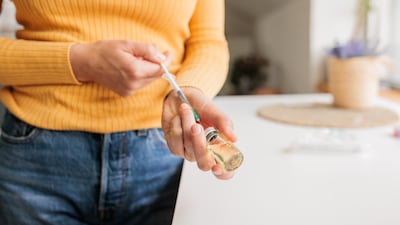
One of my biggest worries was how I was going to manage to inject myself every day.
Fortunately, it was far easier than I expected.
The clinic provided me with a detailed pamphlet and video tutorial, and although it took me a few minutes to gather up the courage to do it the first time, I soon realised that it was painless.
Once you have done one injection (I was told to pick a time between 6pm and 8pm), you must do the others at the same time each day, regardless of where you are or what you are doing. This meant I ended up doing some of mine in gym changing rooms and mall bathrooms, but it was so straightforward that I never had any issues.
3. There will probably be side effects
Dr Melado warned that abdominal bloating, discomfort, headaches and mood changes are all possible symptoms of the ovarian stimulation stage.
Sure enough, after about a week of injections, my stomach had blown up like a balloon, and I was feeling a roller coaster of emotions.
However, these disappeared a few days after the retrieval, and the clinic arranged for me to take part in a private counselling session that covered all the physical and emotional elements of the process.
4. It dominates your life for a month
Egg freezing must start on the second day of your menstrual cycle, meaning you only have one opportunity per month to do it. So, if you are travelling, have a lot of events planned or a busy schedule in general, it can be harder to fit in.
In addition, you need to be prepared to attend numerous in-person appointments, before you begin the cycle, during the stimulation period and for the retrieval itself. Follow-ups might also be necessary.
It's therefore best to choose a clinic that's close to your home or work and, depending on your work schedule, you may need to inform your employer that you will need to be out of the office more than usual.
5. Retrieval is painless and recovery is fast

Having never undergone surgery before, I was very anxious before going in for the egg retrieval.
As instructed, I arrived at the clinic an hour before my surgery was due to take place. As I had only a few eggs that were big enough to harvest, I was told that it would be a quick procedure and that it could be done under conscious sedation rather than a light general anaesthetic.
The nurses and doctors were incredibly kind and they helped me relax and stay calm before I went in.
The procedure took 10 minutes, and I had two people at my side talking me through what was happening and checking I was all right throughout. Except for a kind of pulling and scratching sensation, I couldn’t feel anything at all. It wasn’t painful and I experienced no bleeding, I just felt tired.
6. You need to limit exercise for a week afterwards
Throughout the cycle, you should not smoke or drink alcohol. A healthy diet is also advised, and I was encouraged to continue exercising.
After the retrieval procedure, you cannot drive for 24 hours and you must take the rest of the day off work (the clinic will provide a sick note if necessary).
After that, your life can broadly resume as normal; however, excessive exercise, heavy lifting, swimming and the sauna should be avoided for at least a week. As a keen runner, I found this part the most difficult.
7. You may not end up with as many viable eggs as you hoped

To have a reasonable chance of having a live birth in the future, the goal for someone of my age is to freeze between 10 and 15 eggs.
Based on the results of my initial ultrasound, I was also told that retrieving seven or more eggs from my first cycle was a realistic goal.
Unfortunately, my end result was much lower than expected. Only a couple of eggs grew to the required size, and were successfully retrieved and stored.
8. You might need to do more than one cycle
It is unclear why only a couple of my follicles responded to the medication. Dr Melado explained that by modifying the stimulation protocol and medication dosage, it might be possible to get more if we did it a second time. She also said that it wasn't uncommon for women to do two or more rounds.
“Each mature oocyte represents a potential opportunity for a future pregnancy. However, not every frozen egg will survive warming, fertilise, develop into a viable embryo and ultimately result in a live birth. For this reason, when only a small number of mature oocytes has been obtained, some women choose to undergo more than one stimulation cycle,” she says.
“Ovarian stimulation does not appear to accelerate depletion of the ovarian reserve and there is also no clear evidence that undergoing several appropriately supervised stimulation cycles causes long-term harm to the ovaries.”
9. Egg freezing is only the first stage of future IVF

Frozen eggs cannot be used for natural conception, only for IVF. Another expensive process costing between Dh17,000 and Dh35,000 in the UAE, it involves thawing the eggs, fertilising them and transferring them back into the womb.
If you want your embryos to be genetically tested, it will cost another Dh4,000 to Dh6,000 per embryo.
10. Verify whether egg freezing is appropriate for you
Although I was encouraged to go ahead with egg freezing, the procedure is not recommended for everyone.
“I have worked with Art Fertility Clinics since 2016 and in recent years, I have certainly seen more women inquiring about egg freezing,” says Dr Melado.
“Age is actually one of the most important factors when counselling women about egg freezing because it is strongly associated with oocyte quality and the probability that a frozen egg will ultimately result in a healthy baby. Therefore, the discussion is not simply about whether egg freezing is technically possible, but whether it offers a realistic potential benefit for that particular woman.
“We assess each patient individually, taking into account her age, anti-mullerian hormone, antral follicle count, medical history and reproductive plans before advising whether egg freezing is appropriate.”

