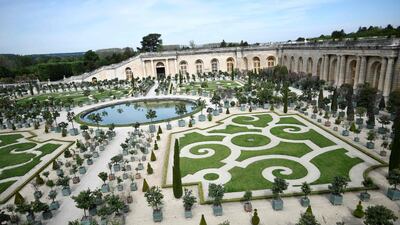
Tourists can now stay on the grounds of France's famed Palace of Versailles for the first time, thanks to the opening of a new luxury hotel.
Made up of 14 rooms and suites, the luxurious Le Grand Controle has opened, offering guests the chance to spend the night within one of the world’s most opulent addresses, and experience luxury fit for royalty.
The hotel is situated within three historic buildings dating back to 1681, which have been restored by architect and interior designer Christophe Tollemer, offering stunning views over the palace’s famous Orangerie.
Built by Louis XIV's preferred architect Jules Hardouin-Mansart, the garden features orange, lemon, oleander, palm and pomegranate trees.
The hotel is named after one of the three buildings it occupies, the Grand Controle building, also built by Mansart, along with Le Petit Controle and the Pavillon.
Guests can also take in the Piece d'Eau des Suisses, a 13-hectare ornamental pool excavated by Swiss Guards between 1679 and 1682.
The palace was built by King Louis XIV, who during the 17th century famously had his former hunting lodge transformed into a sprawling 63,154-square-metre estate, made up of 700 rooms.
Given the luxurious nature of the grounds within which it sits, stays at Le Grand Controle do not come cheap. An overnight stay starts at €1,700 ($2,100) a night.
The hotel is the sixth property for luxury hotel brand Airelles, and features a Louis XIV-inspired menu at its on-site restaurant, helmed by famed chef Alain Ducasse, as well as a Valmont spa, complete with a 15-metre indoor swimming pool.
Each of Le Grand Controle's rooms and suites is individually decorated and named after someone once connected with the property, including Louis XVI's director-general of finances, statesman Jacques Necker and his daughter, novelist Madame de Stael.
Guests will have a dedicated butler, and be shuttled around the grounds via golf buggy or boat, and have access to previously unseen quarters of the property where royals lived and stayed.
Guests will also have a chance to enjoy a number of exclusive experiences, such as after-hours access to the Hall of Mirrors, avoiding the usually packed crowds, as well as taking a stroll through Le Hameau de la Reine (the Queen's Hamlet), a private retreat where Marie Antoinette would walk and host her closest friends.
The hotel was due to open in 2020, but was delayed because of the Covid-19 pandemic. Chateau de Versailles reopened to the public earlier this year, with all visitors required to book a mandatory time slot for entry.

Greatest of All Time
Starring: Vijay, Sneha, Prashanth, Prabhu Deva, Mohan
Afghanistan fixtures
- v Australia, today
- v Sri Lanka, Tuesday
- v New Zealand, Saturday,
- v South Africa, June 15
- v England, June 18
- v India, June 22
- v Bangladesh, June 24
- v Pakistan, June 29
- v West Indies, July 4
RIVER%20SPIRIT
%3Cp%3E%3Cstrong%3EAuthor%3A%20%3C%2Fstrong%3ELeila%20Aboulela%C2%A0%3C%2Fp%3E%0A%3Cp%3E%3Cstrong%3EPublisher%3A%3C%2Fstrong%3E%20Saqi%20Books%3C%2Fp%3E%0A%3Cp%3E%3Cstrong%3EPages%3A%3C%2Fstrong%3E%20320%3C%2Fp%3E%0A%3Cp%3E%3Cstrong%3EAvailable%3A%3C%2Fstrong%3E%20Now%3C%2Fp%3E%0A
A cheaper choice
Vanuatu: $130,000
Why on earth pick Vanuatu? Easy. The South Pacific country has no income tax, wealth tax, capital gains or inheritance tax. And in 2015, when it was hit by Cyclone Pam, it signed an agreement with the EU that gave it some serious passport power.
Cost: A minimum investment of $130,000 for a family of up to four, plus $25,000 in fees.
Criteria: Applicants must have a minimum net worth of $250,000. The process take six to eight weeks, after which the investor must travel to Vanuatu or Hong Kong to take the oath of allegiance. Citizenship and passport are normally provided on the same day.
Benefits: No tax, no restrictions on dual citizenship, no requirement to visit or reside to retain a passport. Visa-free access to 129 countries.
Mercer, the investment consulting arm of US services company Marsh & McLennan, expects its wealth division to at least double its assets under management (AUM) in the Middle East as wealth in the region continues to grow despite economic headwinds, a company official said.
Mercer Wealth, which globally has $160 billion in AUM, plans to boost its AUM in the region to $2-$3bn in the next 2-3 years from the present $1bn, said Yasir AbuShaban, a Dubai-based principal with Mercer Wealth.
“Within the next two to three years, we are looking at reaching $2 to $3 billion as a conservative estimate and we do see an opportunity to do so,” said Mr AbuShaban.
Mercer does not directly make investments, but allocates clients’ money they have discretion to, to professional asset managers. They also provide advice to clients.
“We have buying power. We can negotiate on their (client’s) behalf with asset managers to provide them lower fees than they otherwise would have to get on their own,” he added.
Mercer Wealth’s clients include sovereign wealth funds, family offices, and insurance companies among others.
From its office in Dubai, Mercer also looks after Africa, India and Turkey, where they also see opportunity for growth.
Wealth creation in Middle East and Africa (MEA) grew 8.5 per cent to $8.1 trillion last year from $7.5tn in 2015, higher than last year’s global average of 6 per cent and the second-highest growth in a region after Asia-Pacific which grew 9.9 per cent, according to consultancy Boston Consulting Group (BCG). In the region, where wealth grew just 1.9 per cent in 2015 compared with 2014, a pickup in oil prices has helped in wealth generation.
BCG is forecasting MEA wealth will rise to $12tn by 2021, growing at an annual average of 8 per cent.
Drivers of wealth generation in the region will be split evenly between new wealth creation and growth of performance of existing assets, according to BCG.
Another general trend in the region is clients’ looking for a comprehensive approach to investing, according to Mr AbuShaban.
“Institutional investors or some of the families are seeing a slowdown in the available capital they have to invest and in that sense they are looking at optimizing the way they manage their portfolios and making sure they are not investing haphazardly and different parts of their investment are working together,” said Mr AbuShaban.
Some clients also have a higher appetite for risk, given the low interest-rate environment that does not provide enough yield for some institutional investors. These clients are keen to invest in illiquid assets, such as private equity and infrastructure.
“What we have seen is a desire for higher returns in what has been a low-return environment specifically in various fixed income or bonds,” he said.
“In this environment, we have seen a de facto increase in the risk that clients are taking in things like illiquid investments, private equity investments, infrastructure and private debt, those kind of investments were higher illiquidity results in incrementally higher returns.”
The Abu Dhabi Investment Authority, one of the largest sovereign wealth funds, said in its 2016 report that has gradually increased its exposure in direct private equity and private credit transactions, mainly in Asian markets and especially in China and India. The authority’s private equity department focused on structured equities owing to “their defensive characteristics.”
CREW
%3Cp%3E%3Cstrong%3EDirector%3A%20%3C%2Fstrong%3ERajesh%20A%20Krishnan%3C%2Fp%3E%0A%3Cp%3E%3Cstrong%3EStarring%3A%20%3C%2Fstrong%3ETabu%2C%20Kareena%20Kapoor%20Khan%2C%20Kriti%20Sanon%26nbsp%3B%3C%2Fp%3E%0A%3Cp%3E%3Cstrong%3ERating%3A%3C%2Fstrong%3E%203.5%2F5%3C%2Fp%3E%0A
The five pillars of Islam
