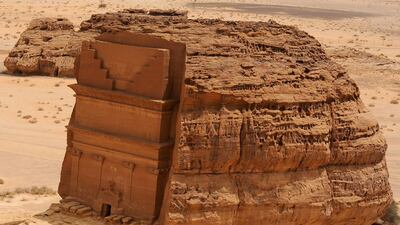
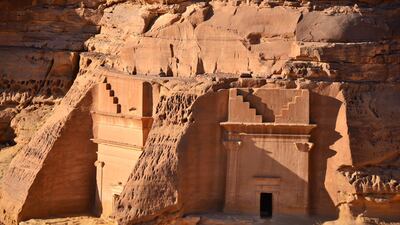
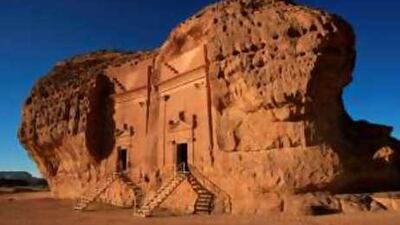
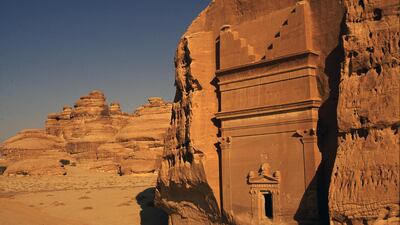
• Madain Saleh is one of the must-visit sites in Al Ula. Reem Mohammed / The National
    Madain Saleh is one of the must-visit sites in Al Ula. Reem Mohammed / The National
  • The ruins of the ancient Dadanian kingdom’s metropolis. Reem Mohammed / The National
    The ruins of the ancient Dadanian kingdom’s metropolis. Reem Mohammed / The National
  • A date harvest in Al Ula. Reem Mohammed / The National
    A date harvest in Al Ula. Reem Mohammed / The National
  • Al Ula's dates farms bring greenery to the mountainous region. Reem Mohammed / The National
    Al Ula's dates farms bring greenery to the mountainous region. Reem Mohammed / The National
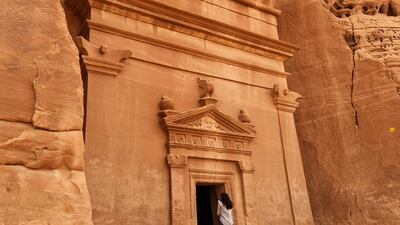
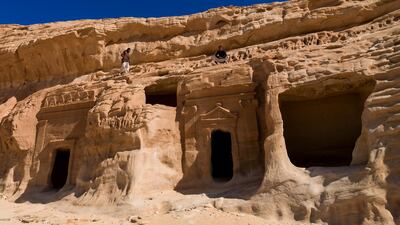
  • Tombs at Madain Saleh. Reem Mohammed / The National
    Tombs at Madain Saleh. Reem Mohammed / The National
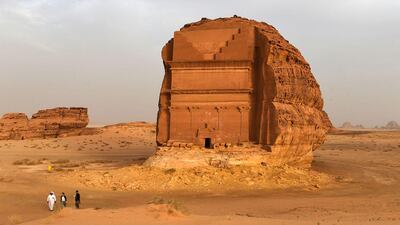
  • Al Farid at Madain Saleh. Reem Mohammed / The National
    Al Farid at Madain Saleh. Reem Mohammed / The National
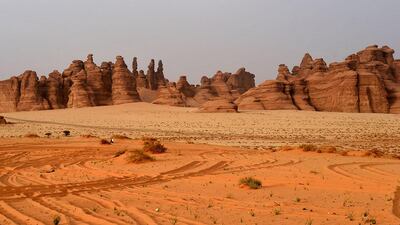
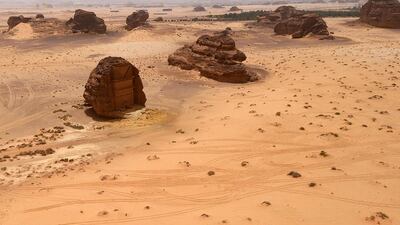
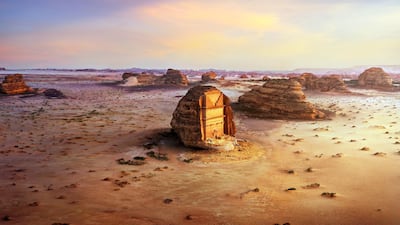
  • Madain Saleh is carved into large rocky outcrops strewn throughout a sparse desert. Reem Mohammed / The National
    Madain Saleh is carved into large rocky outcrops strewn throughout a sparse desert. Reem Mohammed / The National
  • Madain Saleh, the Unesco-listed southernmost settlement of the Nabatean kingdom, is also known as Hegra. Reem Mohammed / The National
    Madain Saleh, the Unesco-listed southernmost settlement of the Nabatean kingdom, is also known as Hegra. Reem Mohammed / The National
  • The railway station at Madain Saleh. Reem Mohammed / The National
    The railway station at Madain Saleh. Reem Mohammed / The National
  • A date farm in Al Ula - the location is known for its fruit. Reem Mohammed / The National
    A date farm in Al Ula - the location is known for its fruit. Reem Mohammed / The National
  • Suleiman Aljuwayhal, a tour guide in Al Ula. Reem Mohammed / The National
    Suleiman Aljuwayhal, a tour guide in Al Ula. Reem Mohammed / The National
  • The railway station at Madain Saleh in Al Ula. Reem Mohammed / The National
    The railway station at Madain Saleh in Al Ula. Reem Mohammed / The National
  • Ghadeer works as the reception office supervisor at Shaden Desert Resort in Al Ula. Reem Mohammed / The National
    Ghadeer works as the reception office supervisor at Shaden Desert Resort in Al Ula. Reem Mohammed / The National
  • The resort is undergoing expansion to accommodate more tourists. Reem Mohammed / The National
    The resort is undergoing expansion to accommodate more tourists. Reem Mohammed / The National
  • New rooms and suites are being built. Reem Mohammed / The National
    New rooms and suites are being built. Reem Mohammed / The National
  • Ghadeer started working at Shaden Desert Resort in Al Ula in 2018. Reem Mohammed / The National
    Ghadeer started working at Shaden Desert Resort in Al Ula in 2018. Reem Mohammed / The National
  • Ghadeer inside the Shaden Desert Resort in Al Ula. Reem Mohammed / The National
    Ghadeer inside the Shaden Desert Resort in Al Ula. Reem Mohammed / The National
  • When the Shaden Desert Resort is completed, it will comprise 120 rooms. Reem Mohammed / The National
    When the Shaden Desert Resort is completed, it will comprise 120 rooms. Reem Mohammed / The National
  • The mountains provide a breathtaking backdrop at Shaden Desert Resort. Reem Mohammed / The National
    The mountains provide a breathtaking backdrop at Shaden Desert Resort. Reem Mohammed / The National
  • The resort is still under construction and isn’t fully functional. Reem Mohammed / The National
    The resort is still under construction and isn’t fully functional. Reem Mohammed / The National

Saudi Arabia's Crown Prince launches new masterplan to turn Al Ula into 'living museum'


Hayley Skirka
  • English
  • Arabic

Saudi Arabia's Crown Prince Mohammed bin Salman on Wednesday announced a new tourism master plan for Al Ula in the country's north-west.

The Journey Through Time master plan aims to turn Al Ula into a global destination for travellers offering heritage, nature, art and culture. When completed, the plan hopes to attract two million visitors every year to the historic Saudi region.

Prince Mohammed's plan will turn the Al Ula region into a "living museum" by immersing travellers in 200,000 years of natural and human history.

The 'Journey Through Time' plan encompasses Al Ula Old Town, Dadan, Jabal Ikmah, Nabataean Horizon district and Hegra Historical City. Courtesy RCU

With a focus on sustainable tourism, a key part of the scheme is the creation of a low-carbon tram line that connects five distinct districts across the region. This tramway will follow a similar route to the ancient one running along the Hijaz Railway, used by pilgrims for hundreds of years. Other options to encourage sustainable travel will include a series of bicycle paths, extensive pedestrian trails and far-reaching equestrian tracks for low-carbon journeys.

The Journey Through Time will take travellers from Al Ula Old Town and neighbouring Dadan, to the open-air wall-carvings at Jabal Ikmah and onwards to the Nabataean Horizon and Hegra historical city, dedicated to Saudi Arabia's first Unesco World Heritage site.

A 20-kilometre Wadi of Hospitality

A total of 5,000 room keys are set to be added to the region, with everything from luxury hotels to eco-lodges and farmstays. Courtesy RCU

At the heart of Al Ula's desert landscape is the region's palm oasis. The new master plan proposes a 20-km Wadi of Hospitality to be created to run along this ancient oasis bed.

This area will act as the green pedestrian "spine" and will be home to restaurants, museums and other interactive attractions that will see visitors go to local farms, pick dates and learn more about the culture while enjoying the beauty of the oasis.

"It's going to be a very special place in Saudi Arabia, but also a place for visitors from around the globe who are interested in learning more about different cultures and multiple civilisations.

"It's a good reason for people to come and appreciate what we have to offer, and educate themselves in a way that will make a visit very memorable," says Phillip Jones, chief destination marketing officer of the Royal Commission for Al Ula.

A low-carbon tram will connect visitors from Al Ula International Airport across the five districts that make up The Journey Through Time. Courtesy RCU

The plan has no shortage of attractions, proposing that 15 new cultural assets such as galleries, museums and cultural centres be constructed across the districts. A 9-km Cultural Oasis will be home to a host of visitor experiences including living gardens, an Arts District, and the Perspectives Galleries. There are also plans for 10 million square metres of greenery and open spaces.

"Travellers will begin the journey at Al Ula Old Town, which is already up and running, and then there's the oasis and the wadi which will give people 20km to walk or ride and enjoy the regenerated wadi. And then travellers can take eco-friendly transportation through the entire area, to Dadan, Ikmah and on to Hegra, which is ultimately where the journey ends," explains Jones.

"Every stop along the way will give you a story, and you'll be able to learn about the civilisations that have left their mark over the last 200,000 years."

As part of the plan, Al Ula's hotel scene also gets a boost with an additional 5,000 rooms and suites to be built across the region. Lodgings will offer a variety of accommodation options including luxury hotels, canyon farms, stays and ecotourism resorts.

The Kingdom's Institute will be a place of research and advancement of the archaeological exploration of the civilizations of northwest Arabia. Courtesy RCU

The announcement also set out the plans for The Kingdoms Institute. Located in the oasis of Dadan, it will become one of the cultural centres of Saudi Arabia and a global hub and learning centre for archaeological research about the civilisations that have inhabited Al Ula. The design of the cluster of buildings making up The Kingdoms Institute is inspired by the Dadan civilisation, and they will appear as if carved in the mountains opposite the archaeological site of Dadan.

Learning from the past, planning for the future

  • The rose-coloured sandstone in Hegra, a Unesco World Heritage site, near Saudi Arabia's northwestern town of AlUla. AFP
    The rose-coloured sandstone in Hegra, a Unesco World Heritage site, near Saudi Arabia's northwestern town of AlUla. AFP
  • One of the tombs at Hegra, formerly known as Madain Saleh. AFP
    One of the tombs at Hegra, formerly known as Madain Saleh. AFP
  • The site was used as the background for a concert by Italian tenor Andea Bocelli. AFP
    The site was used as the background for a concert by Italian tenor Andea Bocelli. AFP
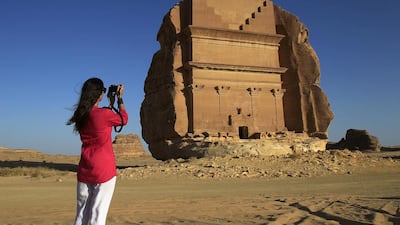
  • The Qasr al-Farid tomb (The Lonely Castle) carved into rose-coloured sandstone in Hegra. AFP
    The Qasr al-Farid tomb (The Lonely Castle) carved into rose-coloured sandstone in Hegra. AFP
  • The Qasr al-Farid tomb (The Lonely Castle) carved into rose-coloured sandstone in Hegra. AFP
    The Qasr al-Farid tomb (The Lonely Castle) carved into rose-coloured sandstone in Hegra. AFP
  • Andrea Bocelli is believed to be the first artist to host a concert at Hegra, Saudi Arabia. Sammy Six
    Andrea Bocelli is believed to be the first artist to host a concert at Hegra, Saudi Arabia. Sammy Six
  • Hegra, known locally as 'rocky place', features 111 monumental tombs carved into stone. AFP
    Hegra, known locally as 'rocky place', features 111 monumental tombs carved into stone. AFP
  • Rock-cut tombs at Hegra, near Al Ula, are Saudi Arabia's equivalent of Petra in Jordan, but receive only a trickle of visitors. Amar Grover / The National
    Rock-cut tombs at Hegra, near Al Ula, are Saudi Arabia's equivalent of Petra in Jordan, but receive only a trickle of visitors. Amar Grover / The National
  • Nabataean tomb in Hegra archaeological site, Al Madinah Province, AlUla, Saudi Arabia. Getty Images
    Nabataean tomb in Hegra archaeological site, Al Madinah Province, AlUla, Saudi Arabia. Getty Images
  • Hegra is the first archeological site in Saudi Arabia to join Unesco's World Heritage List. Photo: Consulum
    Hegra is the first archeological site in Saudi Arabia to join Unesco's World Heritage List. Photo: Consulum
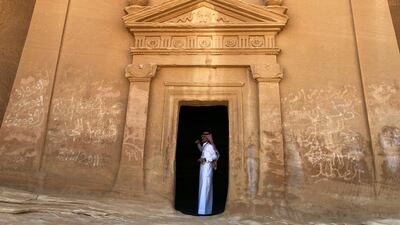
  • A Saudi tour guide stands inside a tomb at Hegra in Saudi Arabia. Reuters
    A Saudi tour guide stands inside a tomb at Hegra in Saudi Arabia. Reuters
  • Hegra is northwest of Riyadh. AP Photo
    Hegra is northwest of Riyadh. AP Photo
  • Nabataean rock-cut tombs at Hegra, near AlUla, are Saudi Arabia's equivalent of Petra in Jordan, but receive only a trickle of visitors.
    Nabataean rock-cut tombs at Hegra, near AlUla, are Saudi Arabia's equivalent of Petra in Jordan, but receive only a trickle of visitors.

While the master plan takes guests on a journey through time from ancient civilisations and pilgrimage routes, to modern carbon-free tramways, it also places importance on protecting tomorrow.

The master plan includes the Al Ula Sustainability Charter, which ensures that all development happens alongside an innovative and integrated approach to sustainability. The charter includes a zero-carbon policy coupled with circular economy principles, and robust resiliency policies around development in heritage and environmentally sensitive areas, as well as flood and improved water management and vegetation planting.

Al Ula residents, who have acted as guardians of ancestral values, techniques, and traditions over millennia, are an integral part of the new master plan. As well as helping to boost local economies, the plan includes community-driven services and amenities including cultural and educational facilities to be constructed across each district.

Laid out in three phases, the master plan is set for completion by 2035, but the first phase is on track to be completed by 2023. Over the next 14 years, the Journey Through Time master plan will create 38,000 new jobs across Al Ula and add 120 billion Saudi riyals ($32bn) to Saudi Arabia's gross domestic product.

By 2035, 80 per cent of Al Ula County will also have been designated as nature reserves, with key indigenous flora and fauna reintroduced across the region.


Company%C2%A0profile
%3Cp%3E%3Cstrong%3EName%3A%20%3C%2Fstrong%3EPyppl%3C%2Fp%3E%0A%3Cp%3E%3Cstrong%3EEstablished%3A%20%3C%2Fstrong%3E2017%3C%2Fp%3E%0A%3Cp%3E%3Cstrong%3EFounders%3A%20%3C%2Fstrong%3EAntti%20Arponen%20and%20Phil%20Reynolds%26nbsp%3B%3C%2Fp%3E%0A%3Cp%3E%3Cstrong%3EBased%3A%3C%2Fstrong%3E%20UAE%3C%2Fp%3E%0A%3Cp%3E%3Cstrong%3ESector%3A%3C%2Fstrong%3E%20financial%20services%3C%2Fp%3E%0A%3Cp%3E%3Cstrong%3EInvestment%3A%3C%2Fstrong%3E%20%2418.5%20million%3C%2Fp%3E%0A%3Cp%3E%3Cstrong%3EEmployees%3A%3C%2Fstrong%3E%20150%3C%2Fp%3E%0A%3Cp%3E%3Cstrong%3EFunding%20stage%3A%3C%2Fstrong%3E%20series%20A%2C%20closed%20in%202021%3C%2Fp%3E%0A%3Cp%3E%3Cstrong%3EInvestors%3A%3C%2Fstrong%3E%20venture%20capital%20companies%2C%20international%20funds%2C%20family%20offices%2C%20high-net-worth%20individuals%3C%2Fp%3E%0A
Conflict, drought, famine

Estimates of the number of deaths caused by the famine range from 400,000 to 1 million, according to a document prepared for the UK House of Lords in 2024.
It has been claimed that the policies of the Ethiopian government, which took control after deposing Emperor Haile Selassie in a military-led revolution in 1974, contributed to the scale of the famine.
Dr Miriam Bradley, senior lecturer in humanitarian studies at the University of Manchester, has argued that, by the early 1980s, “several government policies combined to cause, rather than prevent, a famine which lasted from 1983 to 1985. Mengistu’s government imposed Stalinist-model agricultural policies involving forced collectivisation and villagisation [relocation of communities into planned villages].
The West became aware of the catastrophe through a series of BBC News reports by journalist Michael Buerk in October 1984 describing a “biblical famine” and containing graphic images of thousands of people, including children, facing starvation.

Band Aid

Bob Geldof, singer with the Irish rock group The Boomtown Rats, formed Band Aid in response to the horrific images shown in the news broadcasts.
With Midge Ure of the band Ultravox, he wrote the hit charity single Do They Know it’s Christmas in December 1984, featuring a string of high-profile musicians.
Following the single’s success, the idea to stage a rock concert evolved.
Live Aid was a series of simultaneous concerts that took place at Wembley Stadium in London, John F Kennedy Stadium in Philadelphia, the US, and at various other venues across the world.
The combined event was broadcast to an estimated worldwide audience of 1.5 billion.

Expert input

If you had all the money in the world, what’s the one sneaker you would buy or create?

“There are a few shoes that have ‘grail’ status for me. But the one I have always wanted is the Nike x Patta x Parra Air Max 1 - Cherrywood. To get a pair in my size brand new is would cost me between Dh8,000 and Dh 10,000.” Jack Brett

“If I had all the money, I would approach Nike and ask them to do my own Air Force 1, that’s one of my dreams.” Yaseen Benchouche

“There’s nothing out there yet that I’d pay an insane amount for, but I’d love to create my own shoe with Tinker Hatfield and Jordan.” Joshua Cox

“I think I’d buy a defunct footwear brand; I’d like the challenge of reinterpreting a brand’s history and changing options.” Kris Balerite

 “I’d stir up a creative collaboration with designers Martin Margiela of the mixed patchwork sneakers, and Yohji Yamamoto.” Hussain Moloobhoy

“If I had all the money in the world, I’d live somewhere where I’d never have to wear shoes again.” Raj Malhotra

Aggro%20Dr1ft
%3Cp%3EDirector%3A%20Harmony%20Korine%3Cbr%3EStars%3A%20Jordi%20Molla%2C%20Travis%20Scott%3Cbr%3ERating%3A%202%2F5%3C%2Fp%3E%0A
Ten tax points to be aware of in 2026

1. Domestic VAT refund amendments: request your refund within five years

If a business does not apply for the refund on time, they lose their credit.

2. E-invoicing in the UAE

Businesses should continue preparing for the implementation of e-invoicing in the UAE, with 2026 a preparation and transition period ahead of phased mandatory adoption. 

3. More tax audits

Tax authorities are increasingly using data already available across multiple filings to identify audit risks. 

4. More beneficial VAT and excise tax penalty regime

Tax disputes are expected to become more frequent and more structured, with clearer administrative objection and appeal processes. The UAE has adopted a new penalty regime for VAT and excise disputes, which now mirrors the penalty regime for corporate tax.

5. Greater emphasis on statutory audit

There is a greater need for the accuracy of financial statements. The International Financial Reporting Standards standards need to be strictly adhered to and, as a result, the quality of the audits will need to increase.

6. Further transfer pricing enforcement

Transfer pricing enforcement, which refers to the practice of establishing prices for internal transactions between related entities, is expected to broaden in scope. The UAE will shortly open the possibility to negotiate advance pricing agreements, or essentially rulings for transfer pricing purposes. 

7. Limited time periods for audits

Recent amendments also introduce a default five-year limitation period for tax audits and assessments, subject to specific statutory exceptions. While the standard audit and assessment period is five years, this may be extended to up to 15 years in cases involving fraud or tax evasion. 

8. Pillar 2 implementation 

Many multinational groups will begin to feel the practical effect of the Domestic Minimum Top-Up Tax (DMTT), the UAE's implementation of the OECD’s global minimum tax under Pillar 2. While the rules apply for financial years starting on or after January 1, 2025, it is 2026 that marks the transition to an operational phase.

9. Reduced compliance obligations for imported goods and services

Businesses that apply the reverse-charge mechanism for VAT purposes in the UAE may benefit from reduced compliance obligations. 

10. Substance and CbC reporting focus

Tax authorities are expected to continue strengthening the enforcement of economic substance and Country-by-Country (CbC) reporting frameworks. In the UAE, these regimes are increasingly being used as risk-assessment tools, providing tax authorities with a comprehensive view of multinational groups’ global footprints and enabling them to assess whether profits are aligned with real economic activity. 

Contributed by Thomas Vanhee and Hend Rashwan, Aurifer

War 2

Director: Ayan Mukerji

Stars: Hrithik Roshan, NTR, Kiara Advani, Ashutosh Rana

Rating: 2/5

T20 World Cup Qualifier

October 18 – November 2

Opening fixtures

Friday, October 18

ICC Academy: 10am, Scotland v Singapore, 2.10pm, Netherlands v Kenya

Zayed Cricket Stadium: 2.10pm, Hong Kong v Ireland, 7.30pm, Oman v UAE

UAE squad

Ahmed Raza (captain), Rohan Mustafa, Ashfaq Ahmed, Rameez Shahzad, Darius D’Silva, Mohammed Usman, Mohammed Boota, Zawar Farid, Ghulam Shabber, Junaid Siddique, Sultan Ahmed, Imran Haider, Waheed Ahmed, Chirag Suri, Zahoor Khan

Players out: Mohammed Naveed, Shaiman Anwar, Qadeer Ahmed

Players in: Junaid Siddique, Darius D’Silva, Waheed Ahmed

ALRAWABI%20SCHOOL%20FOR%20GIRLS
%3Cp%3ECreator%3A%20Tima%20Shomali%3C%2Fp%3E%0A%3Cp%3EStarring%3A%C2%A0Tara%20Abboud%2C%C2%A0Kira%20Yaghnam%2C%20Tara%20Atalla%3C%2Fp%3E%0A%3Cp%3ERating%3A%204%2F5%3C%2Fp%3E%0A