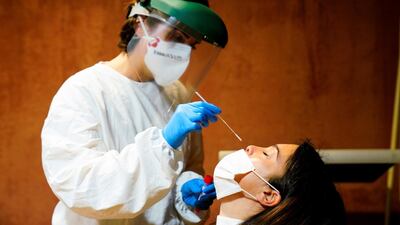
Daily Covid-19 infection numbers continue to fall in the UAE. Reuters

How the cost of Covid-19 testing varies around the world


  • English
  • Arabic

The cost of Covid testing around the world

Egypt

Dh514 for citizens; Dh865 for tourists

Information can be found through VFS Global.

Jordan

Dh212

Centres include the Speciality Hospital, which now offers drive-through testing.

Cambodia

Dh478

Travel tests are managed by the Ministry of Health and National Institute of Public Health.

Zanzibar

AED 295

Zanzibar Public Health Emergency Operations Centre, located within the Lumumba Secondary School compound.

Abu Dhabi

Dh85

Abu Dhabi’s Seha has test centres throughout the UAE.

UK

From Dh400

Heathrow Airport now offers drive through and clinic-based testing, starting from Dh400 and up to Dh500 for the PCR test.

As Covid-19 testing for travel becomes compulsory around the world, disparities in pricing, availability, speed and service levels remain significant.

Residents returning to Dubai over the festive period report paying up to Dh900 for a Covid-19 PCR test, which added huge costs and logistical issues to their travel arrangements. Even within a single country, states and provinces can have different protocols and prices, making it difficult to plan this leg of a trip.

Angus Duthie recently took a PCR test in Alexandria, Egypt, where he had travelled to for business. He booked his test to return to Dubai, where he lives with his family, through VFS, the global visa outsourcing company. With a final cost of Dh866, it was much higher than the costs incurred in the UAE, where even the fast-track PCR testing at the most expensive private hospitals does not exceed Dh250. The drive-through service also required Duthie to return in person to collect the results, and although the time frame given was 24 hours, the results were only ready after 30.

In addition, a local Egyptian mobile number was required for the facility to inform Duthie of when his test results were ready for collection. He says for trips such as his, businesses may cover the cost, but the additional financial strain may act as a deterrent for other travellers.

Nonetheless, the mandatory tests contributed in allaying some of the concerns Duthie had about travelling amid the pandemic. "It's costly, but the fact that the tests are being undertaken is reassuring, both at the departure point and on arrival in Dubai," he says.

“What was concerning was the lack of use of PPE in the departure airport in Egypt, the lack of distancing on the flight and the lack of hygiene protocols, distancing and mask-wearing being followed throughout Egypt.”

Meanwhile, in Cairo, procedures were different for Egyptian resident Tamer Khafaga, who had a test in his home city on January 5, at a Pure Health-affiliated facility, after returning home for a personal emergency. He paid Dh515 for his exit test and the result was back in under 12 hours. In Dubai, he paid Dh150 for his exit test. "The new rules for having a PCR test before travel can put some people off because of cost or associated hassle," he says.

And even though Khafaga participated in the vaccine trials, the trip was no less anxiety-inducing. "My biggest worries were to test positive while in Egypt, especially with the new strain, which for some people doesn't show any symptoms, but is still very infectious. I was worried about infecting family or friends, so it was a stressful time."

Dr Ria Mol, internal medicine specialist at Aster Clinic Dafza, says the availability and cost of tests continue to hinder the recovery of the travel industry. "While travelling, the tests should give faster results," she says. "It should be available in one to six hours, and available to conduct at larger scales."

She recommends the use of saliva samples rather than nasal or throat swabs to help achieve this. “The results should provide a high rate of accuracy. Both false positive and false negative results should be less than 1 per cent.”

People queue in their cars in Zouk Mosbeh north of Beirut to take the Covid-19 PCR test. AFP

PCR tests often require specialised laboratory machines and highly trained technicians, and are difficult to decentralise, explains Mol, who would like to see a more widely accessible diagnostic kit made available, not only to help contain the pandemic but also to prevent any future global health emergencies.

Gilbert Garcia returned to the Philippines for Christmas to visit his parents. The Dubai resident was fortunate to have access to free testing, as his province is covered by the local government. However, for tourists, private hospitals are charging between Dh305 and Dh458, he tells The National.

"For overseas Filipino workers, we also need to secure a return permit [from the Dubai government] stipulating all pertinent documents like an NOC from the company plus the residence visa, our overseas employment certificate, travel details, etc," Garcia says.

Upon arrival to the Philippines, he was immediately tested, as he was in Dubai. The country's department of health then offers a private bus to take travellers to a hotel contracted by the government, where people must wait for 16 to 24 hours for their results. "If it's negative, then we are free to go, otherwise you have to stay for 14 days, but this is all free and provided by our government," says Garcia.

Flydubai is offering travellers departing Dubai PCR tests for Dh180. EPA

In the UK, private tests are among the most expensive in the world, costing as much as £350 ($476) in facilities such as Private Harley Street Clinic. "Some destinations are charging more than $200 for the Covid-19 test, which is a real concern for the majority of the population," says Mol.

Making cost-effective tests available should be a priority for countries around the world, she says. “To prevent certain companies from making unreasonable profit at the expense of others, governments around the world should come forward to offer these tests at a low cost, similar to the international sharing of medical equipment and protection gear across borders.”

Chris Dutt, senior lecturer at the Emirates Academy of Hospitality Management, says the disparity in the cost of tests, and quarantine requirements, while necessary to ensure health and safety, are having a detrimental effect on travel and tourism.

"Concern over these varied requirements and the risk of these requirements changing can make tourists think twice before travelling. With different countries approving different vaccines, similar issues may arise, with some destinations requesting travellers to have a particular vaccine before arriving," he says.

Countries such as those in the GCC, which are taking a more consistent approach, such as a standard PCR test and little to no quarantine, stand to benefit from the pent-up desire for travel, however. "Many of these nations have strong healthcare systems and can handle escalations in infection numbers," says Dutt.

Steve Severance spent the new year in Zanzibar, where there is only one testing centre, in Stone Town. Costing Dh295, the process for testing in order to return to Dubai was fairly fast, he says, consisting of a 40-minute wait in the park beside the testing centre, and then another 10 minutes in the government-run facility, where tests consist of throat swabs.

Beyond the extra logistics and costs, Severance is conscious that travel includes a certain amount of risk amid the pandemic, despite being inoculated in December.

But the avid tourist, who often travels for his love of outdoor adventure, such as his recent kitesurfing trip to Zanzibar, says many will take the risk after almost a year of restrictions.

“I think the whole thing is annoying, but not that off-putting for travellers. For me, it’s worth going through it to be able to travel.”


Benefits of first-time home buyers' scheme
  • Priority access to new homes from participating developers
  • Discounts on sales price of off-plan units
  • Flexible payment plans from developers
  • Mortgages with better interest rates, faster approval times and reduced fees
  • DLD registration fee can be paid through banks or credit cards at zero interest rates
Living in...

This article is part of a guide on where to live in the UAE. Our reporters will profile some of the country’s most desirable districts, provide an estimate of rental prices and introduce you to some of the residents who call each area home.

Huroob Ezterari

Director: Ahmed Moussa

Starring: Ahmed El Sakka, Amir Karara, Ghada Adel and Moustafa Mohammed

Three stars

In numbers: PKK’s money network in Europe

Germany: PKK collectors typically bring in $18 million in cash a year – amount has trebled since 2010

Revolutionary tax: Investigators say about $2 million a year raised from ‘tax collection’ around Marseille

Extortion: Gunman convicted in 2023 of demanding $10,000 from Kurdish businessman in Stockholm

Drug trade: PKK income claimed by Turkish anti-drugs force in 2024 to be as high as $500 million a year

Denmark: PKK one of two terrorist groups along with Iranian separatists ASMLA to raise “two-digit million amounts”

Contributions: Hundreds of euros expected from typical Kurdish families and thousands from business owners

TV channel: Kurdish Roj TV accounts frozen and went bankrupt after Denmark fined it more than $1 million over PKK links in 2013 

The President's Cake

Director: Hasan Hadi

Starring: Baneen Ahmad Nayyef, Waheed Thabet Khreibat, Sajad Mohamad Qasem 

Rating: 4/5

Mercer, the investment consulting arm of US services company Marsh & McLennan, expects its wealth division to at least double its assets under management (AUM) in the Middle East as wealth in the region continues to grow despite economic headwinds, a company official said.

Mercer Wealth, which globally has $160 billion in AUM, plans to boost its AUM in the region to $2-$3bn in the next 2-3 years from the present $1bn, said Yasir AbuShaban, a Dubai-based principal with Mercer Wealth.

Within the next two to three years, we are looking at reaching $2 to $3 billion as a conservative estimate and we do see an opportunity to do so,” said Mr AbuShaban.

Mercer does not directly make investments, but allocates clients’ money they have discretion to, to professional asset managers. They also provide advice to clients.

“We have buying power. We can negotiate on their (client’s) behalf with asset managers to provide them lower fees than they otherwise would have to get on their own,” he added.

Mercer Wealth’s clients include sovereign wealth funds, family offices, and insurance companies among others.

From its office in Dubai, Mercer also looks after Africa, India and Turkey, where they also see opportunity for growth.

Wealth creation in Middle East and Africa (MEA) grew 8.5 per cent to $8.1 trillion last year from $7.5tn in 2015, higher than last year’s global average of 6 per cent and the second-highest growth in a region after Asia-Pacific which grew 9.9 per cent, according to consultancy Boston Consulting Group (BCG). In the region, where wealth grew just 1.9 per cent in 2015 compared with 2014, a pickup in oil prices has helped in wealth generation.

BCG is forecasting MEA wealth will rise to $12tn by 2021, growing at an annual average of 8 per cent.

Drivers of wealth generation in the region will be split evenly between new wealth creation and growth of performance of existing assets, according to BCG.

Another general trend in the region is clients’ looking for a comprehensive approach to investing, according to Mr AbuShaban.

“Institutional investors or some of the families are seeing a slowdown in the available capital they have to invest and in that sense they are looking at optimizing the way they manage their portfolios and making sure they are not investing haphazardly and different parts of their investment are working together,” said Mr AbuShaban.

Some clients also have a higher appetite for risk, given the low interest-rate environment that does not provide enough yield for some institutional investors. These clients are keen to invest in illiquid assets, such as private equity and infrastructure.

“What we have seen is a desire for higher returns in what has been a low-return environment specifically in various fixed income or bonds,” he said.

“In this environment, we have seen a de facto increase in the risk that clients are taking in things like illiquid investments, private equity investments, infrastructure and private debt, those kind of investments were higher illiquidity results in incrementally higher returns.”

The Abu Dhabi Investment Authority, one of the largest sovereign wealth funds, said in its 2016 report that has gradually increased its exposure in direct private equity and private credit transactions, mainly in Asian markets and especially in China and India. The authority’s private equity department focused on structured equities owing to “their defensive characteristics.”

Where to buy

Limited-edition art prints of The Sofa Series: Sultani can be acquired from Reem El Mutwalli at www.reemelmutwalli.com

Qosty Byogaani

Starring: Hani Razmzi, Maya Nasir and Hassan Hosny

Four stars

The cost of Covid testing around the world

Egypt

Dh514 for citizens; Dh865 for tourists

Information can be found through VFS Global.

Jordan

Dh212

Centres include the Speciality Hospital, which now offers drive-through testing.

Cambodia

Dh478

Travel tests are managed by the Ministry of Health and National Institute of Public Health.

Zanzibar

AED 295

Zanzibar Public Health Emergency Operations Centre, located within the Lumumba Secondary School compound.

Abu Dhabi

Dh85

Abu Dhabi’s Seha has test centres throughout the UAE.

UK

From Dh400

Heathrow Airport now offers drive through and clinic-based testing, starting from Dh400 and up to Dh500 for the PCR test.