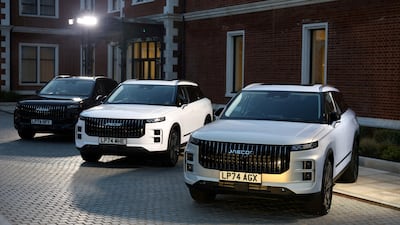

The Chinese-owned Jaecoo 7 has become the UK's most popular new vehicle, with sales outstripping the Tesla Model 3.
It is a remarkable rise for the Jaecoo 7, which launched in the UK in January last year. It first took the top sales spot in March but had been overtaken by rivals until September.
Made in China by Chery Automobile, the Jaecoo 7's boxy shape and distinctive grille have become a common sight on UK roads. With prices starting at about £30,000 ($39,600), the car has been nicknamed the “Temu Range Rover” on social media for being a cheaper version of the British luxury brand, in a nod to the Chinese discount marketplace.


China has made significant inroads into the UK car market in recent years. The model has led the charge of Chinese brands, including MG, BYD and GWM, which grabbed a 23 per cent share in September.
Although the first Chinese cars entered the British market around 15 years ago, the surge in popularity of electric vehicles has driven the rise. The Jaecoo 7 is available as a petrol or plug-in hybrid, with 10,813 new vehicles registered in September. Tesla's Model 3 was second with 9,929, while the Ford Puma registered 6,958.
For the year to date, however, the Ford Puma remains ahead (42,926 registrations), followed by the Jaecoo 7 (39,473,) and Kia Sportage (37,085).
Electric vehicles accounted for a record 58.4 per cent of new vehicle registrations in September, according to preliminary data from the Society of Motor Manufacturers and Traders.
There were 99,199 battery electric vehicles (up 36.3 per cent to a 28.3 per cent share of the market) and 59,563 plug-in hybrid electric vehicles (PHEV) (up 55.7 per cent) registered, compared with 131,861 petrol vehicles (down 6.7 per cent) and 14,057 diesels (up 11.5 per cent) registered.
Hybrid vehicles (HEV) were the only electric version whose market share dipped, down 4.2 per cent to 13.1 per cent.

The rise of battery electric vehicles (BEV) comes as UK buyers respond to unprecedented model choice, compelling discounts and the government’s Electric Car Grant, which is worth £3,750 for a new fully electric passenger car priced below £37,000.
Since 2023, the number of BEV models on the market has more than doubled, with 178 now on sale. Alongside more than 110 PHEV and 50 HEV models, the UK’s electrified options now represents more than three quarters of new cars available.
Despite the surge in sales this year – 454,945 new BEVs registered in the first nine months of the year – it is still only 26.2 per cent of all registrations, significantly below the 33 per cent mandated by the government for 2026 and behind last year’s tally of 28 per cent.
The Society of Motor Manufacturers and Traders said an additional 265,000 new BEV registrations would be needed in the final quarter to meet this year's target, illustrating how targets continue to outpace demand.
It said regulation needed to be aligned more closely with market development to “strengthen UK competitiveness, unlock further investment in new models and plants, support jobs and create a robust, sustainable market capable of delivering the decarbonisation the UK needs”.
Mike Hawes, the society's chief executive, said: “September’s record EV performance is a major achievement. Drivers are increasingly embracing the growing choice of models made available and high fuel prices are also undoubtedly giving more consumers reason to consider going electric. The industry’s commitment is clear with billions of pounds of investment in new models, new technology and incentives.
“Despite all these factors, uptake remains behind mandated targets and, whilst flexibilities help, the UK still has the world’s toughest targets and highest energy costs.”
Unlike in the European Union, Chinese EV imports do not face additional tariffs in the UK. Plug-in hybrids are not affected by trade levies but they may soon be hit with similar duties in the EU.
Nissan executive Massimiliano Messina said last month that the UK might have to levy similar tariffs if it wanted to be given equal treatment under the EU’s local-content rules.
“Tariffs come and go but it won’t change our investment in the UK,” Victor Zhang, UK managing director of Jaecoo and Omoda, which is also owned by Chery, told reporters. “We are here to stay.”
Mr Zhang cited a memorandum of understanding signed with Nissan under which the companies are exploring the possibility of Chery assembling vehicles at the Japanese company’s Sunderland factory, the UK’s largest car plant.
Overall, British new car registrations rose 12.1 per cent in September from a year earlier to 350,518, their highest level for the month since 2017.

