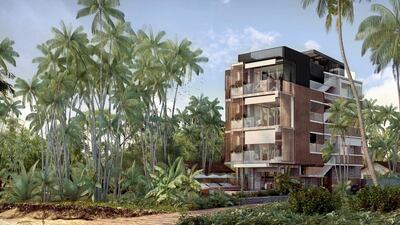
Space will become a luxury, but people do not want to feel isolated, says Jonathan Ashmore, founder of design and architecture firm Anarchitect. Courtesy Anarchitect

What will high-end hotels, restaurants, offices and retail spaces look like in a post-Covid world?


Selina Denman
  • English
  • Arabic

“This will affect human culture. It’ll change human habits,” says Jonathan Ashmore, founder of Anarchitect, a design and architecture practice with branches in Dubai and London.

Much has changed in the past six months, but the full ramifications of the coronavirus pandemic will take much longer to reveal themselves. From how we interact with each other to how we utilise shared spaces, it is possible that our new awareness of the threat of a global health crisis will influence our behaviour and thought patterns even after a vaccine for Covid-19 has been developed and distributed.

'People don't want to feel isolated'

Will the design of high-end restaurants, hotels, luxury offices and retail outlets need to adapt as a result? And, given that maintaining a distance from each other has become the new norm, will space become the ultimate luxury?

Yes and no, says Ashmore. “The problem is, that’s not necessarily what people want. They don’t want to be dispersed and feel isolated.”

While the immediate response to the pandemic has been to limit the capacity of existing commercial spaces – from offices and malls to restaurants and hotels – this is neither economically viable in the long run, nor particularly appealing to consumers. For the most part, people want to feel safe, but do not want to have dinner in an empty, echoey restaurant.

How do you harness space? How do you create a sense of intimacy, but also security

“It’s more about human distribution in space,” says Ashmore. “Not so much isolation and segregation, but how do you harness space? How do you create a sense of intimacy, but also security?

“Luxury can compensate for these new parameters, because it can work with high-quality materials and beautiful lighting; it can look at the composition of space. The most luxurious spaces will be the ones that respond in the most holistic way, where it isn’t overt or obvious,” he continues.

The Harding Boutique Hotel in Ahangama, Sri Lanka was designed by Anarchitect. Jonathan Ashmore, the firm's founder, predicts that smaller, more intimate properties such as this will become more attractive in a post-Covid-19 world. Courtesy Anarchitect

Privacy and compartmentalisation will be important, but not only through the use of walls and partitions. Zones can be created through the subtle use of floor finishes and lighting, or staggered seating heights.

Entry and exit points and the way people move through a space will need to be reconsidered. Creating a sense of volume by playing with height, or introducing outdoor space (or at least the perception of outdoor space) will make “people feel like they can breathe. This idea of not feeling suppressed is key".

The age of 'subtle buffering'

Pallavi Dean, founder of Dubai design studio Roar, is predicting the death of the buffet and sharing concepts in dining settings, but this is only an acceleration of an existing trend, she says.

In terms of design, she agrees that “subtle buffering” is the order of the day, rather than the huge Perspex-style partitions that some are predicting. “People don’t need to know they are being separated, but you’ll have clever design and clever circulation through a restaurant that will allow you to do this,” she says.

Pallavi Dean, founder and creative director of Roar. Pawan Singh / The National

While users may not demand blatant sterility in all the spaces they visit, touchpoints will need to be designed to give people a sense of security. “So, for example, in restaurants, the toilets will have to be pretty much touchless,” says Dean. “Everything is going to be sensor-operated, it’s going to be contactless. You are going to move away from any doors leading to these functional spaces.”

There needs to be careful thought about how to reconfigure and reuse existing layouts. From both an environmental and economic standpoint, this is not the time to be tearing down existing structures to build new ones from scratch.

This could be seen as a precursor to issues surrounding climate change

“An important aspect of all this is working with existing space – that’s where the interesting dynamic is going to be. I don’t think it’s going to be knock out and demolish and build new. That’s the antithesis of what this pandemic means,” says Ashmore. “Because this could be seen as a precursor to issues surrounding climate change.”

New ways of working

Perhaps the greatest shift in design thinking will come in the office arena. Now that employers know working from home actually works, the role and design of offices will need to evolve. Perhaps counter-intuitively at a time when people are going out of their way to distance themselves from each other, Dean is anticipating a rise in shared working spaces.

A boardroom of the future, as envisaged by Pallavi Dean of Dubai design firm Roar. Courtesy Roar

“First we were thinking the cubicle is back and co-working spaces are dead. But actually, what we are going to see is a sophisticated, sanitised version of the co-working space. The thing that will dictate this is not really health and safety concerns, but economics.”

All of the things that have been steadily value engineered out of office builds over recent years are set to make a comeback  whether it is antimicrobial surfaces and materials such as copper, or Hepa filters in air-conditioning units. "This stuff is expensive and it really ramps up the cost per square foot of fitting out an office," says Dean. "As such, people are going have to share this space."

Creative hubs

That doesn’t mean packing more people in, though. It means being selective about who needs to be where, and when. “The first thing we asked ourselves when we started working from home was: ‘What do we need an office for? What are we missing?’” says Ashmore.

“And what was missing was that sense of creativity and social interaction. It’s something we need. Yes, you can be productive at home, yes you can facilitate remote working, and it can be more individually creative and comforting doing things in your own time. But I think what’s going to happen is we are going to have more, smaller hubs.

"I think everyone likes the idea of coming together two or three times a week to meet with their team, or meet with their superiors, or meet with their colleagues, and have a meaningful dialogue with them. It’s like going into a meeting with a proper agenda,” Ashmore says.

Securing that landmark address for your office headquarters and then using it as a symbol of your brand’s clout will quickly become passé. Instead, it will be about facilitating the actual needs of both your organisation and staff.

In terms of retail, luxury brands are already ahead of the game “when it comes to numbers of people, expanded physical distances and customer separation”, says Eric Carlson, founder of design firm Carbondale, which has created Dolce & Gabbana boutiques across the globe.

Boutiques become galleries

“For high-end boutiques, there is a doorman alleviating the need to touch the highly solicited door handle, gloved sales staff to present and polish-clean the leather goods, watches and jewellery products, and VIP rooms to create an additional degree of customer isolation,” he points out.

There will be a return towards more intimate-scale spaces, the desire for 'quality over quantity' and a general reinforcement of exclusivity

Nonetheless, the scale of some of these boutiques will need to be reassessed. In recent years, luxury retail store sizes have inflated to up to 2,000 square metres to accommodate burgeoning product ranges and customer numbers. “Because of the current situation, inevitably there will be an increased weariness for luxury shoppers to be over-exposed in these large environments,” says Carlson. “There will be a return towards more intimate-scale spaces, the desire for ‘quality over quantity’ and a general reinforcement of exclusivity,” he adds.

Either way, do expect “a conspicuous new staff member dedicated to constantly wiping down surfaces and products”.

A cross-pollination design disciplines

As our homes become our offices, as well as a hub for education, relaxation and entertainment, and restaurants, hotels and shops are united in facing the same set of challenges, the boundaries between design disciplines are being broken down. “There’s a cross-pollination of different sectors that’s really coming into play,” says Dean.

“We’ll apply the learnings from all these different sectors: how can the buffering from restaurants be used in offices? How can the collaboration spaces in offices be used in education facilities? I think there will be a lot of hybrids and shared ideas.”

“With all of these conversations now, it’s definitely got to be a dialogue,” adds Ashmore. “No one person or one body has the answer. It’ll need to be an organic response that is flexible.”

Given the amount of time it takes to design and build them, Sonu Shivdasani, founder and chief executive of Soneva Hotels, thinks it is unlikely that the current pandemic will have a long-lasting effect on the actual design of hotels.

Soneva Fushi in the Maldives: the brand's founder, Sonu Shivdasani, predicts that travellers will become more health-focused and aware of nature. Courtesy Ultimate Library / Soneva Fushi Resort

In fact, citing lowering mortality rates and the greater ability of health systems to cope with the virus, he is optimistic that we will have adapted to our new normal within a matter of months. “I believe that even without a vaccine, in a few months’ time, we will come to a stage where we are able to live with this,” he says.

This crisis that the world is going through has allowed many people the opportunity to pause and rethink their values

All the same, he acknowledges that smaller, more boutique hotels will now be seen as more attractive to the travelling public, although this also represents an acceleration of an existing trend. “I do believe that smaller boutique hotels will be perceived as safer as they will be more intimate.

“I believe that individual smaller hotels are gaining in popularity, as luxury has become very institutional. Luxury is all about that which is rare. If certain aspects of luxury hotels are similar and commonplace, then they lose that rarity and that element of luxury. The nice thing about small boutique hotels is that they are individual and in some ways, one-of-a-kind," Shivdasani explains.

“This crisis that the world is going through has allowed many people the opportunity to pause and rethink their values and, importantly, their priorities. I suspect that travellers will become more health-focused, more aware of nature and more sensitive to the challenges of the planet.” 

COMPANY%20PROFILE%20
%3Cp%3E%3Cstrong%3ECompany%20name%3A%20%3C%2Fstrong%3EAlmouneer%3Cbr%3E%3Cstrong%3EStarted%3A%3C%2Fstrong%3E%202017%3Cbr%3E%3Cstrong%3EFounders%3A%3C%2Fstrong%3E%20Dr%20Noha%20Khater%20and%20Rania%20Kadry%3Cbr%3E%3Cstrong%3EBased%3A%20%3C%2Fstrong%3EEgypt%3Cbr%3E%3Cstrong%3ENumber%20of%20staff%3A%20%3C%2Fstrong%3E120%3Cbr%3E%3Cstrong%3EInvestment%3A%20%3C%2Fstrong%3EBootstrapped%2C%20with%20support%20from%20Insead%20and%20Egyptian%20government%2C%20seed%20round%20of%20%3Cbr%3E%243.6%20million%20led%20by%20Global%20Ventures%3Cbr%3E%3C%2Fp%3E%0A
How%20champions%20are%20made
%3Cp%3E%0D%3Cstrong%3EDiet%3C%2Fstrong%3E%20%0D%3Cbr%3E7am%20-%20Protein%20shake%20with%20oats%20and%20fruits%0D%3Cbr%3E10am%20-%205-6%20egg%20whites%0D%3Cbr%3E1pm%20-%20White%20rice%20or%20chapati%20(Indian%20bread)%20with%20chicken%0D%3Cbr%3E4pm%20-%20Dry%20fruits%20%0D%3Cbr%3E7.30pm%20-%20Pre%20workout%20meal%20%E2%80%93%20grilled%20fish%20or%20chicken%20with%20veggies%20and%20fruits%0D%3Cbr%3E8.30pm%20to%20midnight%20workout%0D%3Cbr%3E12.30am%20%E2%80%93%20Protein%20shake%20%0D%3Cbr%3E%3Cstrong%3ETotal%20intake%3A%3C%2Fstrong%3E%204000-4500%20calories%20%0D%3Cbr%3E%3Cstrong%3ESaidu%E2%80%99s%20weight%3A%3C%2Fstrong%3E%20110%20kg%0D%3Cbr%3E%3Cstrong%3EStats%3A%3C%2Fstrong%3E%20Biceps%2019%20inches.%20Forearms%2018%20inches%3C%2Fp%3E%0A
The%20specs%20
%3Cp%3E%3Cstrong%3EEngine%3A%20%3C%2Fstrong%3EDual%20permanently%20excited%20synchronous%20motors%3Cbr%3E%3Cstrong%3EPower%3A%20%3C%2Fstrong%3E516hp%20or%20400Kw%3Cbr%3E%3Cstrong%3ETorque%3A%20%3C%2Fstrong%3E858Nm%3Cbr%3E%3Cstrong%3ETransmission%3A%20%3C%2Fstrong%3ESingle%20speed%20auto%3Cbr%3E%3Cstrong%3ERange%3A%20%3C%2Fstrong%3E485km%3Cbr%3E%3Cstrong%3EPrice%3A%20%3C%2Fstrong%3EFrom%20Dh699%2C000%3C%2Fp%3E%0A
Islamophobia definition

A widely accepted definition was made by the All Party Parliamentary Group on British Muslims in 2019: “Islamophobia is rooted in racism and is a type of racism that targets expressions of Muslimness or perceived Muslimness.” It further defines it as “inciting hatred or violence against Muslims”.

MATCH SCHEDULE

Uefa Champions League semi-final, first leg
Tuesday, April 24 (10.45pm)

Liverpool v Roma

Wednesday, April 25
Bayern Munich v Real Madrid (10.45pm)

Europa League semi-final, first leg
Thursday, April 26

Arsenal v Atletico Madrid (11.05pm)
Marseille v Salzburg (11.05pm)

The specs: 2018 Chevrolet Trailblazer

Price, base / as tested Dh99,000 / Dh132,000

Engine 3.6L V6

Transmission: Six-speed automatic

Power 275hp @ 6,000rpm

Torque 350Nm @ 3,700rpm

Fuel economy combined 12.2L / 100km

box

COMPANY PROFILE

Company name: Letstango.com

Started: June 2013

Founder: Alex Tchablakian

Based: Dubai

Industry: e-commerce

Initial investment: Dh10 million

Investors: Self-funded

Total customers: 300,000 unique customers every month

Funk Wav Bounces Vol.1
Calvin Harris
Columbia

Trippier bio

Date of birth September 19, 1990

Place of birth Bury, United Kingdom

Age 26

Height 1.74 metres

Nationality England

Position Right-back

Foot Right

Who's who in Yemen conflict

Houthis: Iran-backed rebels who occupy Sanaa and run unrecognised government

Yemeni government: Exiled government in Aden led by eight-member Presidential Leadership Council

Southern Transitional Council: Faction in Yemeni government that seeks autonomy for the south

Habrish 'rebels': Tribal-backed forces feuding with STC over control of oil in government territory

Australia tour of Pakistan

March 4-8: First Test, Rawalpindi

March 12-16: Second Test, Karachi

March 21-25: Third Test, Lahore

March 29: First ODI, Rawalpindi

March 31: Second ODI, Rawalpindi

April 2: Third ODI, Rawalpindi

April 5: T20I, Rawalpindi

Sarfira

Director: Sudha Kongara Prasad

Starring: Akshay Kumar, Radhika Madan, Paresh Rawal 

Rating: 2/5

The specs: Lamborghini Aventador SVJ

Price, base: Dh1,731,672

Engine: 6.5-litre V12

Gearbox: Seven-speed automatic

Power: 770hp @ 8,500rpm

Torque: 720Nm @ 6,750rpm

Fuel economy: 19.6L / 100km

Dust and sand storms compared

Sand storm

  • Particle size: Larger, heavier sand grains
  • Visibility: Often dramatic with thick "walls" of sand
  • Duration: Short-lived, typically localised
  • Travel distance: Limited 
  • Source: Open desert areas with strong winds

Dust storm

  • Particle size: Much finer, lightweight particles
  • Visibility: Hazy skies but less intense
  • Duration: Can linger for days
  • Travel distance: Long-range, up to thousands of kilometres
  • Source: Can be carried from distant regions
360Vuz PROFILE

Date started: January 2017
Founder: Khaled Zaatarah 
Based: Dubai and Los Angeles
Sector: Technology 
Size: 21 employees
Funding: $7 million 
Investors: Shorooq Partners, KBW Ventures, Vision Ventures, Hala Ventures, 500Startups, Plug and Play, Magnus Olsson, Samih Toukan, Jonathan Labin

match info

Union Berlin 0

Bayern Munich 1 (Lewandowski 40' pen, Pavard 80')

Man of the Match: Benjamin Pavard (Bayern Munich)


Company: Instabug

Founded: 2013

Based: Egypt, Cairo

Sector: IT

Employees: 100

Stage: Series A

Investors: Flat6Labs, Accel, Y Combinator and angel investors

FULL%20RESULTS
%3Cp%3E%3Cstrong%3EMiddleweight%20%3C%2Fstrong%3E%3C%2Fp%3E%0A%3Cp%3EEslam%20Syaha%20(EGY)%20bt%20Robin%20Roos%20(SWE)%20%0D%3Cbr%3E%3Cstrong%3E%0D%3Cbr%3EWelterweight%20%3C%2Fstrong%3E%3C%2Fp%3E%0A%3Cp%3EAlex%20da%20Silva%20(BRA)%20bt%20Bagyash%20Zharmamatov%20(KGZ)%20%0D%3Cbr%3EMurodov%20Samandar%20(TJK)%20bt%20Lucas%20Sampaio%20(BRA)%20%0D%3Cbr%3EShakhban%20Alkhasov%20(RUS)%20bt%20Salamat%20Orozakunov%20(KGZ)%0D%3Cbr%3EKhotamjon%20Boynazarov%20(UZB)%20bt%20Mikail%20Bayram%20(FRA)%20%0D%3Cbr%3E%0D%3Cbr%3E%3Cstrong%3EBantamweight%20%3C%2Fstrong%3E%0D%3Cbr%3EJieleyisi%20Baergeng%20(CHN)%20bt%20Xavier%20Alaoui%20(CAN)%20%0D%3Cbr%3E%0D%3Cbr%3E%3Cstrong%3EFlyweight%20%3C%2Fstrong%3E%0D%3Cbr%3ERashid%20Vagabov%20(RUS)%20bt%20Lun%20Qui%20(CHN)%20%0D%3Cbr%3EYamato%20Fujita%20(JPN)%20bt%20Furkatbek%20Yokubov%20(UZB)%20%0D%3Cbr%3EAaron%20Aby%20(WLS)%20bt%20Joevincent%20So%20(PHI)%20%0D%3Cbr%3E%0D%3Cbr%3E%3Cstrong%3ECatchweight%20176lb%20%3C%2Fstrong%3E%0D%3Cbr%3EMark%20Hulm%20(RSA)%20bt%20Erkin%20Darmenov%20(KAZ)%20%0D%3Cbr%3E%0D%3Cbr%3E%3Cstrong%3ECatchweight%20160lb%20%3C%2Fstrong%3E%0D%3Cbr%3ERustam%20Serbiev%20(BEL)%20bt%20Anar%20Huseyinov%20(AZE)%20%0D%3Cbr%3E%0D%3Cbr%3E%3Cstrong%3ECatchweight%20150lb%20%3C%2Fstrong%3E%3C%2Fp%3E%0A%3Cp%3EIslam%20Reda%20(EGY)%20bt%20Ernie%20Braca%20(PHI)%0D%3Cbr%3E%0D%3Cbr%3E%3Cstrong%3EFlyweight%20(women)%3C%2Fstrong%3E%20%0D%3Cbr%3EBaktygul%20Kurmanbekova%20(KGZ)%20bt%20Maria%20Eugenia%20Zbrun%20(ARG)%20%0D%3Cbr%3E%3C%2Fp%3E%0A
Key findings of Jenkins report
  • Founder of the Muslim Brotherhood, Hassan al Banna, "accepted the political utility of violence"
  • Views of key Muslim Brotherhood ideologue, Sayyid Qutb, have “consistently been understood” as permitting “the use of extreme violence in the pursuit of the perfect Islamic society” and “never been institutionally disowned” by the movement.
  • Muslim Brotherhood at all levels has repeatedly defended Hamas attacks against Israel, including the use of suicide bombers and the killing of civilians.
  • Laying out the report in the House of Commons, David Cameron told MPs: "The main findings of the review support the conclusion that membership of, association with, or influence by the Muslim Brotherhood should be considered as a possible indicator of extremism."
