



Did you know that trees and green landscaping can actually increase the value of your property, as well as attracting future residents?
This view has been backed by numerous pieces of third-party research over the years, including a Brigham Young University study in 2001, which showed that a property with mature trees, especially in high-income areas, can enjoy a price rise of up to 15 per cent.
Another study in 2006 (Wachter and Gillen) concluded that homes located close to new tree plantings can increase in price by about 10 per cent.
It’s reasonable to conclude, then, that most home buyers prefer properties surrounded by greenery, and yet trees are often overlooked by developers or simply tacked on to urban master plans as an afterthought.

Profitability aside, trees are important from an aesthetic, health, environmental and value-creation perspective. The spaces between homes are just as important as the homes themselves. That’s why my inclination is to design green spaces first, then add the built-up areas, rather than the other way around.
Trees play an incredibly important role in what might otherwise be a relatively sterile landscape. They give residents and visitors an emotional connect to where they live and also lower pollutants such as sulphur dioxide, nitrogen oxides and ammonia (a single tree can absorb 22 kilograms of carbon annually). They’ve even been shown to reduce car accidents, particularly with planned demarcation that slows driving speeds in pedestrian zones.
The calming effect of trees has been proven to reduce fatigue, ADHD, road rage, anxiety, aggression, high blood pressure, and the stress hormone cortisol. They also help to lower noise pollution, while phytoncides released by trees have healing properties and encourage the presence of birds and butterflies.
This all sounds very well, but — as you might have guessed — choosing and nurturing a grove of trees is not an easy job in any part of the world, let alone the Gulf. What species should be selected? How much watering is required? How can the environmental impact of that process be minimised? These are some of the questions both enthusiastic and professional gardeners, and indeed developers, are confounded by.
When it comes to species, I am not the biggest fan of palm trees. While they are highly regarded in this part of the world for their heritage and the production of dates, they are also not very environmentally friendly. They provide very little shade, hardly produce any oxygen, remove only a limited amount of carbon and ozone from the atmosphere, and are also very thirsty.
A better solution for residential communities — and the planet — is a healthy mixture of trees and shrubs that are indigenous or from parts of the world with a similar climate. Flame trees, tree jasmine, neem, trumpet trees, Indian beeches and Indian laurels all complement the beautiful species that are native to the UAE, which include acacia (salam), sidr and the national tree of the UAE, ghaf.

When it comes to planting methods, groups or clusters, not lines are the answer. If you structure your green space with a tree canopy at the top, another layer of shrubs beneath and grass or other low-lying plants below that, you can even lower the overall ambient temperature of your community, according to a recent study conducted in Australia. This showed that tree canopies and grass cover decreased local daytime land surface temperatures by up to 6ºC during summer conditions of above 40ºC.
Watering is, unsurprisingly, a hot topic in a country where the per capita consumption rate is one of the highest in the world. As a result, there is often criticism that planting trees in the UAE is both expensive and unsustainable, due to unfavourable climactic conditions and water wastage.
People are often surprised to learn the actual cost of maintaining trees at Arada’s communities is close to zero. Naturally, we need to invest a small amount early on in the plantation process but the reality is the process can be cost-efficient. Community management teams should only ever irrigate with treated water. There is also a range of technology out there that can help monitor leakage points and further minimise water wastage.
The result is a splendid, leafy canopy that leads to a healthier and happier place to live in. And the best thing about trees? Like all great investments, they grow. Every season brings more maturity, more colour and more variety. Surround your home with nature, and you’ll find that — like the trees flourishing around you — the value of your property will rise as well.
Ahmed Alkhoshaibi is the group chief executive of property development company Arada, which is behind communities such as Aljada, Nasma Residences and Masaar
Scroll through the gallery below to check out Museum of the Future’s garden, which contains100 plant species from across the UAE:
-
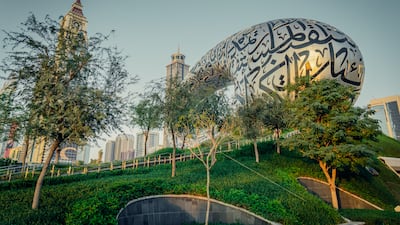
The Museum of the Future’s garden has been designed on the green plinth holding the striking structure. All photos: The Museum of the Future -

In the garden there are about 100 species of trees and plants. -

The different horticultural species reflect the UAE's natural diversity and ecological heritage. -

Palm trees standing tall outside Dubai's Museum of the Future. -

Ghaf, sidr, palm and acacia trees are all growing in the gardens, trees that are well adapted to local environmental conditions. -

The gardens are equipped with a smart, automated irrigation system and support local bee and bird population. -

Museum of the Future’s gardens are set to be an attraction in and of themselves when it opens on February 22.



