


Familiarity breeds complacency. This is the take Greg Malouf has when it comes to Lebanese cuisine.
The Michelin-lauded Australian-Lebanese chef, renowned for his sophisticated approach to Middle Eastern food, laments the state of his native culinary tradition.
“Lebanese food has become lazy and I am prepared to say that publicly,” he tells The National. “There is no longer any effort and care with plenty of restaurants taking short cuts in terms of preparation and produce. As a result, the food itself has reached a brick wall and it has been that way for years.”
Malouf sees no reason why Lebanese cuisine can’t reach the status of its South-East Asian counterparts. After all, it is made up of complex flavours and fresh produce, while being agile enough to accommodate rustic and refined treatments.
This is partly the reason why Malouf signed up to create a lavish menu for the occasion of Formula One Abu Dhabi Grand Prix, to be served in the exclusive Shams Suite at Yas Marina Circuit.
He describes the weekend racing event as an opportunity to demonstrate how Lebanese food is complimentary in the most stylish of settings.
“My mission has always been to put Lebanese food on a pedestal,” he says.
“And that is not to change it, but slightly elevate it. That means working with good produce and presenting it in an interesting way that doesn’t take away from its integrity.”
It will also be a chance to break some misconceptions.
“Not every hummus is the same,” he says. “I don’t feel that many people have had a real and true humus that is made with Lebanese, Mexican or Australian chickpeas with a touch of great extra-virgin olive oil, sea salt and a dash of fresh lemon.
“It is such a humble dish but shortcuts have been taken to lower the costs and this is why the hummus we eat today is mostly poor.”
Malouf will attempt to right those perceived wrongs through dishes he describes as deeply personal.
These offerings stem from a three-decade career in which he has launched ground-breaking Middle Eastern restaurants in Australia, such as MoMo in Melbourne. He is also the former head chef of London’s Michelin-starred institution Petersham Nurseries, and has published eight Middle Eastern cookbooks.
-
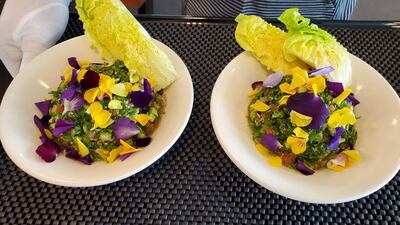
Greg Malouf's elevated take on Lebanese tabbouleh. All photos: Dubai World Trade Centre -
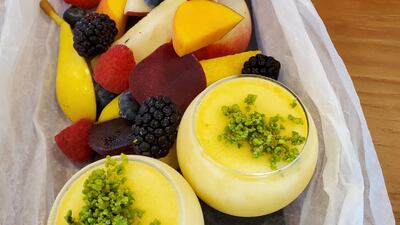
Exotic fruits, cherry and rose sorbet and Arabesque wafers. -
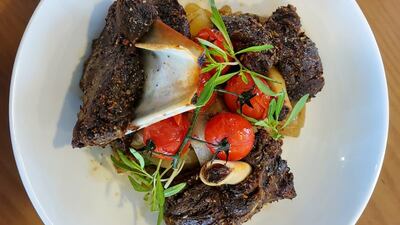
Eight-hour lamb shoulder with wild thyme, shallots, confit garlic and porcini freekeh. -
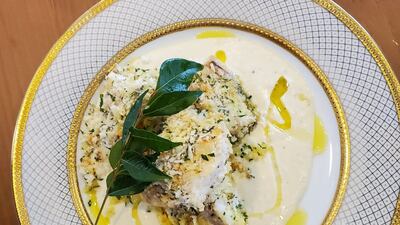
Mahi-e mast-gerdu, an Iranian-style yoghurt-baked hamour with walnut and herb crumbs. -
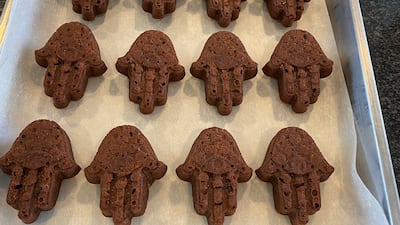
Medjool date brulee served with honey wafers. -
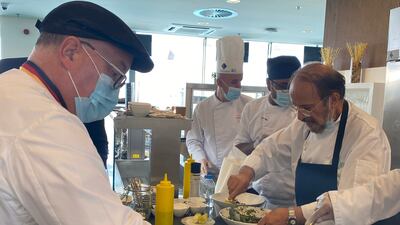
Greg Malouf describes his Abu Dhabi F1 menu as "deeply personal".


“I will basically share some of my interpretations of classic Lebanese dishes but in my own way,” he says.
“Take for example the shanklish, a dish made from leftover cheese curds that have been spiced up. I use a combination of fresh Greek feta cheese and French goat's cheese that has been strained so it’s quite thick. I then spice it up with various ingredients, including a Turkish red chilli, which, I assure you, is quite hard to find.”
Malouf’s other “elevated takes” include a fattoush salad with poached Gulf prawns and a lamb shoulder cooked for eight hours and served with porcini freekah – the latter being a roasted green grain made from durum wheat.
With so much to offer, its bittersweet that Malouf says the days of him running restaurants again – which included former Dubai outlets Zahira and Cle – are behind him.
However, some discernable UAE diners will still be able to subtly experience his creations in the future.
"I feel I have done my share of working 12 hours a day for years in restaurants and I am looking for less stress in my life," he says.
"But my work continues in that I am consulting and training staff here in the UAE and abroad.
“There is still so much to go for Lebanese and Middle Eastern food to reach its potential and getting it to a place where it truly deserves to be.”
Dh11,000 for a three-day Shams Suite pass. The Formula One Etihad Airways Abu Dhabi Grand Prix runs from Friday to Sunday, December 10 to 12; www.yasmarinacircuit.com

