To Gather Cafe: first-of-its-kind venue supports Dubai’s deaf community


Janice Rodrigues
  • English
  • Arabic

Dubai may have many food and beverage outlets, but a new venue is winning hearts thanks to its unique concept.

To Gather Cafe, which opened last month, claims to be the first cafe for deaf people in Dubai, although Ali Binhammad, one of the founders, says it is a place for all to come together. “We wanted everyone to be welcome here," he tells The National. "That’s why we named it To Gather Cafe."

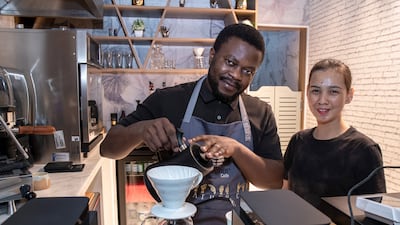
  • Mae Joaquino, right, and Rene Chi, baristas at To Gather Cafe, a hole-in-the-wall cafe that has recently opened in Meyan Mall. It says it’s the first cafe for deaf people in Dubai. All photos: Victor Besa / The National
    Mae Joaquino, right, and Rene Chi, baristas at To Gather Cafe, a hole-in-the-wall cafe that has recently opened in Meyan Mall. It says it’s the first cafe for deaf people in Dubai. All photos: Victor Besa / The National
  • Mae Joaquino, barista at To Gather Cafe. About 60 per cent of the cafe's staff members are hearing-impaired
    Mae Joaquino, barista at To Gather Cafe. About 60 per cent of the cafe's staff members are hearing-impaired
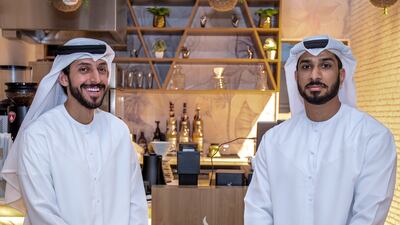
  • Ali Hassan, left, and Omar Rashid, two of four owners at To Gather Cafe
    Ali Hassan, left, and Omar Rashid, two of four owners at To Gather Cafe
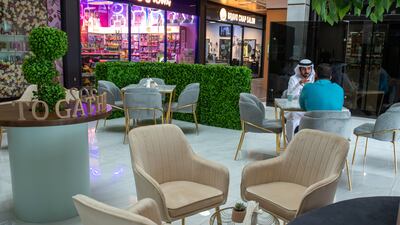
  • Inside To Gather Cafe
    Inside To Gather Cafe
  • The menu teaches customers how to use sign language so they can communicate better with servers
    The menu teaches customers how to use sign language so they can communicate better with servers
  • The cafe aims to teach customers how to interact with people who can't hear
    The cafe aims to teach customers how to interact with people who can't hear
  • At the moment, hot and cold drinks are available, as well as slices of cake
    At the moment, hot and cold drinks are available, as well as slices of cake

The hole-in-the-wall venue is located in Meyan Mall, with a posh seating area in the mall’s main lobby and the kitchen a little farther away. On the menu are a number of hot and cold drinks, from Spanish lattes and Americanos to flat whites and hot chocolate, while the V60 is a bestseller, as are the slices of cake, the flavours of which rotate every week.

It might look like any other cafe, but the uniqueness of the concept lies with its staff. To Gather Cafe primarily hires staff who are deaf; 60 per cent of employees have a hearing-impairment.

“The most important thing was giving them a job, because not a lot of other employers hire them, and that makes them feel like they are less in some way,” says Binhammad.

It is the brainchild of four Emirati entrepreneurs – Binhammad, Omar Rashed, Asma Al Bloshy and Maryam Mohammed – and Mohammed came up with the idea after seeing that it worked in other countries.

Ali Binhammad and Omar Rashed, two of the four partners behind To Gather Cafe, which recently opened in Meyan Mall in Dubai. Photo: Victor Besa / The National

At the moment, staff with a hearing-impairment are in customer-facing positions, such as waiters, but there are plans to upskill them by training them to become baristas, thus helping their employment prospects, says Binhammad.

“We’ve outsourced suppliers for the cakes for now. We won’t be making those in house for now, as we first have to train all the staff to make all the beverages first.”

A cafe with a purpose

The idea behind the cafe is bigger than simply providing employment for those in the deaf community, though. It's also about teaching customers how to interact with people who can't hear.

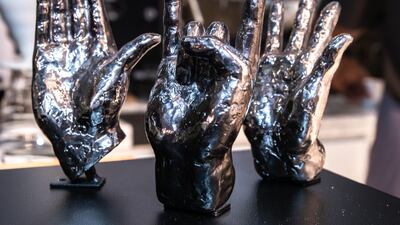
On the menu are pictures of the hand gestures used for the sign language terms for each drink, which will help people to order their beverage or baked treat from a waiter who is deaf. It also shows sign language for common phrases such as “yes”, “no”, “thank you” and “how are you?”

“There are some customers who think sign language is very hard, and we want to break this idea,” says Binhammad. It also encourages customers to interact with the staff. “You can ask them what is good, what’s a bestseller, their opinion on the drink. It’s not just about ordering and leaving.

“We first made the menu in Arabic sign language, but it caused a bit of confusion as some of our staff are trained in American Sign Language. So we are now redoing the menu so that it standardises it to American Sign Language.”

In the future, there are plans to have an animated iPad menu that shows guests how to use sign language.

Customers have to learn some sign language to order their drinks at To Gather Cafe. Photo: Victor Besa/The National.

It may have opened only a month ago, but it’s already getting rave reviews. Anonymous critic the Food Sheikh, who visited the venue recently, told The National that it’s “cute and the coffee is pretty good. There are so many coffee options in the UAE; it's refreshing to find a flat white with a higher purpose.”

Food Sheikh promoted the cafe on social media, too. “The most important one is the word ‘coffee’," he wrote in the post, going on to explain how to use sign language. "Make two fists and put one on top of the other. Think of the movement of an old coffee grinder. The bottom hand stays still while the top hand turns the crank.”

Not everyone is so quick to embrace the idea, however, Binhammad admits. “Not everyone wants to learn sign language. People are afraid of change, and we are forcing them to learn something new.”

He understands it might take time, but if the concept takes off, he hopes to increase the number of deaf staff, and hasn't ruled out the possibility of opening another branch either.

Open daily; noon-11pm; Meyan Mall, Dubai; Instagram: @togather.cafe

Mercer, the investment consulting arm of US services company Marsh & McLennan, expects its wealth division to at least double its assets under management (AUM) in the Middle East as wealth in the region continues to grow despite economic headwinds, a company official said.

Mercer Wealth, which globally has $160 billion in AUM, plans to boost its AUM in the region to $2-$3bn in the next 2-3 years from the present $1bn, said Yasir AbuShaban, a Dubai-based principal with Mercer Wealth.

Within the next two to three years, we are looking at reaching $2 to $3 billion as a conservative estimate and we do see an opportunity to do so,” said Mr AbuShaban.

Mercer does not directly make investments, but allocates clients’ money they have discretion to, to professional asset managers. They also provide advice to clients.

“We have buying power. We can negotiate on their (client’s) behalf with asset managers to provide them lower fees than they otherwise would have to get on their own,” he added.

Mercer Wealth’s clients include sovereign wealth funds, family offices, and insurance companies among others.

From its office in Dubai, Mercer also looks after Africa, India and Turkey, where they also see opportunity for growth.

Wealth creation in Middle East and Africa (MEA) grew 8.5 per cent to $8.1 trillion last year from $7.5tn in 2015, higher than last year’s global average of 6 per cent and the second-highest growth in a region after Asia-Pacific which grew 9.9 per cent, according to consultancy Boston Consulting Group (BCG). In the region, where wealth grew just 1.9 per cent in 2015 compared with 2014, a pickup in oil prices has helped in wealth generation.

BCG is forecasting MEA wealth will rise to $12tn by 2021, growing at an annual average of 8 per cent.

Drivers of wealth generation in the region will be split evenly between new wealth creation and growth of performance of existing assets, according to BCG.

Another general trend in the region is clients’ looking for a comprehensive approach to investing, according to Mr AbuShaban.

“Institutional investors or some of the families are seeing a slowdown in the available capital they have to invest and in that sense they are looking at optimizing the way they manage their portfolios and making sure they are not investing haphazardly and different parts of their investment are working together,” said Mr AbuShaban.

Some clients also have a higher appetite for risk, given the low interest-rate environment that does not provide enough yield for some institutional investors. These clients are keen to invest in illiquid assets, such as private equity and infrastructure.

“What we have seen is a desire for higher returns in what has been a low-return environment specifically in various fixed income or bonds,” he said.

“In this environment, we have seen a de facto increase in the risk that clients are taking in things like illiquid investments, private equity investments, infrastructure and private debt, those kind of investments were higher illiquidity results in incrementally higher returns.”

The Abu Dhabi Investment Authority, one of the largest sovereign wealth funds, said in its 2016 report that has gradually increased its exposure in direct private equity and private credit transactions, mainly in Asian markets and especially in China and India. The authority’s private equity department focused on structured equities owing to “their defensive characteristics.”

Updated: November 08, 2021, 9:31 AM