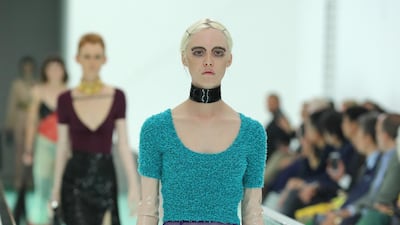
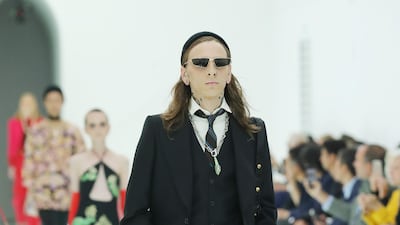
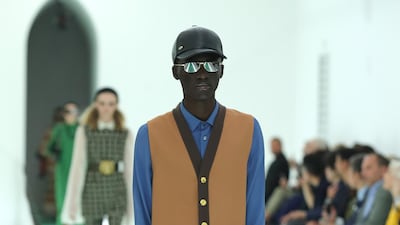
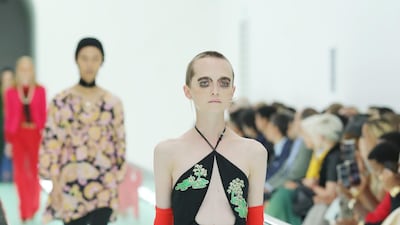
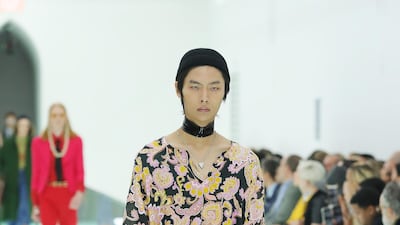
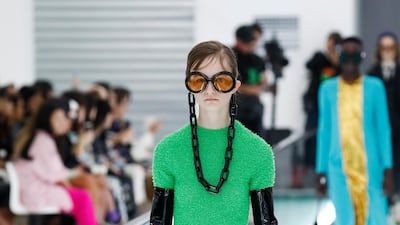
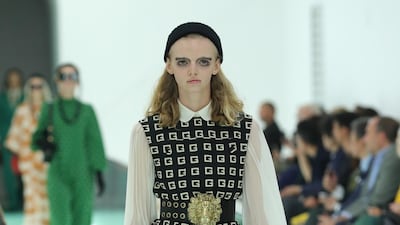
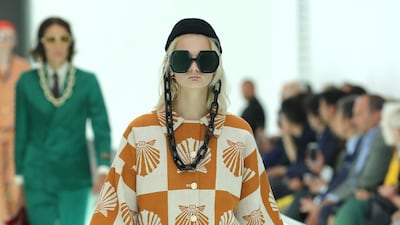
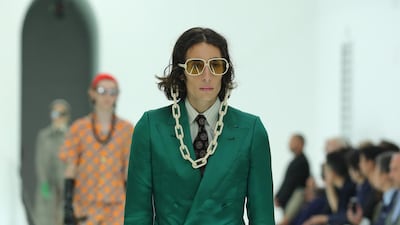
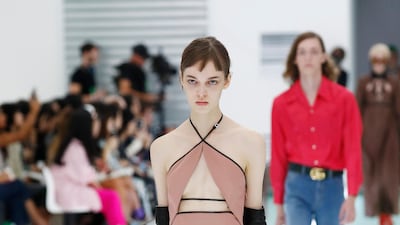
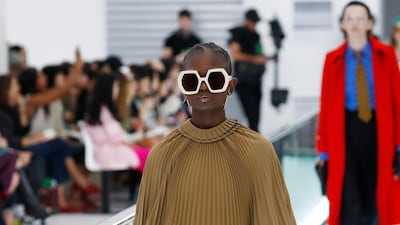
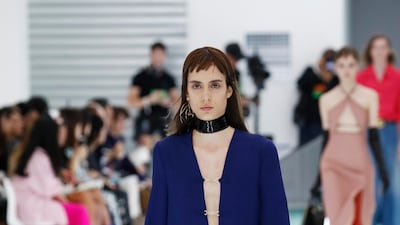
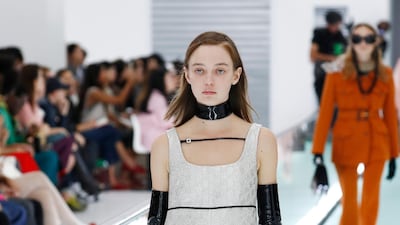
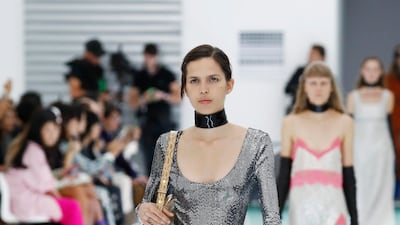
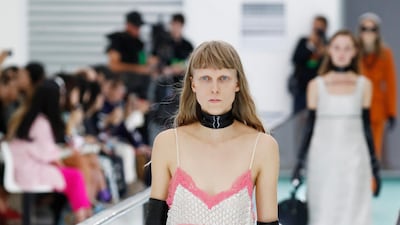
Model Ayesha Tan Jones staged a protest on the Gucci spring summer 2020 runway, with hands that read, 'Mental health is not fashion'. Getty Images

'Mental health is not fashion': Gucci's straitjacket-inspired pieces trigger runway protest


  • English
  • Arabic

Last night's Gucci spring / summer 2020 runway show in Milan saw creative director Alessandro Michele begin in an entirely new way.

Although best known for audacious colour clashing and fearless combinations of prints, Michele – once again – threw a metaphorical spanner into the works by doing the exact opposite of what we all expected.

Instead of opening with a blaze of colour sailing down the runway, the audience was instead treated to conveyor belts, down which all-white clad models glided, motionless. With belts, buckles and cuts reminiscent of straitjackets, and under glaring-white neon strip lights, it brought to mind bleak mental health institutes such as the one portrayed in Ken Kesey's One Flew Over the Cuckoo's Nest.

A model wears a straitjacket-inspired look for Gucci's spring / summer 2020 fashion show during Milan Fashion Week on Sunday, September 22, 2019 in Milan, Italy. Getty Images

One model, however, took the opportunity to protest, holding up her hands to reveal the scrawled message, "Mental health is not fashion".

Model Ayesha Tan Jones later took to social media to state that “it is in bad taste for Gucci to use the imagery of straitjackets and outfits alluding to mental patients, while being rolled out on a conveyor belt as if a piece of factory meat.”

She continued “as an artist and model who has experienced my own struggles with mental health, as well as family members and loved ones who have been affected by depression, anxiety, bipolar and schizophrenia, it is hurtful and insensitive for a major fashion house such as Gucci to use this imagery for a fleeting fashion moment.”

The brand confirmed the protest was not orchestrated by them, and immediately released a statement explaining of the opening that “uniforms, utilitarian clothes, normative dress, including straitjackets, were included in the Gucci SS20 fashion show as the most extreme version of a uniform dictated by society and those who control it.”

A model wears a straitjackets inspired look at the Gucci spring / summer 2020 fashion show during Milan Fashion Week. Getty Images

“These clothes were a statement for the fashion show and will not be sold. Alessandro Michele designed these blank-styled clothes to represent how through fashion, power is exercised over life, to eliminate self-expression," the brand continued in its statement.

"This power prescribes social norms, classifying and curbing identity. The creative director’s antidote is seen in the Gucci spring / summer 2020 lineup of 89 looks, he has designed a collection that conveys fashion as a way to allow people to walk through fields of possibilities, cultivate beauty, make diversity sacrosanct and celebrate the self in expression and identity."

That this furore comes soon after the backlash Gucci faced for appropriating turbans and selling balaclava's bordering on blackface, (which saw Gucci appoint a diversity chief to avoid such indiscretions) will be embarrassing for the brand, and is now overshadowing what was a very beautiful show.

Following the straitjackets, the venue was plunged into darkness, before the second wave of models swept past in 1970s-era two-tone split dresses, enormous glasses on even bigger chains and male models in mismatched trainers, which is surely a look that everyone will now be copying.

By Michele's standards, this show was pared-back and almost restrained, putting the focus back on the individual clothes, that included double breasted skirt suits for women, and endless new takes on the Gucci check.

It was an intelligent, well thought out collection stemming from a genuine desire by Michele to move beyond the norm and continue to challenge expectations. Sadly, that message will now be lost in the latest storm to engulf the brand.

________________

See highlights from Gucci's spring / summer 2020 show here:

________________ 

Specs

Engine: Dual-motor all-wheel-drive electric

Range: Up to 610km

Power: 905hp

Torque: 985Nm

Price: From Dh439,000

Available: Now

PAKISTAN SQUAD

Abid Ali, Fakhar Zaman, Imam-ul-Haq, Shan Masood, Azhar Ali (test captain), Babar Azam (T20 captain), Asad Shafiq, Fawad Alam, Haider Ali, Iftikhar Ahmad, Khushdil Shah, Mohammad Hafeez, Shoaib Malik, Mohammad Rizwan (wicketkeeper), Sarfaraz Ahmed (wicketkeeper), Faheem Ashraf, Haris Rauf, Imran Khan, Mohammad Abbas, Mohammad Hasnain, Naseem Shah, Shaheen Afridi, Sohail Khan, Usman Shinwari, Wahab Riaz, Imad Wasim, Kashif Bhatti, Shadab Khan and Yasir Shah. 

ALRAWABI%20SCHOOL%20FOR%20GIRLS
%3Cp%3ECreator%3A%20Tima%20Shomali%3C%2Fp%3E%0A%3Cp%3EStarring%3A%C2%A0Tara%20Abboud%2C%C2%A0Kira%20Yaghnam%2C%20Tara%20Atalla%3C%2Fp%3E%0A%3Cp%3ERating%3A%204%2F5%3C%2Fp%3E%0A
Who was Alfred Nobel?

The Nobel Prize was created by wealthy Swedish chemist and entrepreneur Alfred Nobel.

  • In his will he dictated that the bulk of his estate should be used to fund "prizes to those who, during the preceding year, have conferred the greatest benefit to humankind".
  • Nobel is best known as the inventor of dynamite, but also wrote poetry and drama and could speak Russian, French, English and German by the age of 17. The five original prize categories reflect the interests closest to his heart.
  • Nobel died in 1896 but it took until 1901, following a legal battle over his will, before the first prizes were awarded.
SPECS
%3Cp%3E%3Cstrong%3EEngine%3A%3C%2Fstrong%3E%201.5-litre%204-cylinder%3Cbr%3E%3Cstrong%3EPower%3A%3C%2Fstrong%3E%20101hp%3Cbr%3E%3Cstrong%3ETorque%3A%3C%2Fstrong%3E%20135Nm%3Cbr%3E%3Cstrong%3ETransmission%3C%2Fstrong%3E%3A%20Six-speed%20auto%3Cbr%3E%3Cstrong%3EPrice%3A%3C%2Fstrong%3E%20From%20Dh79%2C900%3Cbr%3E%3Cstrong%3EOn%20sale%3A%3C%2Fstrong%3E%20Now%3C%2Fp%3E%0A
Groom and Two Brides

Director: Elie Semaan

Starring: Abdullah Boushehri, Laila Abdallah, Lulwa Almulla

Rating: 3/5

Profile of MoneyFellows

Founder: Ahmed Wadi

Launched: 2016

Employees: 76

Financing stage: Series A ($4 million)

Investors: Partech, Sawari Ventures, 500 Startups, Dubai Angel Investors, Phoenician Fund

UAE currency: the story behind the money in your pockets
MATCH INFO

Uefa Nations League

League A, Group 4
Spain v England, 10.45pm (UAE)

Global state-owned investor ranking by size

1.

United States

2.

China

3.

UAE

4.

Japan

5

Norway

6.

Canada

7.

Singapore

8.

Australia

9.

Saudi Arabia

10.

South Korea

The specs

The specs: 2019 Audi Q8
Price, base: Dh315,000
Engine: 3.0-litre turbocharged V6
Gearbox: Eight-speed automatic
Power: 340hp @ 3,500rpm
Torque: 500Nm @ 2,250rpm
Fuel economy, combined: 6.7L / 100km
 

Moon Music

Artist: Coldplay

Label: Parlophone/Atlantic

Number of tracks: 10

Rating: 3/5

The biog

Favourite pet: cats. She has two: Eva and Bito

Favourite city: Cape Town, South Africa

Hobby: Running. "I like to think I’m artsy but I’m not".

Favourite move: Romantic comedies, specifically Return to me. "I cry every time".

Favourite spot in Abu Dhabi: Saadiyat beach

THE LIGHT

Director: Tom Tykwer

Starring: Tala Al Deen, Nicolette Krebitz, Lars Eidinger

Rating: 3/5

COMPANY%20PROFILE
%3Cp%3E%3Cstrong%3EName%3A%20%3C%2Fstrong%3EKinetic%207%3Cbr%3E%3Cstrong%3EStarted%3A%3C%2Fstrong%3E%202018%3Cbr%3E%3Cstrong%3EFounder%3A%3C%2Fstrong%3E%20Rick%20Parish%3Cbr%3E%3Cstrong%3EBased%3A%3C%2Fstrong%3E%20Abu%20Dhabi%2C%20UAE%3Cbr%3E%3Cstrong%3EIndustry%3A%3C%2Fstrong%3E%20Clean%20cooking%3Cbr%3E%3Cstrong%3EFunding%3A%3C%2Fstrong%3E%20%2410%20million%3Cbr%3E%3Cstrong%3EInvestors%3A%3C%2Fstrong%3E%20Self-funded%3C%2Fp%3E%0A
What vitamins do we know are beneficial for living in the UAE

Vitamin D: Highly relevant in the UAE due to limited sun exposure; supports bone health, immunity and mood.Vitamin B12: Important for nerve health and energy production, especially for vegetarians, vegans and individuals with absorption issues.Iron: Useful only when deficiency or anaemia is confirmed; helps reduce fatigue and support immunity.Omega-3 (EPA/DHA): Supports heart health and reduces inflammation, especially for those who consume little fish.

Mercer, the investment consulting arm of US services company Marsh & McLennan, expects its wealth division to at least double its assets under management (AUM) in the Middle East as wealth in the region continues to grow despite economic headwinds, a company official said.

Mercer Wealth, which globally has $160 billion in AUM, plans to boost its AUM in the region to $2-$3bn in the next 2-3 years from the present $1bn, said Yasir AbuShaban, a Dubai-based principal with Mercer Wealth.

Within the next two to three years, we are looking at reaching $2 to $3 billion as a conservative estimate and we do see an opportunity to do so,” said Mr AbuShaban.

Mercer does not directly make investments, but allocates clients’ money they have discretion to, to professional asset managers. They also provide advice to clients.

“We have buying power. We can negotiate on their (client’s) behalf with asset managers to provide them lower fees than they otherwise would have to get on their own,” he added.

Mercer Wealth’s clients include sovereign wealth funds, family offices, and insurance companies among others.

From its office in Dubai, Mercer also looks after Africa, India and Turkey, where they also see opportunity for growth.

Wealth creation in Middle East and Africa (MEA) grew 8.5 per cent to $8.1 trillion last year from $7.5tn in 2015, higher than last year’s global average of 6 per cent and the second-highest growth in a region after Asia-Pacific which grew 9.9 per cent, according to consultancy Boston Consulting Group (BCG). In the region, where wealth grew just 1.9 per cent in 2015 compared with 2014, a pickup in oil prices has helped in wealth generation.

BCG is forecasting MEA wealth will rise to $12tn by 2021, growing at an annual average of 8 per cent.

Drivers of wealth generation in the region will be split evenly between new wealth creation and growth of performance of existing assets, according to BCG.

Another general trend in the region is clients’ looking for a comprehensive approach to investing, according to Mr AbuShaban.

“Institutional investors or some of the families are seeing a slowdown in the available capital they have to invest and in that sense they are looking at optimizing the way they manage their portfolios and making sure they are not investing haphazardly and different parts of their investment are working together,” said Mr AbuShaban.

Some clients also have a higher appetite for risk, given the low interest-rate environment that does not provide enough yield for some institutional investors. These clients are keen to invest in illiquid assets, such as private equity and infrastructure.

“What we have seen is a desire for higher returns in what has been a low-return environment specifically in various fixed income or bonds,” he said.

“In this environment, we have seen a de facto increase in the risk that clients are taking in things like illiquid investments, private equity investments, infrastructure and private debt, those kind of investments were higher illiquidity results in incrementally higher returns.”

The Abu Dhabi Investment Authority, one of the largest sovereign wealth funds, said in its 2016 report that has gradually increased its exposure in direct private equity and private credit transactions, mainly in Asian markets and especially in China and India. The authority’s private equity department focused on structured equities owing to “their defensive characteristics.”