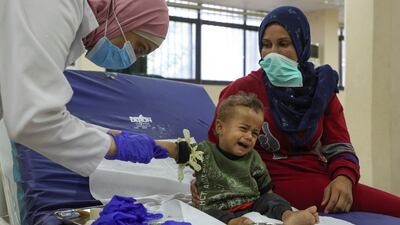
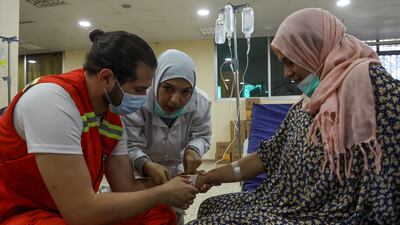
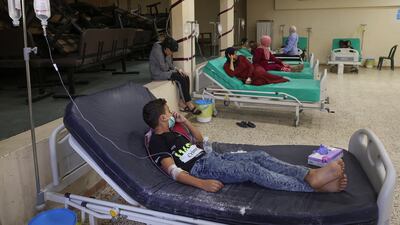
A worker disinfects a rural isolation centre where patients are being treated for cholera in Wad Al Hilu, in Sudan's eastern Kassala state. AFP

Genetic code of cholera strain mapped to discover why it's so deadly


Gillian Duncan
  • English
  • Arabic

Scientists have mapped the genetic code of a strain of cholera responsible for a devastating increase in cases in 2022, in a breakthrough hailed as a major step forward in the fight against the disease.

The research combined machine learning, genomics, genome-scale metabolic modelling and 3D structural analysis to explain why vibrio cholera is evolving in ways that makes the diarrheal disease more severe and harder to control.

Researchers in Britain and Bangladesh analysed bacterial samples from cholera patients across six Bangladeshi regions, collected between 2015 and 2021, identifying a set of unique genes and mutations present in the 2022 outbreak, when global cases more than doubled to 472,697, according to figures from the World Health Organisation.

These genetic traits are linked to the bacteria’s ability to cause severe symptoms like prolonged diarrhoea, intense abdominal pain, vomiting and dehydration, which can lead to death in severe cases.

There are between 1.3 million and 4 million cases of cholera each year worldwide. The disease can kill in hours if untreated. About one in five people experiences severe symptoms, which require rapid treatment with intravenous fluids and antibiotics. In Bangladesh, where the research was conducted, cholera is a persistent danger, with more than 100,000 cases and 4,500 deaths a year.

“By identifying the key genetic factors that drive both the transmission and severity of cholera, we've taken a significant step towards developing more effective treatments and targeted interventions,” said Tania Dottorini from the University of Nottingham. “This could save thousands of lives, not just in Bangladesh, but globally.”

The study showed that some of these disease-causing traits overlap with those that help the bacteria spread more easily, demonstrating how genetic factors enable Vibrio cholerae to survive in the human intestine, making it more resilient to environmental stress and more efficient at causing disease. Researchers said the findings also highlight the complex interactions between the bacteria's genetic make-up and its ability to cause severe illness.

By identifying genetic factors that make Vibrio cholerae more dangerous, scientists can develop better treatments and more targeted strategies to control and prevent future outbreaks. “Our findings open the door to a new era of cholera research, where we can develop tools to predict and potentially prevent severe outbreaks before they occur,” said Dr Dottorini. “The ultimate goal is to translate these insights into real-world solutions that protect vulnerable populations."

The study, which was carried out in collaboration with Bangladesh’s Institute of Epidemiology, Disease Control and Research, the International Centre for Diarrhoeal Disease Research and North South University, was published in Nature Communications.

Cholera in Lebanon – in pictures

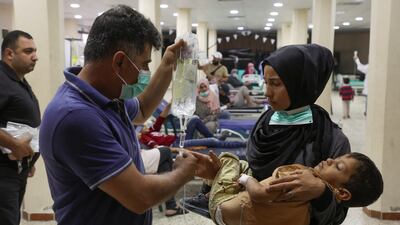
  • A health worker treats a child who is suspected of having cholera at a field hospital in Bebnine, Akkar district, northern Lebanon. All photos: Reuters
    A health worker treats a child who is suspected of having cholera at a field hospital in Bebnine, Akkar district, northern Lebanon. All photos: Reuters
  • Lebanon's Ministry of Public Health has reported 130 cases of cholera, taking the total of suspected and confirmed case to 1,225 as of October 28.
    Lebanon's Ministry of Public Health has reported 130 cases of cholera, taking the total of suspected and confirmed case to 1,225 as of October 28.
  • Confirmed cholera cases in Lebanon now stand at 371, with 16 deaths.
    Confirmed cholera cases in Lebanon now stand at 371, with 16 deaths.
  • There are 154 cases of cholera in the Lebanese town of Bebnine.
    There are 154 cases of cholera in the Lebanese town of Bebnine.
  • Lebanon's first case of cholera since 1993 was reported on October 6 in Akkar district, about 20 kilometres north of Tripoli.
    Lebanon's first case of cholera since 1993 was reported on October 6 in Akkar district, about 20 kilometres north of Tripoli.
  • Cholera is an acute diarrhoeal disease that can be treated with oral rehydration but is deadly if left untreated, according to the World Health Organisation.
    Cholera is an acute diarrhoeal disease that can be treated with oral rehydration but is deadly if left untreated, according to the World Health Organisation.
  • Cholera is spread by unsafe water and food that has been contaminated by human waste.
    Cholera is spread by unsafe water and food that has been contaminated by human waste.
  • Lebanon shares border with Syria, where cases of cholera continue to rise.
    Lebanon shares border with Syria, where cases of cholera continue to rise.
  • Syria’s cholera outbreak is likely to have started with contaminated water and food irrigated by the Euphrates River, Save the Children says.
    Syria’s cholera outbreak is likely to have started with contaminated water and food irrigated by the Euphrates River, Save the Children says.

Vibrio cholera, the bacteria that causes cholera, usually lives in warm, salty waters, like estuaries and coastal areas. There are hundreds of strains, with only two serotypes known to cause outbreaks and epidemics.

It is not known when the first cholera outbreak occurred, but one of the first detailed written accounts described a large crop of cases in 1543 in the Ganges Delta, which killed victims within eight hours of developing symptoms. Locals struggled to bury all the dead due to the high fatality rate, according to reports.

The first cholera pandemic also emerged in the Ganges Delta in 1817, from contaminated rice. There have since been six other pandemics. The seventh originated in Indonesia in 1961 and still continues, affecting mainly less developed nations.


Ziina users can donate to relief efforts in Beirut

Ziina users will be able to use the app to help relief efforts in Beirut, which has been left reeling after an August blast caused an estimated $15 billion in damage and left thousands homeless. Ziina has partnered with the United Nations High Commissioner for Refugees to raise money for the Lebanese capital, co-founder Faisal Toukan says. “As of October 1, the UNHCR has the first certified badge on Ziina and is automatically part of user's top friends' list during this campaign. Users can now donate any amount to the Beirut relief with two clicks. The money raised will go towards rebuilding houses for the families that were impacted by the explosion.”

Stage result

1. Pascal Ackermann (GER) Bora-Hansgrohe, in 3:29.09

2. Caleb Ewan (AUS) Lotto-Soudal

3. Rudy Barbier (FRA) Israel Start-Up Nation

4. Dylan Groenewegen (NED) Jumbo-Visma

5. Luka Mezgec (SLO) Mitchelton-Scott

6. Alberto Dainese (ITA) Sunweb

7. Jakub Mareczko (ITA) CCC

8. Max Walscheid (GER) NTT

9. José Rojas (ESP) Movistar

10. Andrea Vendrame (ITA) Ag2r La Mondiale, all at same time

Mercer, the investment consulting arm of US services company Marsh & McLennan, expects its wealth division to at least double its assets under management (AUM) in the Middle East as wealth in the region continues to grow despite economic headwinds, a company official said.

Mercer Wealth, which globally has $160 billion in AUM, plans to boost its AUM in the region to $2-$3bn in the next 2-3 years from the present $1bn, said Yasir AbuShaban, a Dubai-based principal with Mercer Wealth.

Within the next two to three years, we are looking at reaching $2 to $3 billion as a conservative estimate and we do see an opportunity to do so,” said Mr AbuShaban.

Mercer does not directly make investments, but allocates clients’ money they have discretion to, to professional asset managers. They also provide advice to clients.

“We have buying power. We can negotiate on their (client’s) behalf with asset managers to provide them lower fees than they otherwise would have to get on their own,” he added.

Mercer Wealth’s clients include sovereign wealth funds, family offices, and insurance companies among others.

From its office in Dubai, Mercer also looks after Africa, India and Turkey, where they also see opportunity for growth.

Wealth creation in Middle East and Africa (MEA) grew 8.5 per cent to $8.1 trillion last year from $7.5tn in 2015, higher than last year’s global average of 6 per cent and the second-highest growth in a region after Asia-Pacific which grew 9.9 per cent, according to consultancy Boston Consulting Group (BCG). In the region, where wealth grew just 1.9 per cent in 2015 compared with 2014, a pickup in oil prices has helped in wealth generation.

BCG is forecasting MEA wealth will rise to $12tn by 2021, growing at an annual average of 8 per cent.

Drivers of wealth generation in the region will be split evenly between new wealth creation and growth of performance of existing assets, according to BCG.

Another general trend in the region is clients’ looking for a comprehensive approach to investing, according to Mr AbuShaban.

“Institutional investors or some of the families are seeing a slowdown in the available capital they have to invest and in that sense they are looking at optimizing the way they manage their portfolios and making sure they are not investing haphazardly and different parts of their investment are working together,” said Mr AbuShaban.

Some clients also have a higher appetite for risk, given the low interest-rate environment that does not provide enough yield for some institutional investors. These clients are keen to invest in illiquid assets, such as private equity and infrastructure.

“What we have seen is a desire for higher returns in what has been a low-return environment specifically in various fixed income or bonds,” he said.

“In this environment, we have seen a de facto increase in the risk that clients are taking in things like illiquid investments, private equity investments, infrastructure and private debt, those kind of investments were higher illiquidity results in incrementally higher returns.”

The Abu Dhabi Investment Authority, one of the largest sovereign wealth funds, said in its 2016 report that has gradually increased its exposure in direct private equity and private credit transactions, mainly in Asian markets and especially in China and India. The authority’s private equity department focused on structured equities owing to “their defensive characteristics.”

Ferrari 12Cilindri specs

Engine: naturally aspirated 6.5-liter V12

Power: 819hp

Torque: 678Nm at 7,250rpm

Price: From Dh1,700,000

Available: Now

Result
Qualifier: Islamabad United beat Karachi Kings by eight wickets

Fixtures
Tuesday, Lahore: Eliminator 1 - Peshawar Zalmi v Quetta Gladiators
Wednesday, Lahore: Eliminator 2 – Karachi Kings v Winner of Eliminator 1
Sunday, Karachi: Final – Islamabad United v Winner of Eliminator 2

In numbers

Number of Chinese tourists coming to UAE in 2017 was... 1.3m

Alibaba’s new ‘Tech Town’  in Dubai is worth... $600m

China’s investment in the MIddle East in 2016 was... $29.5bn

The world’s most valuable start-up in 2018, TikTok, is valued at... $75bn

Boost to the UAE economy of 5G connectivity will be... $269bn 

LIGUE 1 FIXTURES

All times UAE ( 4 GMT)

Friday
Nice v Angers (9pm)
Lille v Monaco (10.45pm)

Saturday
Montpellier v Paris Saint-Germain (7pm)
Bordeaux v Guingamp (10pm)
Caen v Amiens (10pm)
Lyon v Dijon (10pm)
Metz v Troyes (10pm)

Sunday
Saint-Etienne v Rennes (5pm)
Strasbourg v Nantes (7pm)
Marseille v Toulouse (11pm)

ELIO

Starring: Yonas Kibreab, Zoe Saldana, Brad Garrett

Directors: Madeline Sharafian, Domee Shi, Adrian Molina

Rating: 4/5

MATCH INFO

Cricket World Cup League Two
Oman, UAE, Namibia
Al Amerat, Muscat
 
Results
Oman beat UAE by five wickets
UAE beat Namibia by eight runs
Namibia beat Oman by 52 runs
UAE beat Namibia by eight wickets
UAE v Oman - abandoned
Oman v Namibia - abandoned

Updated: September 23, 2024, 10:51 AM