Participants who did short bursts of light exercise at night extended their average duration of sleep, researchers found. Getty Images

Light exercise before bed may improve sleep, study finds


Gillian Duncan
  • English
  • Arabic

Short bursts of light exercise in the evening – such as walking around the house in between TV programmes – may improve sleep length, a study has found.

Experts currently recommend that people avoid intense exercise before bed because it increases both body temperature and heart rate, which can lead to poor sleep.

But the effects of light activity have not been studied as widely.

Researchers set out to discover its impact, recruiting 30 people aged 18 to 40, who clocked up more than five hours of sedentary time during the day and two hours in the evening, to do exercises such as squats and calf raises for two to three minutes, every 30 minutes.

After these activity breaks, participants slept for an additional 27 minutes on average, compared with prolonged sitting.

Jennifer Gale, of the department of human nutrition at the University of Otago in Dunedin, New Zealand, told The National the results show the activity breaks do not need to be long or intense.

“The main thing is to get up and move your body – this could be marching on the spot, walking up down a set of stairs, or dancing around the living room,” she said.

“Performing some activity to interrupt prolonged sitting is better than doing none. This does not need to be long or very intense – the key is to frequently get out of your chair and move your body.”

Each participant wore an activity tracker and spent two four-hour sessions in a laboratory environment on the same day of the week, starting in the late afternoon, separated by a minimum period of six days.

In one session participants remained seated for four hours, while in the second they did three minutes of simple resistance exercise every 30 minutes over the four-hour period. Afterwards participants returned to their normal life.

Each activity break included three rounds of three exercises: chair squats, calf raises and standing knee raises with straight leg hip extensions for 20 seconds each.

Before the experiment, participants spent an average of 7 hours 47 minutes asleep, 10 hours 31 minutes sitting down, and 4 hours 55 minutes engaged in vigorous physical activity a day.

South Korea's 'Power Nap' contest - in pictures

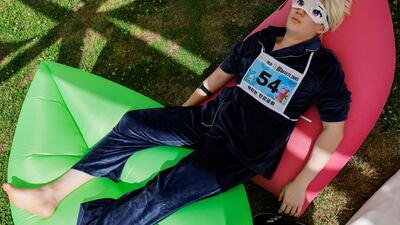
  • A participant sleeps during the 2024 Power Nap contest in Seoul, South Korea. All photos: Reuters
    A participant sleeps during the 2024 Power Nap contest in Seoul, South Korea. All photos: Reuters
  • The city held the event to help residents relax and experience the pleasure of napping outdoors, in a country that has the lowest sleep hours amont OECD countries
    The city held the event to help residents relax and experience the pleasure of napping outdoors, in a country that has the lowest sleep hours amont OECD countries
  • About 100 people, some dressed in sleepwear, gathered at the Han River Park to catch some competitive shut-eye for one hour and 30 minutes
    About 100 people, some dressed in sleepwear, gathered at the Han River Park to catch some competitive shut-eye for one hour and 30 minutes
  • Various distractions such as feather tickling, whispering and mosquito noises were used to challenge the participants
    Various distractions such as feather tickling, whispering and mosquito noises were used to challenge the participants
  • Participants stretch their legs before sleeping
    Participants stretch their legs before sleeping
  • Heart-rate measurements were taken to determine the winner - the larger the deviation between the heart rate before and during the nap, the better the sleep quality
    Heart-rate measurements were taken to determine the winner - the larger the deviation between the heart rate before and during the nap, the better the sleep quality
  • For those who took part, they are hoping that this will bring more attention to the need for better sleep habits in South Korea
    For those who took part, they are hoping that this will bring more attention to the need for better sleep habits in South Korea
  • 'Our country is known for its competitive society, and the importance of sleep seems to be undervalued,' said Son Ji-hong, 24, (not pictured) who came to the contest with a neck pillow and sunglasses.
    'Our country is known for its competitive society, and the importance of sleep seems to be undervalued,' said Son Ji-hong, 24, (not pictured) who came to the contest with a neck pillow and sunglasses.
  • According to South Korea’s National Assembly, the country records the lowest average sleep duration among OECD nations, with citizens averaging only 7 hours and 41 minutes of sleep per night, significantly lower than the OECD average of 8 hours and 22 minutes
    According to South Korea’s National Assembly, the country records the lowest average sleep duration among OECD nations, with citizens averaging only 7 hours and 41 minutes of sleep per night, significantly lower than the OECD average of 8 hours and 22 minutes
  • The awning is reflected in the sunglasses of a sleeping participant
    The awning is reflected in the sunglasses of a sleeping participant

Three out of four slept for the recommended 7 hours a night, while 21 per cent slept less than that, and 4 per cent slept longer than 9 hours.

After completing the activities, the average sleep duration was 7 hours 12 minutes, compared with 6 hours and 45 minutes after prolonged sitting.

And while the time at which participants attempted to go to sleep was more or less the same, average waking times differed. Participants woke, on average, at 7.35am after the prolonged sitting intervention and 8.06am after regular activity breaks.

And researchers found another benefit, too.

“Other research by our group and others, that also interrupted evening sitting with two to three minutes of activity every 30 minutes, found improvements in the amount of sugar in the bloodstream after a meal,” said Ms Gale.

That is important because poor sleep is associated with an increased risk of cardiometabolic disorders, such as coronary heart disease and Type 2 diabetes, said researchers.

“So from these perspectives, two to three minutes of activity, every 30 minutes, seems like a good target,” she added.

“The main thing is any interruption to sitting is better than none and this can be whatever works best for you and your household.”

Evening exercise may help improve sleep but a study from last year found that taking exercise in the morning may be the most effective way to burn fat.

Researchers found that mice that exercised in an early active phase – which corresponds to morning exercise in humans – increased their metabolism more than mice that exercised at a time when they usually rest.


THE BIO

Born: Mukalla, Yemen, 1979

Education: UAE University, Al Ain

Family: Married with two daughters: Asayel, 7, and Sara, 6

Favourite piece of music: Horse Dance by Naseer Shamma

Favourite book: Science and geology

Favourite place to travel to: Washington DC

Best advice you’ve ever been given: If you have a dream, you have to believe it, then you will see it.

Who's who in Yemen conflict

Houthis: Iran-backed rebels who occupy Sanaa and run unrecognised government

Yemeni government: Exiled government in Aden led by eight-member Presidential Leadership Council

Southern Transitional Council: Faction in Yemeni government that seeks autonomy for the south

Habrish 'rebels': Tribal-backed forces feuding with STC over control of oil in government territory

Mercer, the investment consulting arm of US services company Marsh & McLennan, expects its wealth division to at least double its assets under management (AUM) in the Middle East as wealth in the region continues to grow despite economic headwinds, a company official said.

Mercer Wealth, which globally has $160 billion in AUM, plans to boost its AUM in the region to $2-$3bn in the next 2-3 years from the present $1bn, said Yasir AbuShaban, a Dubai-based principal with Mercer Wealth.

Within the next two to three years, we are looking at reaching $2 to $3 billion as a conservative estimate and we do see an opportunity to do so,” said Mr AbuShaban.

Mercer does not directly make investments, but allocates clients’ money they have discretion to, to professional asset managers. They also provide advice to clients.

“We have buying power. We can negotiate on their (client’s) behalf with asset managers to provide them lower fees than they otherwise would have to get on their own,” he added.

Mercer Wealth’s clients include sovereign wealth funds, family offices, and insurance companies among others.

From its office in Dubai, Mercer also looks after Africa, India and Turkey, where they also see opportunity for growth.

Wealth creation in Middle East and Africa (MEA) grew 8.5 per cent to $8.1 trillion last year from $7.5tn in 2015, higher than last year’s global average of 6 per cent and the second-highest growth in a region after Asia-Pacific which grew 9.9 per cent, according to consultancy Boston Consulting Group (BCG). In the region, where wealth grew just 1.9 per cent in 2015 compared with 2014, a pickup in oil prices has helped in wealth generation.

BCG is forecasting MEA wealth will rise to $12tn by 2021, growing at an annual average of 8 per cent.

Drivers of wealth generation in the region will be split evenly between new wealth creation and growth of performance of existing assets, according to BCG.

Another general trend in the region is clients’ looking for a comprehensive approach to investing, according to Mr AbuShaban.

“Institutional investors or some of the families are seeing a slowdown in the available capital they have to invest and in that sense they are looking at optimizing the way they manage their portfolios and making sure they are not investing haphazardly and different parts of their investment are working together,” said Mr AbuShaban.

Some clients also have a higher appetite for risk, given the low interest-rate environment that does not provide enough yield for some institutional investors. These clients are keen to invest in illiquid assets, such as private equity and infrastructure.

“What we have seen is a desire for higher returns in what has been a low-return environment specifically in various fixed income or bonds,” he said.

“In this environment, we have seen a de facto increase in the risk that clients are taking in things like illiquid investments, private equity investments, infrastructure and private debt, those kind of investments were higher illiquidity results in incrementally higher returns.”

The Abu Dhabi Investment Authority, one of the largest sovereign wealth funds, said in its 2016 report that has gradually increased its exposure in direct private equity and private credit transactions, mainly in Asian markets and especially in China and India. The authority’s private equity department focused on structured equities owing to “their defensive characteristics.”

UAE%20v%20West%20Indies
%3Cp%3EFirst%20ODI%20-%20Sunday%2C%20June%204%20%0D%3Cbr%3ESecond%20ODI%20-%20Tuesday%2C%20June%206%20%0D%3Cbr%3EThird%20ODI%20-%20Friday%2C%20June%209%26nbsp%3B%3C%2Fp%3E%0A%3Cp%3EMatches%20at%20Sharjah%20Cricket%20Stadium.%20All%20games%20start%20at%204.30pm%0D%3Cbr%3E%0D%3Cbr%3E%3Cstrong%3EUAE%20squad%3C%2Fstrong%3E%0D%3Cbr%3EMuhammad%20Waseem%20(captain)%2C%20Aayan%20Khan%2C%20Adithya%20Shetty%2C%20Ali%20Naseer%2C%20Ansh%20Tandon%2C%20Aryansh%20Sharma%2C%20Asif%20Khan%2C%20Basil%20Hameed%2C%20Ethan%20D%E2%80%99Souza%2C%20Fahad%20Nawaz%2C%20Jonathan%20Figy%2C%20Junaid%20Siddique%2C%20Karthik%20Meiyappan%2C%20Lovepreet%20Singh%2C%20Matiullah%2C%20Mohammed%20Faraazuddin%2C%20Muhammad%20Jawadullah%2C%20Rameez%20Shahzad%2C%20Rohan%20Mustafa%2C%20Sanchit%20Sharma%2C%20Vriitya%20Aravind%2C%20Zahoor%20Khan%0D%3C%2Fp%3E%0A
Countries recognising Palestine

France, UK, Canada, Australia, Portugal, Belgium, Malta, Luxembourg, San Marino and Andorra


The Sand Castle

Director: Matty Brown

Stars: Nadine Labaki, Ziad Bakri, Zain Al Rafeea, Riman Al Rafeea

Rating: 2.5/5

The five pillars of Islam
Updated: July 18, 2024, 6:27 PM