• Mayra Navarrete, 13, receives the Pfizer Covid-19 vaccine from registered nurse, Noleen Nobleza at a clinic set up in the parking lot of CalOptima in Orange, California. AP
    Mayra Navarrete, 13, receives the Pfizer Covid-19 vaccine from registered nurse, Noleen Nobleza at a clinic set up in the parking lot of CalOptima in Orange, California. AP
  • Hospital workers assisted by parents administer doses of Covid-19 vaccine to children at the Lady Ridgeway Children's Hospital in Colombo, Sri Lanka. EPA
    Hospital workers assisted by parents administer doses of Covid-19 vaccine to children at the Lady Ridgeway Children's Hospital in Colombo, Sri Lanka. EPA
  • A boy receives the first dose of the Pfizer/BioNTech Covid-19 vaccine in Tegucigalpa, Honduras. AFP
    A boy receives the first dose of the Pfizer/BioNTech Covid-19 vaccine in Tegucigalpa, Honduras. AFP
  • A health worker inoculates a child with a dose of the Pfizer-BioNTech vaccine against the Covid-19 coronavirus at a children's hospital in Colombo. AFP
    A health worker inoculates a child with a dose of the Pfizer-BioNTech vaccine against the Covid-19 coronavirus at a children's hospital in Colombo. AFP
  • A woman takes a snapshot of his son after he received the first dose of the Pfizer/BioNTech Covid-19 vaccine in Tegucigalpa. AFP
    A woman takes a snapshot of his son after he received the first dose of the Pfizer/BioNTech Covid-19 vaccine in Tegucigalpa. AFP
  • A teenager receives the first dose of the Pfizer/BioNTech Covid-19 vaccine in Tegucigalpa during a vaccination programme for teens aged 12 to 15. AFP
    A teenager receives the first dose of the Pfizer/BioNTech Covid-19 vaccine in Tegucigalpa during a vaccination programme for teens aged 12 to 15. AFP
  • Doses containing Pfizer vaccines to be administered is seen ahead of the launch of the VaxuMzansi National Vaccine Day Campaign at the Gandhi Phoenix Settlement in Bhambayi township, north of Durban. AFP
    Doses containing Pfizer vaccines to be administered is seen ahead of the launch of the VaxuMzansi National Vaccine Day Campaign at the Gandhi Phoenix Settlement in Bhambayi township, north of Durban. AFP
  • A boy receives the first dose of the Pfizer/BioNTech Covid-19 vaccine in Tegucigalpa. AFP
    A boy receives the first dose of the Pfizer/BioNTech Covid-19 vaccine in Tegucigalpa. AFP
  • A health personnel prepares a dose of the Pfizer-BioNTech vaccine against the Covid-19 coronavirus at a children's hospital in Colombo. AFP
    A health personnel prepares a dose of the Pfizer-BioNTech vaccine against the Covid-19 coronavirus at a children's hospital in Colombo. AFP
  • A boy receives the first dose of the Pfizer/BioNTech Covid-19 vaccine in Tegucigalpa. AFP
    A boy receives the first dose of the Pfizer/BioNTech Covid-19 vaccine in Tegucigalpa. AFP
  • A girl receives the first dose of the Pfizer/BioNTech Covid-19 vaccine in Tegucigalpa during a vaccination programme for teens aged 12 to 15.
    A girl receives the first dose of the Pfizer/BioNTech Covid-19 vaccine in Tegucigalpa during a vaccination programme for teens aged 12 to 15.
  • A boy receives the first dose of the Pfizer/BioNTech Covid-19 vaccine in Tegucigalpa during a vaccination programme for teens aged 12 to 15. AFP
    A boy receives the first dose of the Pfizer/BioNTech Covid-19 vaccine in Tegucigalpa during a vaccination programme for teens aged 12 to 15. AFP

UK aid cuts 'body blow' to health workers


Jamie Prentis
  • English
  • Arabic

UK aid cuts are a “body blow” to front line workers tackling diseases and must be reversed when economically possible, the British parliament’s influential Foreign Affairs Select Committee has said.

In its report Global Health, Global Britain, the cross-party group of MPs said it was “only a matter of time before the next pandemic” and, as a result, the multilateral health system must be strengthened.

Earlier this year the government confirmed it would slash its annual aid budget from 0.7 per cent of gross national income to 0.5 per cent. It insists the measures are temporary and has highlighted the devastating economic impact of Covid-19.

“It is short-sighted to cut spending on neglected tropical diseases, or health research for lower-income countries, in order to focus on Covid-19,” the MPs said.

“These steps could undermine the response to Covid, and put us all at greater risk from the next pandemic. In particular, cutting spending on important medical research and development programmes is a dangerous false economy, and could endanger Global Britain’s reputation as a science superpower.”

The committee’s chairman Tom Tugendhat said the pandemic had underlined the need for global co-operation and a united response.

“The decision to cut aid to some vital health aid programmes is a step backward in global health security, and our report urges the government to reinstate this funding as soon as the fiscal situation allows,” he said.

“Strengthening global health security must be a foreign policy priority; recent cuts are a body blow to those on the front line fighting disease.”

In tackling future pandemics, the MPs said a key focus must be on bolstering health systems in the developing world. They urged the government not to allow global health security to “slide down the agenda once Covid-19 is under control in the UK".

Last year, the government announced it would integrate its foreign and development ministries to empower its international policy.

But the committee said the government was wasting the opportunity “by making ill-considered cuts to vital global health programmes".

The British government was also urged to quickly take steps to reduce vaccine inequity, which has seen poorer nations lag far behind the developed world in inoculating people.

The MPs also argued that the pandemic had exposed frailties in the multilateral health system. They argued that the World Health Organisation needed to be reformed in order to better respond to future crises.

While they praised the work of the WHO during the pandemic, the MPs said it lacks the necessary funds, power and independence.

“There is little doubt that the WHO has done vital work, with limited powers, in challenging, unprecedented circumstances,” said Mr Tugendhat.

“However, it is undeniable that the WHO is in need of serious reform. It is critical to make sure that the independence of the WHO cannot be undermined.”

The committee recommended that the UK should press for the WHO to have greater transparency and accountability in its work.

“The WHO operates in a highly political realm, and the director general, who is directly elected by member states, inevitably comes under political pressure,” the report said.

  • Tunisians over 40 were welcomed at 335 centres around the country for the vaccine.
    Tunisians over 40 were welcomed at 335 centres around the country for the vaccine.
  • The Tunisian Scouts and others volunteered to help the process go smoothly.
    The Tunisian Scouts and others volunteered to help the process go smoothly.
  • Tunisia suffered a deadly fourth wave of Covid-19 in June and July, prompting many to come for vaccines they' had previously been hesitant about.
    Tunisia suffered a deadly fourth wave of Covid-19 in June and July, prompting many to come for vaccines they' had previously been hesitant about.
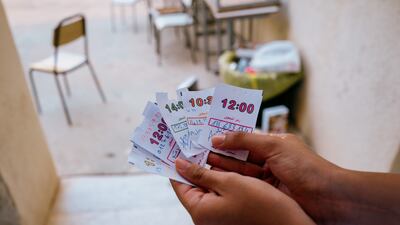
  • Each patient received a slip with their Evax confirmation number and the brand of vaccine they received, which would later be logged in government systems.
    Each patient received a slip with their Evax confirmation number and the brand of vaccine they received, which would later be logged in government systems.
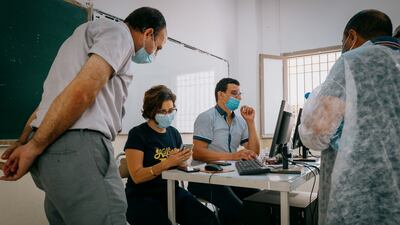
  • Spotty internet and a sluggish government system threatened to derail the drive, but resourceful volunteers found work arounds.
    Spotty internet and a sluggish government system threatened to derail the drive, but resourceful volunteers found work arounds.
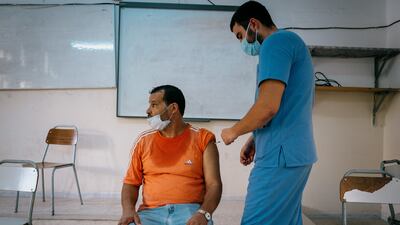
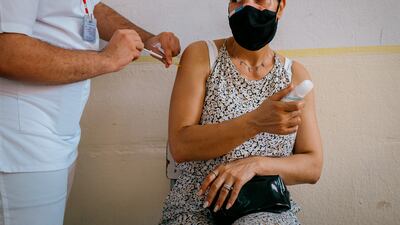
  • Nursing student Farouk Damak, 20, volunteered to administer jabs for the walk-in drive after spending the spring treating covid patients in hospital.
    Nursing student Farouk Damak, 20, volunteered to administer jabs for the walk-in drive after spending the spring treating covid patients in hospital.
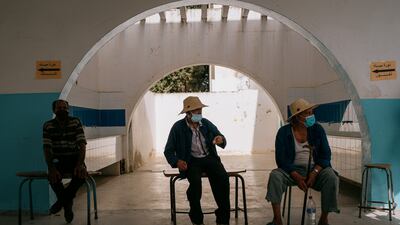
  • People rest in the shade after receiving their first dose of AstraZeneca on Sunday.
    People rest in the shade after receiving their first dose of AstraZeneca on Sunday.
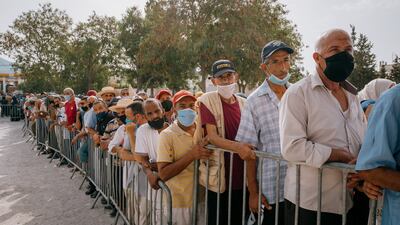
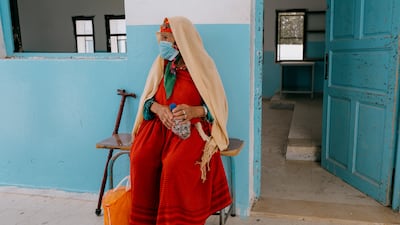
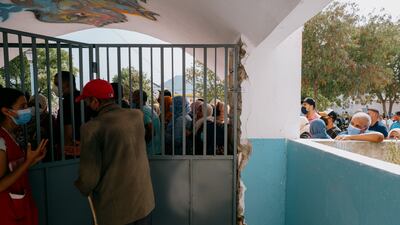
  • Hundreds of people from remote rural communities made the trek to the more than 300 walk-in vaccine centres across Tunisia.
    Hundreds of people from remote rural communities made the trek to the more than 300 walk-in vaccine centres across Tunisia.
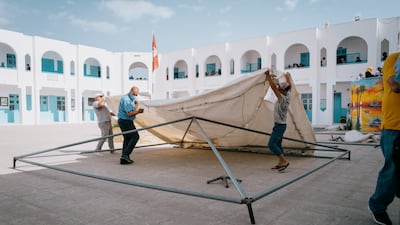
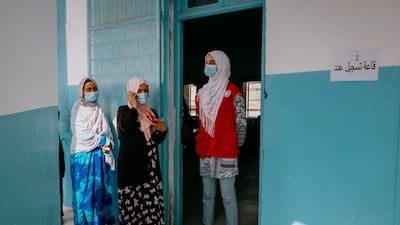
  • Volunteers from organisations including the Red Crescent and the Tunisian Scouts came together to keep vaccine centres running smoothly.
    Volunteers from organisations including the Red Crescent and the Tunisian Scouts came together to keep vaccine centres running smoothly.
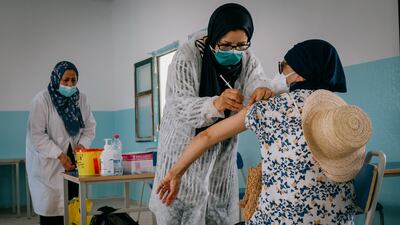
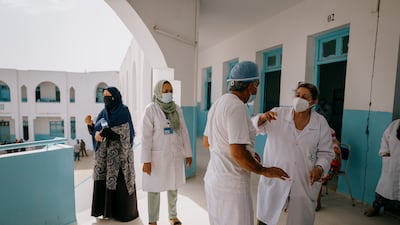
  • Nurses volunteered for the 12-hour shift, which they endured in 36° heat without air conditioning. "We have each other's backs," one of them said.
    Nurses volunteered for the 12-hour shift, which they endured in 36° heat without air conditioning. "We have each other's backs," one of them said.
  • Many of Tunisia's most vulnerable were able to receive their first jab after months of sluggish vaccination campaigns.
    Many of Tunisia's most vulnerable were able to receive their first jab after months of sluggish vaccination campaigns.
  • Technical troubles meant hundreds of people waited in the heat to get into the vaccine centre in Mornag.
    Technical troubles meant hundreds of people waited in the heat to get into the vaccine centre in Mornag.
  • A nursing student administers the coronavirus vaccine at a high school in Sfax, Tunisia, during the country's open vaccine drive.
    A nursing student administers the coronavirus vaccine at a high school in Sfax, Tunisia, during the country's open vaccine drive.
  • Ahmed Nursutlan, 78, said his family persuaded him to overcome his fear of needles to get the vaccine. "It was time," he said.
    Ahmed Nursutlan, 78, said his family persuaded him to overcome his fear of needles to get the vaccine. "It was time," he said.
  • Volunteers from the Red Crescent helped control the crowds.
    Volunteers from the Red Crescent helped control the crowds.
  • Doctors and nurses discuss another internet outtage as they wait for their patients at the vaccine centre in Mornag.
    Doctors and nurses discuss another internet outtage as they wait for their patients at the vaccine centre in Mornag.

The government “should support reforms to give the WHO more financial stability, to insulate its leadership from political pressure, and to make its operations more transparent. It should work with others to give the WHO greater powers to independently gather information on outbreaks, mirroring the work of the International Atomic Energy Agency,” it added.

The WHO was also accused of failing to hold China, where Covid-19 first emerged last year, to account over the origins of the virus.

“Our report recommends that the UK take a leading role in reforms to preserve the integrity and independence of the WHO including increasing its powers and funding,” said Mr Tugendhat.

MPs also showed support for calls to limit the director general to one term in office, which would be extended from five to seven years.

Mr Tugendhat said “Covid-19 has exposed serious flaws in how the international community responds to global health crises. The next pandemic is a matter of when, not if”.


Ten tax points to be aware of in 2026

1. Domestic VAT refund amendments: request your refund within five years

If a business does not apply for the refund on time, they lose their credit.

2. E-invoicing in the UAE

Businesses should continue preparing for the implementation of e-invoicing in the UAE, with 2026 a preparation and transition period ahead of phased mandatory adoption. 

3. More tax audits

Tax authorities are increasingly using data already available across multiple filings to identify audit risks. 

4. More beneficial VAT and excise tax penalty regime

Tax disputes are expected to become more frequent and more structured, with clearer administrative objection and appeal processes. The UAE has adopted a new penalty regime for VAT and excise disputes, which now mirrors the penalty regime for corporate tax.

5. Greater emphasis on statutory audit

There is a greater need for the accuracy of financial statements. The International Financial Reporting Standards standards need to be strictly adhered to and, as a result, the quality of the audits will need to increase.

6. Further transfer pricing enforcement

Transfer pricing enforcement, which refers to the practice of establishing prices for internal transactions between related entities, is expected to broaden in scope. The UAE will shortly open the possibility to negotiate advance pricing agreements, or essentially rulings for transfer pricing purposes. 

7. Limited time periods for audits

Recent amendments also introduce a default five-year limitation period for tax audits and assessments, subject to specific statutory exceptions. While the standard audit and assessment period is five years, this may be extended to up to 15 years in cases involving fraud or tax evasion. 

8. Pillar 2 implementation 

Many multinational groups will begin to feel the practical effect of the Domestic Minimum Top-Up Tax (DMTT), the UAE's implementation of the OECD’s global minimum tax under Pillar 2. While the rules apply for financial years starting on or after January 1, 2025, it is 2026 that marks the transition to an operational phase.

9. Reduced compliance obligations for imported goods and services

Businesses that apply the reverse-charge mechanism for VAT purposes in the UAE may benefit from reduced compliance obligations. 

10. Substance and CbC reporting focus

Tax authorities are expected to continue strengthening the enforcement of economic substance and Country-by-Country (CbC) reporting frameworks. In the UAE, these regimes are increasingly being used as risk-assessment tools, providing tax authorities with a comprehensive view of multinational groups’ global footprints and enabling them to assess whether profits are aligned with real economic activity. 

Contributed by Thomas Vanhee and Hend Rashwan, Aurifer

Labour dispute

The insured employee may still file an ILOE claim even if a labour dispute is ongoing post termination, but the insurer may suspend or reject payment, until the courts resolve the dispute, especially if the reason for termination is contested. The outcome of the labour court proceedings can directly affect eligibility.


- Abdullah Ishnaneh, Partner, BSA Law 

Updated: September 29, 2021, 11:01 PM