
Two Saudi astronauts who are heading to the International Space Station will carry out 11 science experiments, including a study of cloud seeding in microgravity.
Ali Alqarni, Rayyanah Barnawi and their two American colleagues are scheduled to launch from the Kennedy Space Centre in Florida on May 12 for a 10-day mission.
They are part of the Axiom-2 mission by Axiom Space, the second privately led trip to the orbiting laboratory by the Houston-based company.
The trip for Saudi Arabia comes nearly 40 years after the kingdom sent its first astronaut to space.
Cloud seeding research in space
One of the experiments they will carry out is to test cloud-seeding techniques in a reaction chamber.
Cloud seeding on Earth involves firing silver iodide, or salt crystals, into certain types of clouds, helping to generate rain.
“Cloud seeding has been adopted by many countries to increase precipitation in areas suffering from drought,” Axiom Space said in a statement.
“In this experiment, cloud seeding will be examined for the first time in space under microgravity conditions.
“Moist air and AgI [silver iodide] crystals will be mixed in a reaction chamber to examine the possibility of nucleation, where water vapour condenses on AgI crystals to form water droplets.
“The outcome of this experiment will help develop weather control technology to generate artificial rain in future human settlements on the Moon and Mars.”
-

Saudi astronaut Rayyanah Barnawi training for the Ax-2 mission to the International Space Station, with launch scheduled for May 22 from Florida. Photo: Axiom Space -
Saudi Arabia now has four citizens in its astronaut corps; Rayyanah Barnawi, top right; Ali Al Qarni, middle left; Mariam Fardous, middle right; and Ali Al Gamdi, bottom. Photo: Saudi Space Commission -
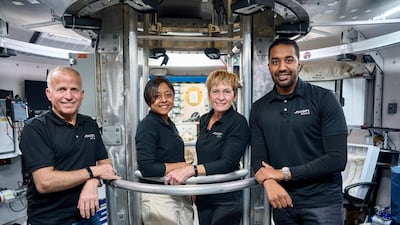
Right to left, the Ax-2 mission crew: Ali Al Qarni, Peggy Whitson, Rayyanah Barnawi and John Shoffner. Photo: Saudi Space Commission -
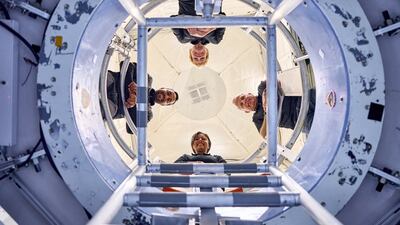
The Ax-2 crew comprises two former Nasa astronauts and Saudi Arabia's newest astronauts. Photo: Axiom Space -
Rayyanah Barnawi, set to become the first Arab female in space, and Ali Al Qarni learn about the equipment on the ISS. Photo: Axiom Space -
Rayyanah Barnawi and Ali Al Qarni. Photo: Mr Al Qarni/Twitter -
Rayyanah Barnawi and Ali Al Qarni learn how to prepare food in space. Photo: Mr Al Qarni/Twitter


Saudi Arabia’s King Fahd University of Petroleum and Minerals is sending the experiment with the help of the Saudi Space Commission and Nanoracks, a US company that helps its customers launch experiments and technology to space.
The UAE is currently leading the way in cloud-seeding efforts in the Middle East, including regular seeding flights and research.
In 2022, the Emirates conducted 311 cloud-seeding missions, clocking up close to 1,000 flying hours.
While cloud seeding could help with the Middle East’s water security, similar techniques could help future explorers create water on other planets.
As space agencies and companies plan to build settlements on the Moon and Mars, it has becoming increasingly important for scientists to create ways for astronauts to build their own resources.
Water is heavy and it would be challenging for rocket companies to deliver large amounts to space.
Studying immune cells
The Saudi astronauts will also carry out an experiment for the King Faisal Specialist Hospital and Research Centre.
It involves studying the inflammatory response of human immune cells in microgravity.
They will investigate changes in the mRNA – a genetic material that tells the body how to make proteins.
“The crew will take RNA samples for analysis on the ground, where the investigators will monitor RNA expression patterns, and thousands of mRNA half-lives will be measured,” Axiom Space said.
“Results could contribute to a better understanding of space health and uncover biomarkers or potential therapies for inflammatory diseases in space and on Earth.”
Getting pupils involved
School pupils and university students will also take part in research, including studying the differences in fluid behaviour on Earth and in microgravity.
They will be provided with ground kits by DreamUp, a company that creates low-cost access to space research for young people.
“The Stem-focused experiments are conducted in microgravity to educate students on the unique environment of the Space Station,” Axiom Space said.
“These three visual experiments will demonstrate differences in fluid behaviour on Earth and in microgravity, explore the aerodynamic behaviour of different kite shapes on the ISS, and show the effects of the vacuum of space on heat transfer.
“Students across the Kingdom of Saudi Arabia will participate in ground-based experiments on Earth.”

