



Read the latest updates on the Hajj pilgrimage here
Under the wheeling birds that fly over Makkah’s Grand Mosque, Fatma's parents circle the holy Kaaba before Hajj and pray for a miracle to save their 19-year-old daughter's life.
Imtiaz Khan, 54 and Khadija Khan, 51, haven’t told Fatma that her brain tumour is terminal. Instead, they have put their faith in prayer and hope that Hajj will bring them a miracle.
“This is our first Hajj and we are here for faith healing, from the strong faith we have in Allah. In our prayer, we ask Him for his intervention, while we perform the Hajj rituals in the presence of the Kaaba,” Imtiaz told The National.
The couple had never left Pakistan before but managed to scrape together enough money from their small greengrocers on the outskirts of Karachi to undertake the holy pilgrimage to Makkah.
Imtiaz watches Fatma drinking the holy Zamzam water drawn from the spring under the Grand Mosque and dispensed from the many electric fountains around the walls of the open yard.
Then his wife sprinkles the holy water on Fatma's face with her hand. Imtiaz's wife and daughter giggle.
“Fatma started having headaches just a month after graduating from secondary school but we did not think of anything until it got serious and she had to see doctors,” he said.
“A series of tests confirmed the cancer. We were shocked but we kept a happy face to tell her that her problem was not terminal to keep her spirit up.”
He gets up and joins his family, spreading both his arms wide and holding them close, resting his right cheek on his daughter’s head.
The small family holding each other doesn't stand out among the throng already in Makkah for the Hajj season. Like the Khans, every pilgrim has a story behind their journey to Islam’s holiest city.
But not all come looking for miracles. Some come to Makkah looking to wipe away a lifetime of sins.
-
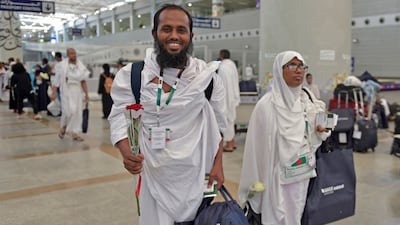
Muslim pilgrims arrive at King Abdulaziz International Airport in Jeddah. Saudi Arabia has welcomed its first batch of Hajj pilgrims from abroad since the start of the coronavirus pandemic, which prompted the authorities to impose restrictions. AFP -
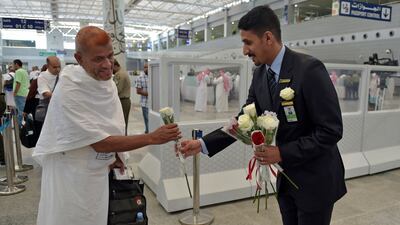
Muslim pilgrims arrive at King Abdulaziz International Airport in Jeddah. AFP -
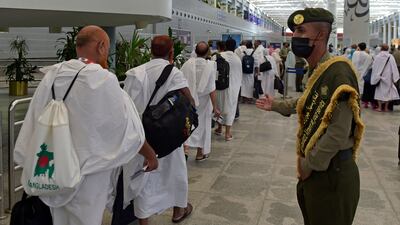
Muslim pilgrims arrive in Jeddah. AFP -

Muslim pilgrims arrive at King Abdulaziz International Airport in Saudi Arabia. AFP -

A pilgrim in Srinagar, Kashmir, is embraced by her relatives before leaving for the annual Hajj pilgrimage. AFP -

Pilgrims prepare to leave for the annual Hajj pilgrimage in Srinagar, Kashmir. AFP -
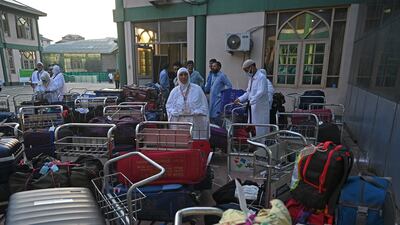
Pilgrims prepare to leave for the annual Hajj pilgrimage in Srinagar, Kashmir. AFP -
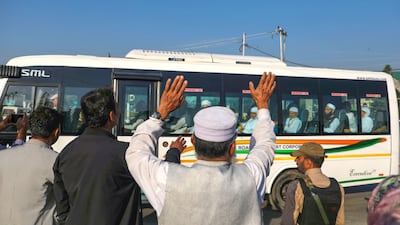
Kashmiri Muslims wave towards Hajj pilgrims as they leave for the annual pilgrimage. EPA -

Kashmiri Muslim pilgrims wave as they leave for the Hajj. EPA -
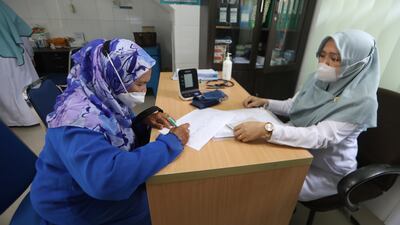
A pilgrim Banda Aceh, Indonesia, registers for a vaccination required to undertake the Hajj. EPA -
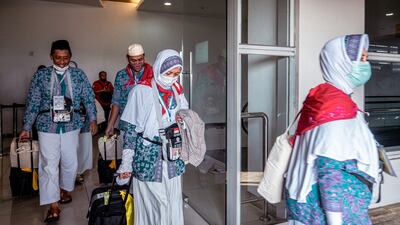
Indonesian pilgrims prepare to depart from Juanda International Airport in Surabaya. AFP -
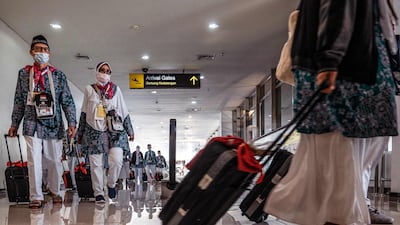
Indonesian pilgrims prepare to depart from Juanda International Airport in Surabaya. AFP


“You know what I do to clean away the grease from my body? I just apply Vaseline before I wash it all away with soap. I wish I could do the same with all of my accumulated sins committed over the years of pure ignorance,” said Nigerian car mechanic Mohammed Abeid, 61.
Mohammed owns a vehicle repair shop in Lagos. He admits that not all his business transactions have been “clean” over the years.
“I over-exaggerated the repairs so I could squeeze more money from my customers. I am not proud of it now. I am here to confess to my God and wipe the slate clean. I really hope God will forgive me,” he told The National.
Not all of the million pilgrims taking part in this year's Hajj — less than half the pre-pandemic number — are as frank about the forgiveness they seek.
“It is a secret between them and their God,” Sheikh Mohammed Al Kharoosi, an Omani Hajj mission leader, told The National.
“But we can see that from their faces and actions. Sometimes the pain of keeping it in is too much. They just cry out in the open, right here in the Grand Mosque's courtyard,” Sheikh Mohammed said, as he pointed towards an elderly man standing at a distance, facing the Kaaba and wailing, with his hands reaching to the night sky.
The Grand Mosque is a place of forgiveness and repentance and Hajj is one of the pillars of Islam for those who have the financial means to undertake the pilgrimage.
“Unfortunately, not everyone has the means to come here and repent. But I believe God listens from any corner of the world if you really ask for divine forgiveness,” Sheikh Mohammed said, as the call to prayer started.

