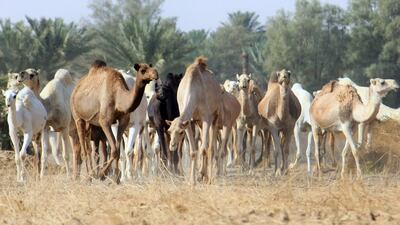
• Camels living near a petroleum plant close to the city of Al Jubail, Saudi Arabia, are affected by heavy metals, according to a new study. AFP
    Camels living near a petroleum plant close to the city of Al Jubail, Saudi Arabia, are affected by heavy metals, according to a new study. AFP
  • Traces of metals were found in the soil where the camels lived, as well as in the animals. EPA
    Traces of metals were found in the soil where the camels lived, as well as in the animals. EPA
  • Children who drink the milk of camels living within a certain radius of an oil refinery could be at risk, said the study. AFP
    Children who drink the milk of camels living within a certain radius of an oil refinery could be at risk, said the study. AFP
  • The study also showed that camels experienced tissue damage, inflammation, and liver and kidney abnormalities. Pawan Singh / The National
    The study also showed that camels experienced tissue damage, inflammation, and liver and kidney abnormalities. Pawan Singh / The National
  • Traces of heavy metals were also found in camel meat. Delores Johnson / The National
    Traces of heavy metals were also found in camel meat. Delores Johnson / The National
  • Material was also collected from camels at a site several hundred kilometres inland from Al Jubail, and from camels living roughly halfway between the two. Pawan Singh / The National
    Material was also collected from camels at a site several hundred kilometres inland from Al Jubail, and from camels living roughly halfway between the two. Pawan Singh / The National
  • Some samples were from living camels, while others were collected from animals slaughtered for human consumption. AFP
    Some samples were from living camels, while others were collected from animals slaughtered for human consumption. AFP
  • Liver and kidney tissue was examined and the greatest abnormalities were found in camels closest to the facility. Reuters
    Liver and kidney tissue was examined and the greatest abnormalities were found in camels closest to the facility. Reuters

Camels kept near oil refinery suffered organ damage, Saudi study finds


Daniel Bardsley
  • English
  • Arabic

Camels living near a petroleum plant in Saudi Arabia are susceptible to ingesting a range of heavy metals, potentially putting at risk people who consume their meat or milk, according to a new study.

The research found increased levels of lead and other heavy metals in camels that lived close to an oil-extraction depot in the east of Saudi Arabia. Similar contamination was detected in the area’s soil.

The study, by academics at King Saud University in Riyadh, Taif University and Cairo University, also showed that the camels experienced tissue damage, inflammation, and liver and kidney abnormalities.

Consumption of camel milk and meat could be a route of transmitting these heavy metals to the body of people living near the oil industry site, particularly children
Researchers

“Heavy metals were increased in the blood, milk, and meat of the camel samples collected from the site of the oil industry,” the researchers wrote in the journal Animals.

“Therefore, the consumption of camel milk and meat could be a route of transmitting these heavy metals to the body of people living near the oil industry site, particularly children who consume a large amount of milk.”

Titled “Heavy metal accumulation, tissue injury, oxidative stress, and inflammation in dromedary camels living near petroleum industry sites in Saudi Arabia,” the study looked at camels living near Al Jubail. This city on the Arabian Gulf is, the researchers said, home to the Middle East’s largest petrochemical company.

Liver and kidney tissue samples were examined under the microscope and greatest abnormalities were found in camels closest to the facility. Chris Whiteoak / The National

Material was also collected from camels at a site several hundred kilometres inland from Al Jubail, and from camels living roughly halfway between the two.

The researchers, based in Saudi Arabia, Egypt and the UK, measured levels of heavy metals in the milk, blood, muscle, liver, and kidney of camels from the three sites.

Some samples were from living camels, while others were collected from animals slaughtered for human consumption.

As well as finding elevated levels of lead in the camels and in the soil near the petroleum plant, the researchers detected larger amounts of cadmium, nickel and vanadium, all of which are heavy metals. Lead has been associated with kidney and brain damage, anaemia and weakness when ingested by humans.

A type of chemical imbalance called oxidative stress and a form of cell death named apoptosis were also more common in camels living close to the plant.

Liver and kidney tissue samples were examined under the microscope and greatest abnormalities were found in camels closest to the facility, with their liver tissue containing fat droplets and evidence of fibrosis or scarring.

“These findings may be of public interest and call attention to the assessment of the impact of the petroleum industry on the environment and the health of nearby communities,” the researchers wrote.

Dr Ulrich Wernery, scientific director of the Central Veterinary Research Laboratory (CVRL) in Dubai, who was not connected to the study, said that effects the camels suffered were probably because of the food or water they ate, rather than because of pollutants in the air.

He said he had some reservations about the research, such as a lack of detail about exactly how far from the plant the camels lived, and whether they roamed the nearby desert — where they potentially could have ingested heavy metals while browsing vegetation. However, despite his misgivings, Dr Wernery described the findings as a “nice” study.

“A plant will have emissions and it goes into the soil, that’s for sure,” Dr Wernery said.

“It can affect animals, wildlife and goats and sheep.

“I’m sure there’s an effect from the plant, there’s no doubt about it, and for other animals.”

Prof Rajiv Chowdhury, chair of the Department of Global Health at Florida International University, who has researched the effects of heavy metals, said that exposure to heavy metals, such as lead and cadmium, could increase the risk of cardiovascular disease. The risk of cancer is also increased.

“Exposure to lead, particularly in occupational cohort studies in humans, showed higher risks of brain cancer, Hodgkin’s lymphoma, lung and rectal cancers,” he said.

“Childhood lead exposure in humans has also been associated with lower cognitive function in later life.”

He said there is also evidence linking occupational exposure to cadmium to increased risk of lung cancer, while nickel compounds may be carcinogenic too.

For both lead and cadmium, Prof Chowdhury said industrial activities are a source of exposure. This is because the metals could contaminate the air and the surrounding environment, although there are numerous other sources of exposure, including water supplies.

According to Dr Wernery, the absence of large-scale petroleum plants on land in Dubai means that the issues highlighted in the paper are much less likely to affect camels in the emirate.

He said feed given to camels and other animals at the CVRL was regularly checked for heavy metals, such as lead and cadmium, but was never found to be contaminated. Much of the feed is imported from Canada or Australia, but fresh alfalfa (a flowering plant) is sourced locally.

The CVRL also tests locally made honey, which was likewise found to be free of heavy metals.

Camels still at risk of spreading MERS: in pictures

  • While the world’s attention has been focused on the coronavirus in recent years, a related pathogen -- the Middle East Respiratory Syndrome (MERS) -- has been continuing to circulate and cause deaths. Reuters
    While the world’s attention has been focused on the coronavirus in recent years, a related pathogen -- the Middle East Respiratory Syndrome (MERS) -- has been continuing to circulate and cause deaths. Reuters
  • Since the disease emerged a decade ago, there have been 2,605 confirmed cases, about 84 per cent of them in Saudi Arabia. AFP
    Since the disease emerged a decade ago, there have been 2,605 confirmed cases, about 84 per cent of them in Saudi Arabia. AFP
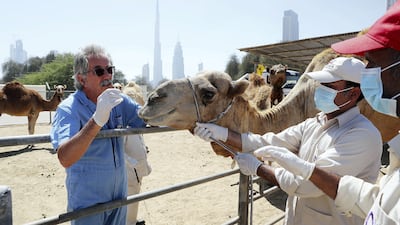
  • Ulrich Wernery, scientific director of the Central Veterinary Research Laboratory in Dubai, takes samples from a camel to assist with a study of Mers. Pawan Singh / The National
    Ulrich Wernery, scientific director of the Central Veterinary Research Laboratory in Dubai, takes samples from a camel to assist with a study of Mers. Pawan Singh / The National
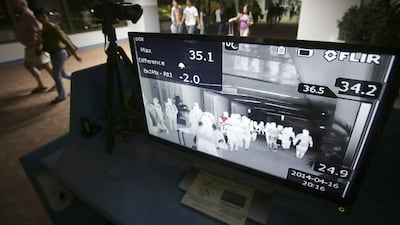
  • Passengers walk past a thermal scanner at Manila International Airport in the Philippines. The country is one of 18 that have reported cases of the MERS coronavirus. AP
    Passengers walk past a thermal scanner at Manila International Airport in the Philippines. The country is one of 18 that have reported cases of the MERS coronavirus. AP
  • Camel owners do not want to vaccinate their herd because the animals themselves do not become ill.
    Camel owners do not want to vaccinate their herd because the animals themselves do not become ill.
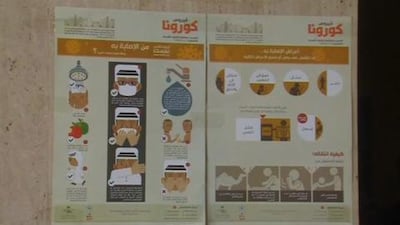
  • Saudi Arabia has urged its citizens and foreign workers to wear masks and gloves when dealing with camels. AFP
    Saudi Arabia has urged its citizens and foreign workers to wear masks and gloves when dealing with camels. AFP
  • Better hygiene and other virus control measures have helped to reduce the number of people infected with the virus from camels. Pawan Singh / The National
    Better hygiene and other virus control measures have helped to reduce the number of people infected with the virus from camels. Pawan Singh / The National
The burning issue

The internal combustion engine is facing a watershed moment – major manufacturer Volvo is to stop producing petroleum-powered vehicles by 2021 and countries in Europe, including the UK, have vowed to ban their sale before 2040. The National takes a look at the story of one of the most successful technologies of the last 100 years and how it has impacted life in the UAE.

Read part three: the age of the electric vehicle begins

Read part two: how climate change drove the race for an alternative 

Read part one: how cars came to the UAE

Election pledges on migration

CDU: "Now is the time to control the German borders and enforce strict border rejections" 

SPD: "Border closures and blanket rejections at internal borders contradict the spirit of a common area of freedom" 

BEACH SOCCER WORLD CUP

Group A

Paraguay
Japan
Switzerland
USA

Group B

Uruguay
Mexico
Italy
Tahiti

Group C

Belarus
UAE
Senegal
Russia

Group D

Brazil
Oman
Portugal
Nigeria

The years Ramadan fell in May

1987

1954

1921

1888

The Farewell

Director: Lulu Wang

Stars: Awkwafina, Zhao Shuzhen, Diana Lin, Tzi Ma

Four stars

Avatar: Fire and Ash

Director: James Cameron

Starring: Sam Worthington, Sigourney Weaver, Zoe Saldana

Rating: 4.5/5

Kandahar%20
%3Cp%3E%3Cstrong%3EDirector%3A%3C%2Fstrong%3E%20Ric%20Roman%20Waugh%3C%2Fp%3E%0A%3Cp%3E%3Cstrong%3EStars%3A%C2%A0%3C%2Fstrong%3EGerard%20Butler%2C%20Navid%20Negahban%2C%20Ali%20Fazal%3C%2Fp%3E%0A%3Cp%3E%3Cstrong%3ERating%3A%3C%2Fstrong%3E%202.5%2F5%3C%2Fp%3E%0A
Results

Catchweight 60kg: Mohammed Al Katheeri (UAE) beat Mostafa El Hamy (EGY) TKO round 3

Light Heavyweight: Ibrahim El Sawi (EGY) no contest Kevin Oumar (COM) Unintentional knee by Oumer

Catchweight 73kg:  Yazid Chouchane (ALG) beat Ahmad Al Boussairy (KUW) Unanimous decision

Featherweight: Faris Khaleel Asha (JOR) beat Yousef Al Housani (UAE) TKO in round 2 through foot injury

Welterweight: Omar Hussein (JOR) beat Yassin Najid (MAR); Split decision

Middleweight: Yousri Belgaroui (TUN) beat Sallah Eddine Dekhissi (MAR); Round-1 TKO

Lightweight: Abdullah Mohammed Ali Musalim (UAE) beat Medhat Hussein (EGY); Triangle choke submission

Welterweight: Abdulla Al Bousheiri (KUW) beat Sofiane Oudina (ALG); Triangle choke Round-1

Lightweight: Mohammad Yahya (UAE) beat Saleem Al Bakri (JOR); Unanimous decision

Bantamweight: Ali Taleb (IRQ) beat Nawras Abzakh (JOR); TKO round-2

Catchweight 63kg: Rany Saadeh (PAL) beat Abdel Ali Hariri (MAR); Unanimous decision

Key developments

All times UTC 4

Company Fact Box

Company name/date started: Abwaab Technologies / September 2019

Founders: Hamdi Tabbaa, co-founder and CEO. Hussein Alsarabi, co-founder and CTO

Based: Amman, Jordan

Sector: Education Technology

Size (employees/revenue): Total team size: 65. Full-time employees: 25. Revenue undisclosed

Stage: early-stage startup 

Investors: Adam Tech Ventures, Endure Capital, Equitrust, the World Bank-backed Innovative Startups SMEs Fund, a London investment fund, a number of former and current executives from Uber and Netflix, among others.

End of free parking

- paid-for parking will be rolled across Abu Dhabi island on August 18

- drivers will have three working weeks leeway before fines are issued

- areas that are currently free to park - around Sheikh Zayed Bridge, Maqta Bridge, Mussaffah Bridge and the Corniche - will now require a ticket

- villa residents will need a permit to park outside their home. One vehicle is Dh800 and a second is Dh1,200. 

- The penalty for failing to pay for a ticket after 10 minutes will be Dh200

- Parking on a patch of sand will incur a fine of Dh300

Updated: June 01, 2022, 4:55 AM