

Ramadan shoppers in Saudi Arabia have been assured that the cost of essential foods will remain stable during the holy month despite the impact on supply chains of higher fuel prices and a global wheat shortage arising from the war in Ukraine.
Although prices of food and beverages have edged up in recent months, there will be no shortage of basic necessities thanks to the kingdom's “multiplicity of import sources globally”, the Ministry of Environment, Water and Agriculture said last month.
The ministry said Ukraine conflict had not had any negative repercussions on the local market or on supplies due to Saudi Arabia's experience in “dealing with crises that sweep the world”.
However, despite supply chain security, the inflation rate rose to 1.6 per cent in February from 1.2 per cent the previous month — its highest level since June last year.
Food and beverage prices rose by a five-month high of 2.4 per cent in February, compared with 2 per cent in January, mainly due to a 9.7 per cent surge in vegetable prices, according to the Central Department of Statistics & Information (GSTAT).
Preparations for Ramadan — in pictures
-
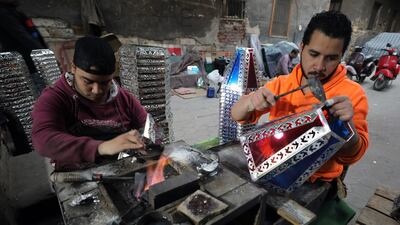
Egyptian craftsmen produce Ramadan lanterns, called fanous, at a workshop in Cairo. EPA -
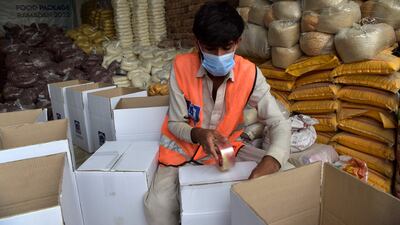
An activist of the Al Khidmat Foundation Pakistan, a non-profit organisation, packs iftar food to be sent to Afghanistan, in Peshawar, in preparation for the start of Ramadan. AFP -
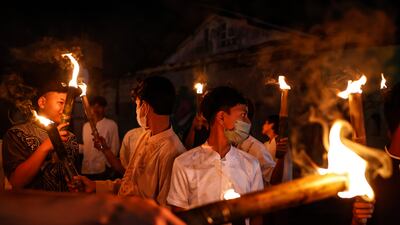
Youths hold torches at a parade to welcome the holy month in Jakarta, Indonesia. EPA -
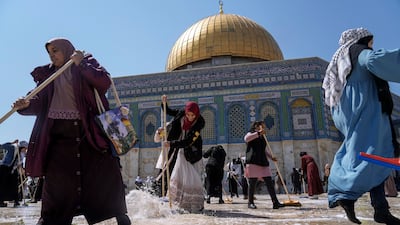
Palestinian volunteers clean the Al-Aqsa compound, in front of the Dome of Rock Mosque in Jerusalem's Old City. AP -
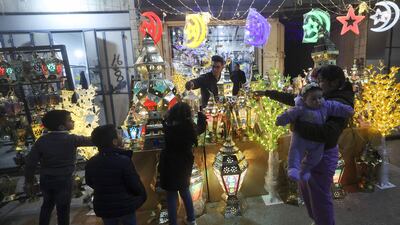
Palestinians shop for traditional 'fanous', a decoration used to celebrate the start of Ramadan, in Hebron in the occupied West Bank. AFP -
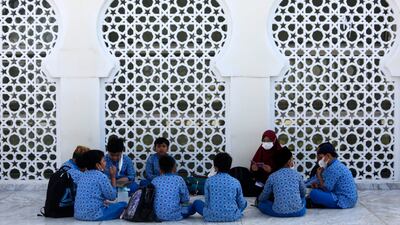
A Quran reading at Baiturrahman Grand Mosque, in Banda Aceh, Indonesia. EPA -
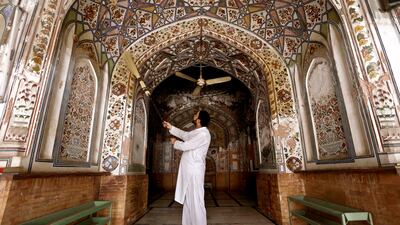
A man cleans a mosque in the run-up to Ramadan in Peshawar, Pakistan. EPA -
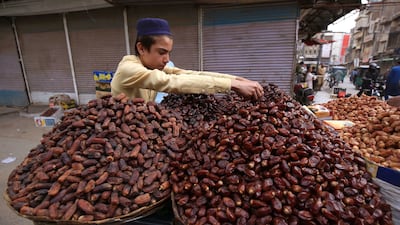
A vendor sells dates in Peshawar. EPA -

A Palestinian man tries to attract custom for his fanous in Jerusalem. AFP -

A Palestinian craftsman works on a section of an Islamic-style monument that consists of lantern and a crescent, two symbols of the Islamic holy month, in the West Bank city of Ramallah. AP -
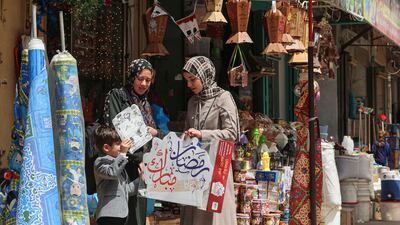
Palestinians shop at Al-Zawya old market in Gaza city in preparation for Ramadan. AFP -
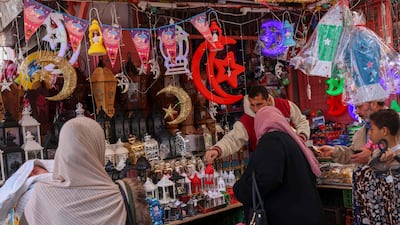
Shopping for decorations in Al-Zawya old market in Gaza city, in preparation for Ramadan. AFP -
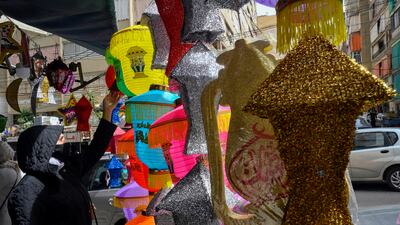
A woman buys a Ramadan decoration in Beirut. EPA -

A shopkeeper sells prayer mats in Peshawar. EPA


According to traders quoted in Saudi media, the two items that have seen biggest increase in prices before Ramadan are coffee and spices, both of which are in high demand during holy month. While spices went up by 5-6 per cent, traditional Arabic coffee rose sharply, by 30 per cent, they said.
Other Ramadan necessities, such as flour, oil and sugar, are likely to remain stable during Ramadan, supermarket manager Talal Mohammed told The National.
supermarket manager
“Supply has been good, we haven’t experienced any significant shortages or delays,” Mr Mohammed said. “We expect prices to stay stable for the entire month.”
The Saudi government has made significant attempts to control unwarranted price increases since the start of the Covid-19 pandemic in February 2020.
According to trade guidelines from the Ministry of Commerce, food prices are subject to free competition between traders and dealers. However, in cases of shortage, monopoly, or an increase in indicated prices, traders who attempt to manipulate or hide item prices or conceal stocks are subject to fines ranging from 1,000 riyals ($267) to 50,000 riyals.
The ministry has also set up an online platform and a hotline for citizens to report cases of overcharging.
Overall, shoppers preparing for Ramadan appeared to be unconcerned as they loaded up their carts.
Hanaa Al Hamdan, a mother and hospital administration employee, told The National that she felt “secure” enough to shop freely, with government protective measures in place.
“Ramadan is the worst time to try to be conservative about shopping,” she said. “Food is such a central part of the experience. I trust that the government is looking out for us, especially since this time of year is so important to everyone.”

