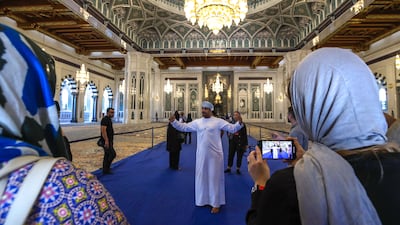
Khalifa Nasser Al Maskery, 70, has been a volunteer tour guide for the Sultan Qaboos Grand Mosque for more than 8 years now. Victor Besa /The National

Sultan Qaboos Grand Mosque connects Oman’s past and future


Ali Al Shouk
  • English
  • Arabic

Oman will mark the third anniversary of Sultan Haitham's ascension to the throne on Thursday with a national holiday.

Sultan Haitham succeeded Sultan Qaboos bin Said ― who ruled Oman for 50 years ― in January 2020.

The former ruler left a lasting legacy in the sultanate and is remembered as a moderniser who put Oman on the map as one of the fastest developing countries in the world, while still respecting its traditions.

One of the physical legacies is the Sultan Qaboos Grand Mosque in Muscat.

Sultan Haitham interacts with the people in Oman and listens to their opinions for a better future for the country and the citizens
Khalifa Al Maskery,
Omani tour guide

Built more than 20 years ago, Oman's iconic landmark stands as a symbolic bridge between the country's past and future as one of its most popular buildings.

Khalifa Al Maskery, 71, an Omani volunteer who has worked in the mosque for eight years, said that after the passing of Sultan Qaboos, people found solace in the fact that he left many lifelong memories.

“He (Sultan Qaboos) was the father figure in Oman. He taught people in the sultanate to love peace, to honour and respect themselves and others and to love their country and culture,” Mr Al Maskery told The National.

“Sultan Haitham is following the steps of the late Sultan Qaboos to make all feel secure in this beautiful country.

“Sultan Haitham interacts with the people in Oman and listens to their opinions for a better future for the country and the citizens.”

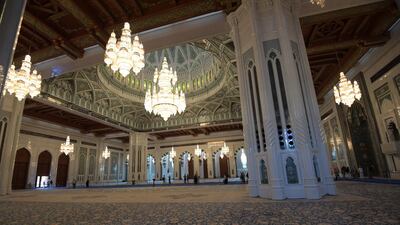
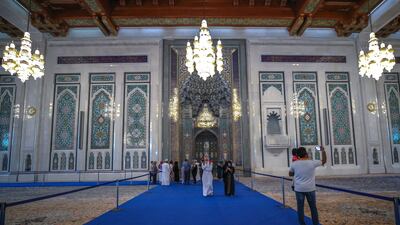
  • Since the mosque is 90m high, the chandelier looks proportional. It used to be the world's largest, before being overtaken by the one at the Sheikh Zayed Mosque in Abu Dhabi. Victor Besa / The National
    Since the mosque is 90m high, the chandelier looks proportional. It used to be the world's largest, before being overtaken by the one at the Sheikh Zayed Mosque in Abu Dhabi. Victor Besa / The National
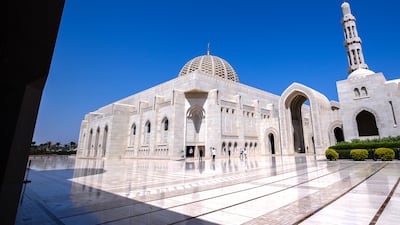
  • The Sultan Qaboos Grand Mosque in Oman's capital Muscat was completed in 2001. Victor Besa / The National
    The Sultan Qaboos Grand Mosque in Oman's capital Muscat was completed in 2001. Victor Besa / The National
  • The chandelier above the praying hall is 14 metres tall. Victor Besa / The National
    The chandelier above the praying hall is 14 metres tall. Victor Besa / The National
  • The late ruler of Oman, Sultan Qaboos, ordered the construction of the mosque in 1992. Victor Besa / The National
    The late ruler of Oman, Sultan Qaboos, ordered the construction of the mosque in 1992. Victor Besa / The National
  • During the peak winter season, more than 3,000 tourists from around the world visit the mosque each day. Victor Besa /The National
    During the peak winter season, more than 3,000 tourists from around the world visit the mosque each day. Victor Besa /The National
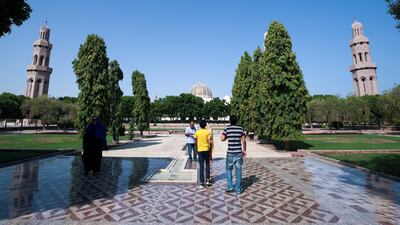
  • The mosque’s interior can hold up to 6,500 worshippers while the exterior, surrounded by beautiful gardens, can accommodate about 10,000 people. AFP
    The mosque’s interior can hold up to 6,500 worshippers while the exterior, surrounded by beautiful gardens, can accommodate about 10,000 people. AFP
  • It has a 21-tonne carpet, which was handmade in Iran. Craftswomen from that country came to place the carpet over an area of 4,263 square metres. Victor Besa / The National
    It has a 21-tonne carpet, which was handmade in Iran. Craftswomen from that country came to place the carpet over an area of 4,263 square metres. Victor Besa / The National

Sulaiman Al Amri, 30, an Omani tour guide, said Sultan Haitham has inspired citizens to build on the achievements of Sultan Qaboos.

“Oman’s vision 2040 is a road map for all aspirations,” he said.

“We have huge confidence in our leadership and we know that Oman will have a better future with this vision.

“Education and work are our only means of development within the context of our Islamic civilisation represented in this mosque.”

Representing Oman’s history

As a guide at the mosque, Mr Al Maskery speaks with hundreds of tourists every week about the beauty and history of the building.

“During the winter, we have more than 3,000 tourists per day visiting the mosque mostly from Europe, US, Japan and China,” he said.

“This mosque represents a lot of Oman’s history with its iconic carpet and huge chandelier.”

He described Sultan Qaboos Grand Mosque as an architectural and artistic marvel that reflects the beauty of Islamic, Oriental and Omani art.

Oman commissioned Swarovski, the Austrian crystal glass manufacturer, to design the chandelier.

Sulaiman Al Amri is a tour guide at the Sultan Qaboos Grand Mosque. Victor Besa / The National

Hanging from the mosque's large dome above the prayer hall, the chandelier is eight metres in diameter and 14 metres high, weighing about eight tonnes.

It has 1,000 halogen lamps surrounded by 600,000 pieces of crystal glass, which are supported by an array of gold-plated structures.

“At the time it was installed, just a few months before the grand mosque was opened in May 2001, the grandiose chandelier was the biggest in the world,” Mr Al Maskery said.

Carpet weighing 21 tonnes was brought from Iran and with Iranian women laying it on an area of 4,263 square metres.

“It contains 1,700 million knots and took 27 months to make,” he said.

“It has thousands of beautiful patterns of intricate Islamic designs beautifully woven together in great harmony.

“It is a feast for the eyes of any visitor who comes to see it.”

The mosque's square roof is surrounded by the central dome with a total height of 50 metres.

“It has five minarets that define the five pillars of Islam. The main minaret is 92 metres tall while the rest are 45 metres,” Mr Al Amri said.

The mosque has a capacity of 6,500 worshippers inside, while gardens outside can accommodate 10,000. A separate hall for women holds 4,000.


Ten tax points to be aware of in 2026

1. Domestic VAT refund amendments: request your refund within five years

If a business does not apply for the refund on time, they lose their credit.

2. E-invoicing in the UAE

Businesses should continue preparing for the implementation of e-invoicing in the UAE, with 2026 a preparation and transition period ahead of phased mandatory adoption. 

3. More tax audits

Tax authorities are increasingly using data already available across multiple filings to identify audit risks. 

4. More beneficial VAT and excise tax penalty regime

Tax disputes are expected to become more frequent and more structured, with clearer administrative objection and appeal processes. The UAE has adopted a new penalty regime for VAT and excise disputes, which now mirrors the penalty regime for corporate tax.

5. Greater emphasis on statutory audit

There is a greater need for the accuracy of financial statements. The International Financial Reporting Standards standards need to be strictly adhered to and, as a result, the quality of the audits will need to increase.

6. Further transfer pricing enforcement

Transfer pricing enforcement, which refers to the practice of establishing prices for internal transactions between related entities, is expected to broaden in scope. The UAE will shortly open the possibility to negotiate advance pricing agreements, or essentially rulings for transfer pricing purposes. 

7. Limited time periods for audits

Recent amendments also introduce a default five-year limitation period for tax audits and assessments, subject to specific statutory exceptions. While the standard audit and assessment period is five years, this may be extended to up to 15 years in cases involving fraud or tax evasion. 

8. Pillar 2 implementation 

Many multinational groups will begin to feel the practical effect of the Domestic Minimum Top-Up Tax (DMTT), the UAE's implementation of the OECD’s global minimum tax under Pillar 2. While the rules apply for financial years starting on or after January 1, 2025, it is 2026 that marks the transition to an operational phase.

9. Reduced compliance obligations for imported goods and services

Businesses that apply the reverse-charge mechanism for VAT purposes in the UAE may benefit from reduced compliance obligations. 

10. Substance and CbC reporting focus

Tax authorities are expected to continue strengthening the enforcement of economic substance and Country-by-Country (CbC) reporting frameworks. In the UAE, these regimes are increasingly being used as risk-assessment tools, providing tax authorities with a comprehensive view of multinational groups’ global footprints and enabling them to assess whether profits are aligned with real economic activity. 

Contributed by Thomas Vanhee and Hend Rashwan, Aurifer

Infiniti QX80 specs

Engine: twin-turbocharged 3.5-liter V6

Power: 450hp

Torque: 700Nm

Price: From Dh450,000, Autograph model from Dh510,000

Available: Now

Updated: January 11, 2023, 8:25 AM