


Saudi Arabia's Royal Commission for AlUla (RCU) has announced an agreement with the Louvre Museum in Paris to display a statue dating back to the Lihyan or Dadan period.
The statue, weighing more than 800 kilograms and carved from sandstone, will be displayed in the museum for five years. This comes after the RCU signed a deal on Tuesday to begin a collaboration with French museums of heritage.
The statue, which is more than two metres long and 2.3 metres high and is missing its head, dates back to the 5th and 3rd centuries BCE. It represents a rendering of a masculine figure standing upright in a frontal pose.
Experts say it most probably depicts a Lihyanite king, if not a priest or a praying figure.
The statue was unveiled in the Louvre’s hall of Oriental Antiquities.
The statue was discovered at the Dadan archaeological site in AlUla, north-west Saudi Arabia, during excavation work by teams overseen by Riyadh's King Saud University.

About 2,800 years ago, Dadan was one of the most important trade route stations of the ancient world. In about the second half of the 1st millennium BCE, the Dadan kingdom was ruled by the kings of the Lihyan tribe, who stayed in power for many centuries.
The statue was previously displayed as part of Roads of Arabia, a travelling exhibition that first appeared at Louvre Abu Dhabi from November 2018 to February 2019. The exhibition was then held in Rome, Berlin, Paris, Barcelona, St Petersburg, Houston and Tokyo.
-
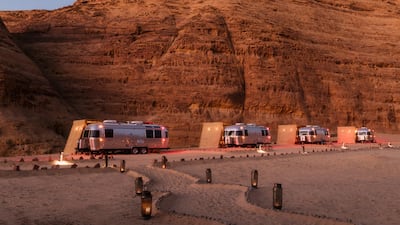
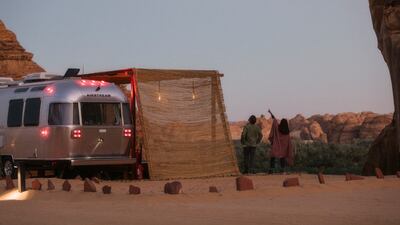
Caravan by Habitas glamping site opens in AlUla, Saudi Arabia in March. All photos: Habitas -

Carvan AlUla will be surrounded by mountains and ancient Nabatean sites. -
The eco-conscious escape is geared towards travellers seeking adventure, exploration and human connection. -

Inside an Airstream trailer at Habitas Caravan AlUla. -

The Airstream trailers will be fully equipped with lots of fun details. -

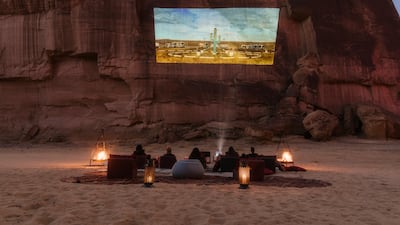
Projection screens will provide an outdoor cinema experience. -

The gathering tent at Caravan AlUla is designed as a place for guests to come together and reconnect. -
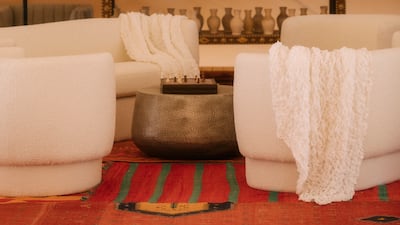
The tent is decorated with antiques and artefacts from around the kingdom. -
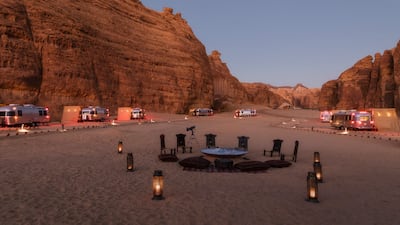
A fire pit with circular seating is the best location for stargazing. -
Each trailer comes with a private outdoor viewing deck.



