• Solar dishes can be seen behind trees at the King Abdulaziz City of Sciences and Technology. Reuters
    Solar dishes can be seen behind trees at the King Abdulaziz City of Sciences and Technology. Reuters
  • Aramco's Dhahran Research and Development Centre in Saudi Arabia's eastern region of Dhahran. AFP
    Aramco's Dhahran Research and Development Centre in Saudi Arabia's eastern region of Dhahran. AFP
  • Dr Munir El Desouki, president of King Abdul Aziz City for Science and Technology (KACST). Photo: @munireldesouki
    Dr Munir El Desouki, president of King Abdul Aziz City for Science and Technology (KACST). Photo: @munireldesouki
  • Delegates attending the fourth edition of the Future Investment Initiative (FII) conference at the capital Riyadh's Ritz-Carlton hotel in January 2021. AFP
    Delegates attending the fourth edition of the Future Investment Initiative (FII) conference at the capital Riyadh's Ritz-Carlton hotel in January 2021. AFP
  • A Saudi host addressing guests during a presentation on the Saudi Green Initiative earlier in July, which includes goals for tree-planting and reducing emissions. AFP
    A Saudi host addressing guests during a presentation on the Saudi Green Initiative earlier in July, which includes goals for tree-planting and reducing emissions. AFP
  • A beacon rises above the harbour at the King Abdullah University of Science and Technology near Jeddah. Reuters
    A beacon rises above the harbour at the King Abdullah University of Science and Technology near Jeddah. Reuters
  • Visitors test VR glasses at the Mobile World Congress 2019 in Barcelona at the Saudi Telecom Company stand. Photo: dpa
    Visitors test VR glasses at the Mobile World Congress 2019 in Barcelona at the Saudi Telecom Company stand. Photo: dpa
  • The Operations Co-ordination Centre in Dhahran in eastern Saudi Arabia. AFP
    The Operations Co-ordination Centre in Dhahran in eastern Saudi Arabia. AFP

How Saudi Arabia is investing in research and development to diversify its economy


  • English
  • Arabic

Saudi Arabia’s Crown Prince Mohammed bin Salman recently announced the national aspirations and priorities for the research, development and innovation sector to enhance the kingdom’s competitiveness and add 60 billion riyals ($16bn) to its gross domestic product by 2040.

Dr Munir El Desouki, president of King Abdul Aziz City for Science and Technology (KACST) in Riyadh, sits down with The National to explain what these plans for the RDI sector entail.

“What was announced on June 30 was a major milestone for the kingdom and all our partners around the world,” Dr El Desouki. who also heads the team setting up the Research, Development and Innovation Authority (RDIA), said.

“It sets our ambition for what we want to achieve, and innovation being our long-term goal we are targeting the year 2040 as it takes a while for plans to materialise in these kinds of sectors while building on intellectual property and talent development,” he tells The National.

The KACST supports innovation and facilitates scientific research to promote Saudi Arabia's industrial development.

The National Aspirations and Priorities for RDI initiative will entail an annual investment equivalent to 2.5 per cent of the country's GDP in 2040, creating “high-value” jobs in science and technology, and will strengthen the kingdom's position as the Arab world's biggest economy, Prince Mohammed said, according to a report by the official Saudi Press Agency (SPA).

What to expect from the Innovation Authority

RDI governance has been restructured and a supreme committee, headed by Prince Mohammed, has been formed to oversee the combined sector.

Dr El Desouki said the authority announces priorities for the kingdom to address such issues as water or food security, and selects flagship projects, moonshots which are then strategised and worked upon with partners. “We have 400 stakeholders — including Sabic, Aramco, every ministry, local and international partners — we work with all of them.”

“We work with all of them, to address what we need to work on, what should the road map look like, what to invest in — that's different sector by sector.”

The kingdom's economy in the first quarter of 2022 saw the highest rate of growth in the last 10 years amid increased activity in the oil sector, government data showed.

Prince Mohammed announced four priority areas — health and wellness; environmental sustainability and supply of essential needs; energy and industry leadership; and economies of the future.

“We developed strategies and steps to execute the policies in the right way, which led to a completely new re-governance of the sector that took place in the kingdom. This is really exciting for me and any other researcher in the kingdom,” said Dr El Desouki.

Seeking scientists from all over the world

The RDI plans rely heavily on open-innovation and science, including the launch of special programmes through the centre for special residency that will attract scientists from around the world and make it easy for them to migrate to the kingdom.

Dr El Desouki said the budget will increase tremendously towards 2040. “The research talent pool is going to need to increase by seven to eight times. That is huge.”

In 2019, Saudi Arabia launched a new programme to attract talent from around the world, whereby it grants citizenship to foreigners in fields such as science, technology and medicine, among others, to diversify its economy.

Omar Yaghi, an internationally-renowned chemist, is an example of that. Saudi Arabia granted Mr Yaghi citizenship last year.

An elected member of the National Academy of Sciences and the James and Neeltje Tretter Professor of Chemistry at the University of California, Berkeley, Mr Yaghi uses technology to harvest clean water from arid environments.

Saudi Arabia is one of the top producers of desalinated water, according to its Ministry of Environment, Water and Agriculture (MEWA).

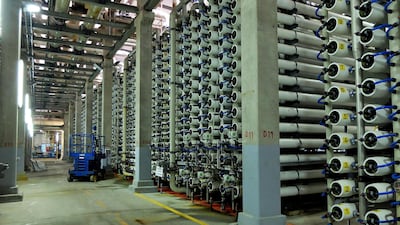
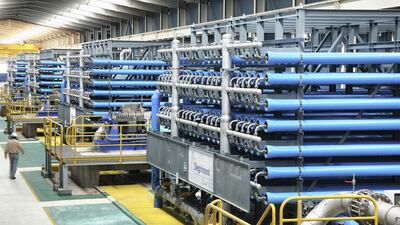
  • At a water desalination plant on the sea near the northern Israeli town of Hadera, water pumped in from the Mediterranean is pushed through rows of multi-layered plastic membranes, and through a process called reverse osmosis, emerges after 90 minutes as tasty drinking water. Quique Kierszenbaum / Tribune News Service via Getty Images
    At a water desalination plant on the sea near the northern Israeli town of Hadera, water pumped in from the Mediterranean is pushed through rows of multi-layered plastic membranes, and through a process called reverse osmosis, emerges after 90 minutes as tasty drinking water. Quique Kierszenbaum / Tribune News Service via Getty Images
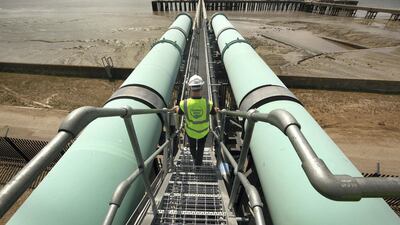
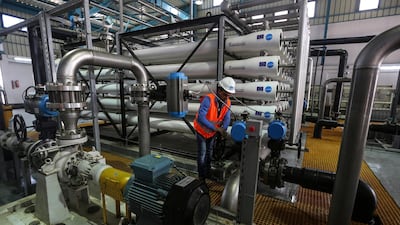
  • A worker walks between giant transfer pipes at Britain's desalination plant, the Thames Gateway Water Treatment Works, in Beckton, England. Peter Macdiarmid / Getty Images
    A worker walks between giant transfer pipes at Britain's desalination plant, the Thames Gateway Water Treatment Works, in Beckton, England. Peter Macdiarmid / Getty Images
  • This picture taken on December 11, 2019 shows a view of Jubail Desalination Plant at the Jubail Industrial City, about 95 kilometres north of Dammam in Saudi Arabia's eastern province overlooking the Gulf. AFP
    This picture taken on December 11, 2019 shows a view of Jubail Desalination Plant at the Jubail Industrial City, about 95 kilometres north of Dammam in Saudi Arabia's eastern province overlooking the Gulf. AFP
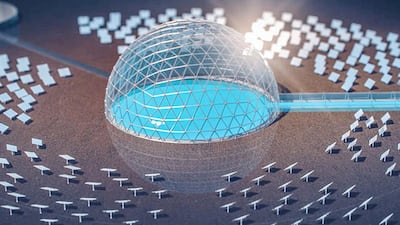
  • Concept art for the Solar Dome being planned for Saudi Arabia's new city at Neom. Solar Water PLC
    Concept art for the Solar Dome being planned for Saudi Arabia's new city at Neom. Solar Water PLC
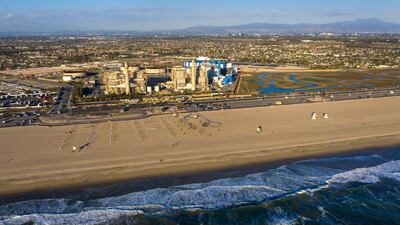
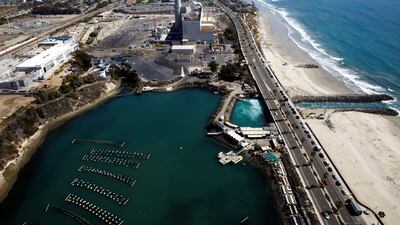
  • A view of the AES Huntington Beach Power Station and the proposed site of the Poseidon Desalination Plant in Huntington Beach, California in February, 2021. Allen J. Schaben / Los Angeles Times via Getty Images
    A view of the AES Huntington Beach Power Station and the proposed site of the Poseidon Desalination Plant in Huntington Beach, California in February, 2021. Allen J. Schaben / Los Angeles Times via Getty Images
  • The Carlsbad Desalination plant stands under construction in this aerial photograph taken over Carlsbad, California on August 2015. Patrick T Fallon / Bloomberg via Getty Images
    The Carlsbad Desalination plant stands under construction in this aerial photograph taken over Carlsbad, California on August 2015. Patrick T Fallon / Bloomberg via Getty Images
  • Water desalination plant in Antofagasta, Chile. Oliver Llaneza Hesse / Getty Images
    Water desalination plant in Antofagasta, Chile. Oliver Llaneza Hesse / Getty Images
  • A view of the European Union and Unicef funded huge seawater desalination plant opening in Deir al Balah, Gaza on January 19, 2017. Ali Jadallah / Anadolu Agency / Getty Images
    A view of the European Union and Unicef funded huge seawater desalination plant opening in Deir al Balah, Gaza on January 19, 2017. Ali Jadallah / Anadolu Agency / Getty Images
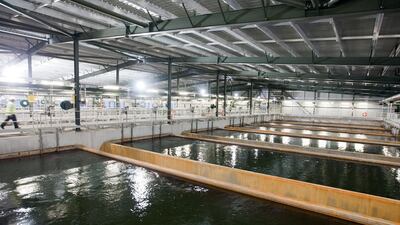
  • Saltwater flows into the pre-treatment hall at the Kurnell desalination plant, in Sydney, Australia. Bloomberg via Getty Images
    Saltwater flows into the pre-treatment hall at the Kurnell desalination plant, in Sydney, Australia. Bloomberg via Getty Images

The ministry has announced it is launching 16 more projects to develop water resources in the Riyadh region, at a cost of more than 100 million riyals. Saudi Arabia produces around 7.5 million cubic meters of desalinated water per day and is working to increase the daily production rate to 9 million cubic meters of water by 2025, according to MEWA.

“We produce it at the highest efficiency in the world, we have a world record for that. We also generated desalinated water using renewable energy- and one of the first plants that does so- in the world,” Dr El Desouki said.

“There will be a special track under the innovation policy to attract VC's, investors, potential future Nobel laureates and Omar Yaghi is one of them, among others. They're part of our family, and community.”

“We aren't constraining it to citizenship programmes, we have extended residency programmes for entrepreneurs, VCs and investors,” he added.

“One unicorn starting here or there can result in being one of the biggest tech companies in the world,” he said.

“Scientists want more than just a place with good tech or funding; they want to be in a place where innovation can take place and we aim to make Riyadh the innovation hub by launching these programmes.”

“All the challenges we are facing are global challenges, be it sustainability to food security — over 2 billion in the world don't have water- it's a global issue not just a Saudi one.

Fundamental transformation

On a personal level, Dr El Desouki is passionate about making a difference to help solve problems through technology. He said the fact that the message came from the Crown Prince sends a message to the world about how important it is to the kingdom.

“For the first time in the kingdom, we have a centre of government alignment on these kind of plans. The ministry of energy has its own plans, Neom has futuristic plans, be it Oxagon or The Line, but we need to alignment on all of them — from national or international players — to be able to solve the challenges.

“We have a subcommittee from the council of ministers that is leading the RDI upper council. This council will align everything happening on a national level. From space strategy, to Neom to other mega projects. We are fortunate that the Crown Prince himself is leading this project.”

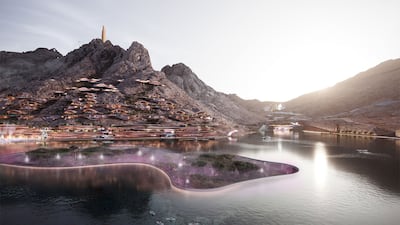
  • Trojena will open in 2026 as part of Saudi Arabia's megacity of the future. Photo: Neom
    Trojena will open in 2026 as part of Saudi Arabia's megacity of the future. Photo: Neom
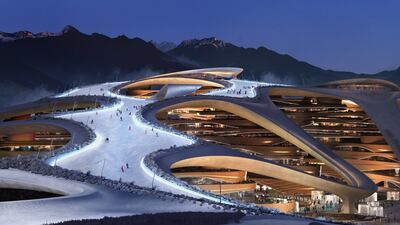
  • Trojena is designed to attract visitors, holidaymakers and winter sports enthusiasts from around the world. PA
    Trojena is designed to attract visitors, holidaymakers and winter sports enthusiasts from around the world. PA
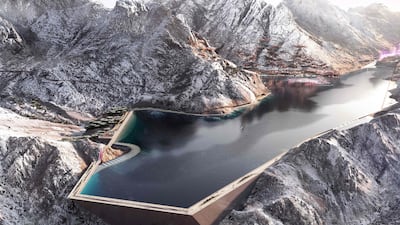
  • The design plan for Trojena, an area in Saudi Arabia's planned megacity of Neom chosen to host the 2029 Asian Winter Games. AFP
    The design plan for Trojena, an area in Saudi Arabia's planned megacity of Neom chosen to host the 2029 Asian Winter Games. AFP
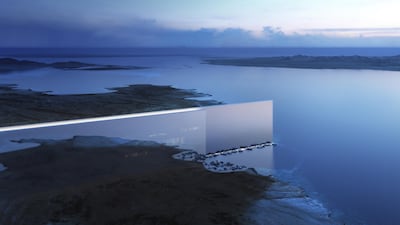
  • The Line is also being built at Neom. It will be free of cars and streets and have zero carbon emissions. Photo: Neom
    The Line is also being built at Neom. It will be free of cars and streets and have zero carbon emissions. Photo: Neom
  • Neom chief executive Nadhmi Al Nasr said The Line would make use of artificial intelligence technology to the fullest. Photo: Neom
    Neom chief executive Nadhmi Al Nasr said The Line would make use of artificial intelligence technology to the fullest. Photo: Neom
  • Neom city will be powered by clean energy, officials say. Photo: Neom
    Neom city will be powered by clean energy, officials say. Photo: Neom
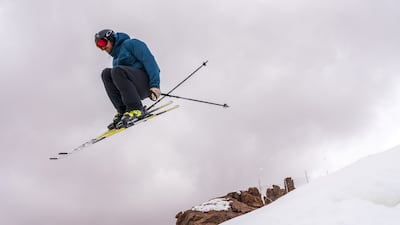
  • Trojena in Neom will host the first outdoor snow skiing destination in the GCC region. Photo: Neom
    Trojena in Neom will host the first outdoor snow skiing destination in the GCC region. Photo: Neom
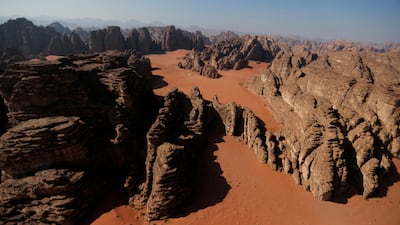
  • Neom lies in a desert bordering the Red Sea in Saudi Arabia. Reuters
    Neom lies in a desert bordering the Red Sea in Saudi Arabia. Reuters
  • Architects say Neom will be designed to make the most of its environmental surroundings. Photo: Neom
    Architects say Neom will be designed to make the most of its environmental surroundings. Photo: Neom
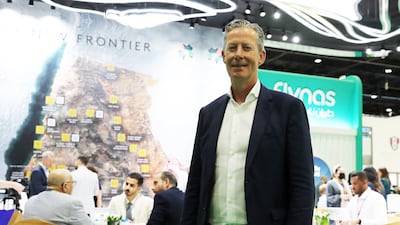
  • Andrew McEvoy, sector head for tourism at Neom, at Arabian Travel Market held at Dubai World Trade Centre. Pawan Singh / The National
    Andrew McEvoy, sector head for tourism at Neom, at Arabian Travel Market held at Dubai World Trade Centre. Pawan Singh / The National
  • The $500bn Neom project in the Tabuk Province of north-western Saudi Arabia is supported by the kingdom's Public Investment Fund. Photo: Saudi Commission for Tourism and Natural Heritage
    The $500bn Neom project in the Tabuk Province of north-western Saudi Arabia is supported by the kingdom's Public Investment Fund. Photo: Saudi Commission for Tourism and Natural Heritage

“This dedicated budget and commitment from central government was what every researcher in the kingdom was dreaming of.”

Dr El Desouki said the kingdom is aiming for a 20-year horizon.

This strategy should be announced by the end of the year, with details, he said.

He said that even though the kingdom is the leader in research in the region, it was difficult in the past to link the academia to the private sector, start-ups and SMEs.

“So the pull-side was missing and a lot of the big companies that do R&D found it easier to do it abroad. We are fixing all these policies and working with the private sector to help make it easier for them that could be giving tax backs or subsidies or incentives.”

Another addition to the kingdom's innovation transformation are the recently signed 18 agreements and memorandums of co-operation between Saudi Arabia and the US in the fields of space, investment, energy, communications and health, during President Joe Biden's visit earlier this month.

Dr El Desouki welcomed the cooperative agreements adding that “it will further enhance the kingdom’s position as an attractive environment for innovators and creators, and in line with its vision 2030 of the country.”

“We launched an incubator called The Garage — which is a deep tech incubator — the largest of its kind in the region. We are renovating an existing parking building in KACST, just like the Station F where they turned a metro station into an incubator,” he said.

“They get access to all facilities. Until its launched we have a monthly event called the Garage-disrupt. I've seen start-ups coming from UAE, Oman, Bahrain, Ukraine and Russia. We already knew it was the largest market but now people are relocating to it because of the reforms and exciting changes taking place.”


Mercer, the investment consulting arm of US services company Marsh & McLennan, expects its wealth division to at least double its assets under management (AUM) in the Middle East as wealth in the region continues to grow despite economic headwinds, a company official said.

Mercer Wealth, which globally has $160 billion in AUM, plans to boost its AUM in the region to $2-$3bn in the next 2-3 years from the present $1bn, said Yasir AbuShaban, a Dubai-based principal with Mercer Wealth.

Within the next two to three years, we are looking at reaching $2 to $3 billion as a conservative estimate and we do see an opportunity to do so,” said Mr AbuShaban.

Mercer does not directly make investments, but allocates clients’ money they have discretion to, to professional asset managers. They also provide advice to clients.

“We have buying power. We can negotiate on their (client’s) behalf with asset managers to provide them lower fees than they otherwise would have to get on their own,” he added.

Mercer Wealth’s clients include sovereign wealth funds, family offices, and insurance companies among others.

From its office in Dubai, Mercer also looks after Africa, India and Turkey, where they also see opportunity for growth.

Wealth creation in Middle East and Africa (MEA) grew 8.5 per cent to $8.1 trillion last year from $7.5tn in 2015, higher than last year’s global average of 6 per cent and the second-highest growth in a region after Asia-Pacific which grew 9.9 per cent, according to consultancy Boston Consulting Group (BCG). In the region, where wealth grew just 1.9 per cent in 2015 compared with 2014, a pickup in oil prices has helped in wealth generation.

BCG is forecasting MEA wealth will rise to $12tn by 2021, growing at an annual average of 8 per cent.

Drivers of wealth generation in the region will be split evenly between new wealth creation and growth of performance of existing assets, according to BCG.

Another general trend in the region is clients’ looking for a comprehensive approach to investing, according to Mr AbuShaban.

“Institutional investors or some of the families are seeing a slowdown in the available capital they have to invest and in that sense they are looking at optimizing the way they manage their portfolios and making sure they are not investing haphazardly and different parts of their investment are working together,” said Mr AbuShaban.

Some clients also have a higher appetite for risk, given the low interest-rate environment that does not provide enough yield for some institutional investors. These clients are keen to invest in illiquid assets, such as private equity and infrastructure.

“What we have seen is a desire for higher returns in what has been a low-return environment specifically in various fixed income or bonds,” he said.

“In this environment, we have seen a de facto increase in the risk that clients are taking in things like illiquid investments, private equity investments, infrastructure and private debt, those kind of investments were higher illiquidity results in incrementally higher returns.”

The Abu Dhabi Investment Authority, one of the largest sovereign wealth funds, said in its 2016 report that has gradually increased its exposure in direct private equity and private credit transactions, mainly in Asian markets and especially in China and India. The authority’s private equity department focused on structured equities owing to “their defensive characteristics.”

TOUR RESULTS AND FIXTURES

June 3: NZ Provincial Barbarians 7 Lions 13
June 7: Blues 22 Lions 16
June 10: Crusaders 3 Lions 12
June 13: Highlanders 23 Lions 22
June 17: Maori All Blacks 10 Lions 32
June 20: Chiefs 6 Lions 34
June 24: New Zealand 30 Lions 15 (First Test)
June 27: Hurricanes 31 Lions 31
July 1: New Zealand 21 Lions 24 (Second Test)
July 8: New Zealand v Lions (Third Test) - kick-off 11.30am (UAE)

Our legal columnist

Name: Yousef Al Bahar

Advocate at Al Bahar & Associate Advocates and Legal Consultants, established in 1994

Education: Mr Al Bahar was born in 1979 and graduated in 2008 from the Judicial Institute. He took after his father, who was one of the first Emirati lawyers

GOLF’S RAHMBO

- 5 wins in 22 months as pro
- Three wins in past 10 starts
- 45 pro starts worldwide: 5 wins, 17 top 5s
- Ranked 551th in world on debut, now No 4 (was No 2 earlier this year)
- 5th player in last 30 years to win 3 European Tour and 2 PGA Tour titles before age 24 (Woods, Garcia, McIlroy, Spieth)

12%20restaurants%20opening%20at%20the%20hotel%20this%20month
%3Cp%3EAriana%E2%80%99s%20Persian%20Kitchen%3Cbr%3EDinner%20by%20Heston%20Blumenthal%3Cbr%3EEstiatorio%20Milos%3Cbr%3EHouse%20of%20Desserts%3Cbr%3EJaleo%20by%20Jose%20Andres%3Cbr%3ELa%20Mar%3Cbr%3ELing%20Ling%3Cbr%3ELittle%20Venice%20Cake%20Company%3Cbr%3EMalibu%2090265%3Cbr%3ENobu%20by%20the%20Beach%3Cbr%3EResonance%20by%20Heston%20Blumenthal%3Cbr%3EThe%20Royal%20Tearoom%C2%A0%3C%2Fp%3E%0A
The drill

Recharge as needed, says Mat Dryden: “We try to make it a rule that every two to three months, even if it’s for four days, we get away, get some time together, recharge, refresh.” The couple take an hour a day to check into their businesses and that’s it.

Stick to the schedule, says Mike Addo: “We have an entire wall known as ‘The Lab,’ covered with colour-coded Post-it notes dedicated to our joint weekly planner, content board, marketing strategy, trends, ideas and upcoming meetings.”

Be a team, suggests Addo: “When training together, you have to trust in each other’s abilities. Otherwise working out together very quickly becomes one person training the other.”

Pull your weight, says Thuymi Do: “To do what we do, there definitely can be no lazy member of the team.” 

DUBAI%20BLING%3A%20EPISODE%201
%3Cp%3E%3Cstrong%3ECreator%3A%20%3C%2Fstrong%3ENetflix%3C%2Fp%3E%0A%3Cp%3E%3Cstrong%3EStars%3A%20%3C%2Fstrong%3EKris%20Fade%2C%20Ebraheem%20Al%20Samadi%2C%20Zeina%20Khoury%3C%2Fp%3E%0A%3Cp%3E%3Cstrong%3ERating%3A%3C%2Fstrong%3E%202%2F5%3C%2Fp%3E%0A
Updated: July 21, 2022, 4:01 AM