

US Secretary of State Antony Blinken said he hopes a UN-brokered truce in Yemen could lead to lasting peace in the country at his first meeting with Yemen’s foreign minister on Tuesday in Washington.
He stressed the importance of securing freedom of movement in disputed areas of the war-torn country and ensuring the flow of goods and services to those most in need.
Yemeni Foreign Minister Ahmed Awad bin Mubarak thanked Mr Blinken for meeting with him and reiterated that the internationally recognised government of Yemen was committed to a political solution to the conflict.
“Our position is we are always seeking peace," he said. "We did a lot, so many concessions to make peace. We respected the truce and we are very hopeful to extend this truce and start … a negotiation. We are ready for peace. The question is, are Houthis ready for that?”
Yemen’s new ruling Presidential Leadership Council has promised to work through the UN and international partners towards a political solution to the years-long conflict. It also insisted it is ready to fight to liberate the rest of the country from the Iran-backed Houthi rebels if they refuse dialogue.
Who are Yemen's Presidential Leadership Council - In pictures
-

Gen Rashad Al Alimi, pictured at Sanaa airport on June 13, 2012. AFP -

Marib Governor Sultan Al Aradah, pictured on June 7, 2016. Reuters -

Maj Gen Tariq Saleh, a nephew of former Yemeni president Ali Abdullah Saleh, pictured in Sanaa on January 10, 2011. Reuters -
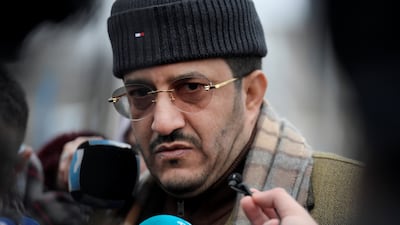
Othman Mujali, a Yemeni MP and former minister. Reuters -
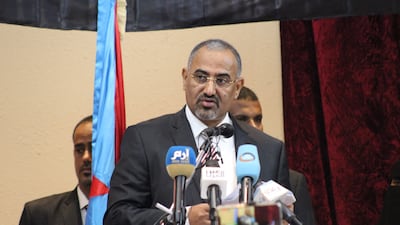
President of the Southern Transitional Council, Brig Aidrous Al Zubaidi, pictured in February 16, 2019. AFP -
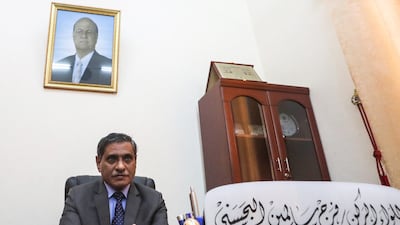
Gen Faraj Salmain Al Bahsani, governor of Hadramawt province, pictured in August 2018 at his office in Mukalla. AFP -
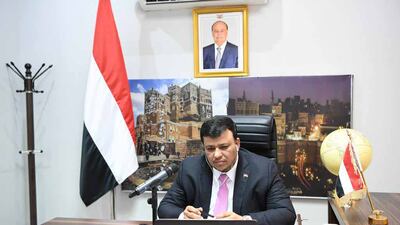
Abdullah Al Alimi Bawazeer, a senior aide to President Abdrabu Mansur Hadi. Photo: Marib Governorate


The UN has brokered the first truce in Yemen in nearly six years to ease the humanitarian crisis and pave the way for more substantive talks.
“This is an ... important opportunity for Yemen and its people,” Mr Blinken said. “After so many years of war, conflict and suffering, an opportunity for peace that we hope all Yemenis will find a way to seize."
The meeting came just days after the first commercial flight in six years took off from Yemen’s rebel-held capital. It’s part of a fragile truce in the county’s grinding civil war. The flight by national carrier Yemenia — also known as Yemen Airways — was bound for Jordan’s capital of Amman.
It had 151 passengers on board, including many patients seeking treatment abroad, according to the Houthi media office.
The flight is part of the UN-brokered, 60-day nationwide truce that began on April 2 after an agreement last month between the internationally recognised government and the Iran-backed Houthi rebels.
The truce accord called for two commercial flights a week to and from Sanaa to Jordan and Egypt. The Houthi-held Sanaa is blockaded by the Saudi-led coalition, which backs the internationally recognised government.
“We very much welcome the government’s support for the truce for the resumption now of commercial flights from Sanaa,” Mr Blinken said.
The warring parties are being urged to work towards implementing other elements of the deal, including the reopening of roads around Taiz and other provinces.
Taiz, which remains partially held by the forces fighting on behalf of the government, has been blockaded by the Houthis since 2016.
-

Yemen has been swamped by severe humanitarian problems, which have been made worse by dangers of landmines. All photos: Masam -

The country has already been ravaged by poverty, war and economic collapse and to compound matters, landmines have been laid across much of the nation in a series of conflicts and uprisings. -

The explosives have been used extensively by the Iranian-backed Houthi rebels as part of the civil war that began in 2014. -

But efforts are under way to demine Yemen, including by the Yemeni authorities and the Saudi Project for Landmine Clearance (Masam). -

The demining campaign was launched by the King Salman Humanitarian Aid and Relief Centre. -

Since 2018, Masam has been removing mines, improvised explosive devices and unexploded ordnance. -

Ousama Algosaibi, Masam’s managing director, says the task is mammoth because the number of explosive devices laid in Yemen is 'mind-boggling'. -

Mr Algosaibi says landmines have been found in villages, on agricultural land, in children’s schools and on roads leading to villages. -

Mr Algosaibi says: ‘These are all civilian areas that are now very far from any active front. I don’t understand the reason they have planted those areas with mines and IEDs.’ -

'What is the use of planting IEDs under the floor of a children’s school?' he says. 'It just doesn’t make sense.' -

'Houthis want to use that as ... a terror tool against the local population, against the local civilians' Mr Algosaibi suggests. -

The demining is carried out by 32 teams of Yemenis, who have been through comprehensive training. -

Residents may pinpoint a location where a mine cost a relative a leg or killed an animal, and operatives can often then work out the line in which others were laid. -

Metal detectors highlight the precise location of devices, which are typically collected and destroyed, hundreds at a time, in controlled explosions. -

Masam and other entities carrying out demining in Yemen are doing so while conflict continues to rage. -

Masam has cleared more than 32 million square metres and destroyed more than 335,000 explosives to date. -

Operating in a war zone magnifies the dangers to the staff and Masam has lost 28 personnel in 16 incidents. -

Half of these incidents happened during demining, such as when a mine or other device suddenly exploded or was booby trapped. -

The other eight were caused directly by the civil war, such as when drones targeted vehicles or camps.


The UN envoy met last month with the government delegation to prepare for meetings on reopening roads in Taiz and other provinces.
The Houthis have yet to name their delegation to the road-reopening meeting, raising concerns about their commitment to lifting the blockade.
"The Secretary specifically noted the importance of ensuring the freedom of movement of people and goods through contested areas, like the city of Taiz, Yemen's third-largest city, where hundreds of thousands of Yemenis are suffering," State Department spokesman, Ned Price, said in a statement.
Mr Mubarak called for more international pressure on the Houthis to start the talks on Taiz.
“Taiz is still under siege. Even the meeting about Taiz is not conducted because the Houthis didn’t nominate their names. So, we are expecting more pressure from the international community, specifically from the US administration. We want to see lift the siege. The people of Taiz, they cannot wait more. There is a window of peace. There is a moment that we all have to seize.”
Mr Blinken also said that the US would work with Yemen’s new Presidential Leadership Council to help it work for the Yemeni people and towards peace.
“The Presidential Leadership Council [must start] doing everything possible to support the needs of the Yemeni people, despite the great challenges," he said. "The United States strongly supports all of these efforts. We are with you and trying to move things forward and to take advantage of this moment.
“Again, as I say, take advantage of the fact that after so many years, there is an opening for a more durable peace, something that the United States will be a partner in and do what is necessary to help make it real.”
Yemen’s civil war erupted in 2014, when the Houthis seized the capital, Sanaa, and forced the government into exile.
The Saudi-led coalition entered the war in early 2015 at the request of the internationally recognised administration and has been trying to restore the government to power. It halted the Houthi offensive on the south, pushing them back from areas around Aden — now the de facto seat of government — and rallied pro-government militias to bolster local forces.
Since the truce agreement, the near-daily attacks on Saudi Arabia by the Houthi rebels using ballistic missiles and weaponised drones have ceased. There have also been no further attacks on the UAE after a spate of incidents in January.

