
Saudi Arabia’s embassy in Ethiopia has called on its citizens to leave the African country immediately.
The embassy asked Saudi citizens to leave “in light of the current circumstances” in Ethiopia, after fighting intensified between government forces and rebels from the northern Tigray region who could advance on the capital.
Saudis were urged to contact the embassy in case of an emergency.
The US followed suit and ordered non-emergency government employees to leave Ethiopia, its embassy in Addis Ababa said on Saturday.
“Incidents of civil unrest and ethnic violence are occurring without warning. The situation may escalate further and may cause supply chain shortages, communications blackouts and travel disruptions,” the embassy said.
‘Existential war’
Prime Minister Abiy Ahmed’s government declared a national state of emergency on Tuesday, saying it was locked in an “existential war” with forces from Tigray and their allies.
On Saturday, Mr Abiy said Ethiopia must be ready to make sacrifices to “salvage” the country.
A day earlier, nine rebel groups said they would form an alliance built around the Tigray People’s Liberation Front, which has been locked in a year-long war against government forces.
-
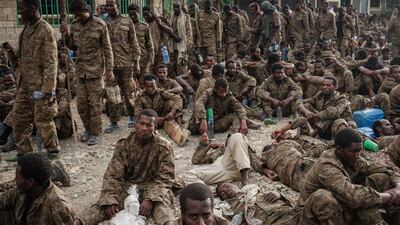
Captive Ethiopian soldiers arrive at the Mekele Rehabilitation Centre in Tigray, Ethiopia, after a four-day journey from Abdi Eshir. All photos: AFP -
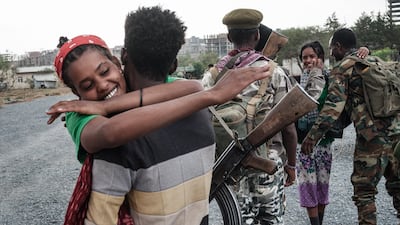
Women welcome Tigray People's Liberation Front fighters as they return to Mekele after seizing control of the city in June 2021. -
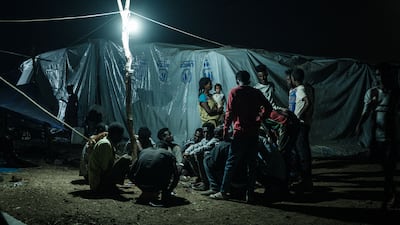
Ethiopians who fled the Tigray conflict wait to charge their phones at Um Raquba refugee camp in Gedaref, Sudan. -
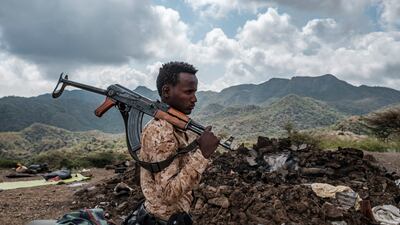
A member of the Afar Special Forces stands in front of the debris of a house on the outskirts of the village of Bisober in Tigray. -
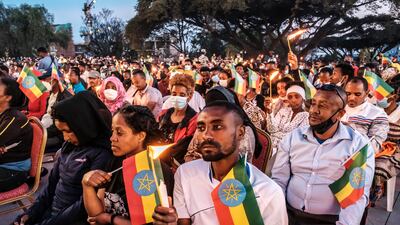
People hold candles and Ethiopian flags at a memorial service for the victims of the Tigray conflict in Addis Ababa. -

An Ethiopian refugee who fled fighting in Tigray waits behind a fence in a camp in Sudan. -
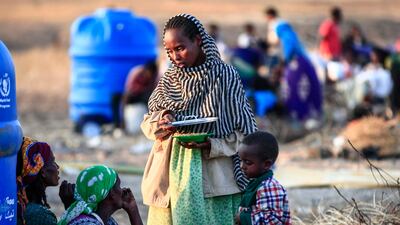
Refugees living in a camp in Sudan after fleeing violence in Tigray. -
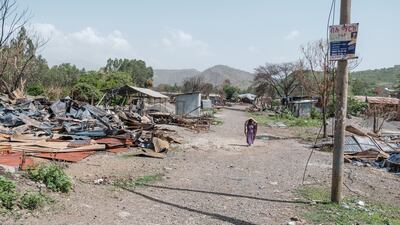
A woman walks among the remains of a destroyed factory in Ataye, Ethiopia, where more than 100 civilians died in a recent flare-up of violence. -
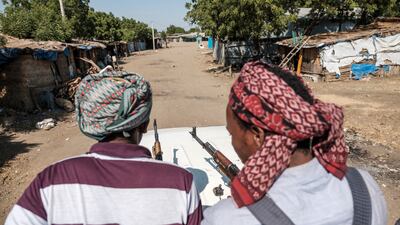
Two members of the Amhara militia ride in the back of a pick-up truck. Amharas and Tigrayans were uneasy neighbours before the current fighting, with tension over land sparking violent clashes. -

Militias from the Amhara region have been involved in the fighting in Tigray. -
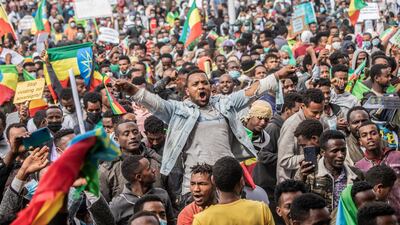
Tens of thousands of Ethiopians gather at a rally organised by the mayor of Addis Ababa to show support for the military's efforts in Tigray. -
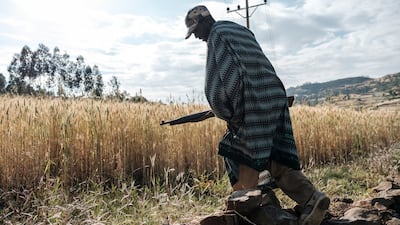
Zeleke Alabachew, farmer and militia fighter, tends to his land near the village of Tekeldengy, Ethiopia, Africa's second most populous nation. -
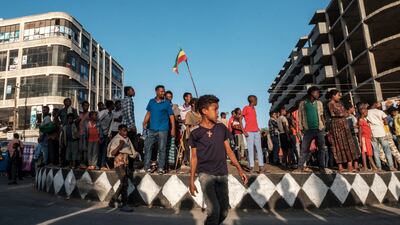
People celebrate the liberation of opposition leaders in the city of Alamata, Ethiopia. -
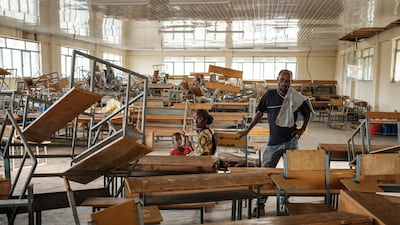
A family fleeing violence sit in a former classroom at May Weyni secondary school, now hosting 10,500 displaced people, in Mekele, capital of Tigray. -
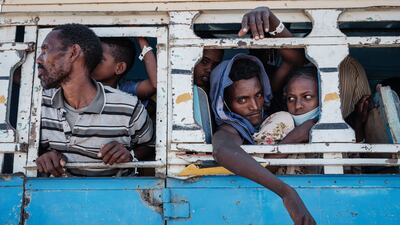
Ethiopian refugees travel to Sudan to escape violence in Tigray. -

Ethiopian refugees gather to celebrate the 46th anniversary of the Tigray People's Liberation Front at Um Raquba refugee camp in Gedaref, Sudan. The TPLF dominated Ethiopian politics before being ousted from their regional stronghold last year. -
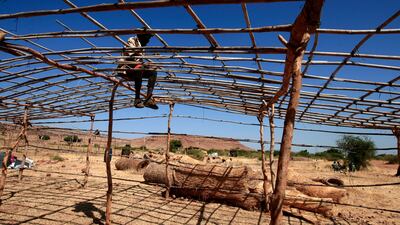
An Ethiopian refugee sets up a tent in a camp in the town of Gedaref, Sudan, after being transported from the border reception centre. -
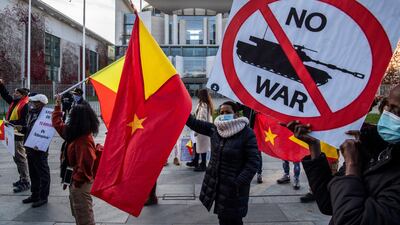
Pro-Tigrayan demonstrators display placards during a protest in front of the chancellery in Berlin. -
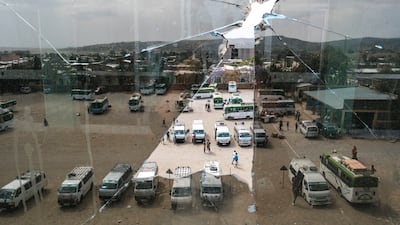
The aftermath of heavy shelling in Wukro, a city north of Mekele, in Ethiopia.
TPLF representative Berhane Gebre-Christos said the alliance aimed to “remove the regime”, as he signed the agreement in Washington.
On Saturday, Mr Abiy tweeted that “there are sacrifices to be made, but those sacrifices will salvage Ethiopia”.
“We have seen the tests and obstacles and it made us stronger. We have more allies than the people who turned their backs on us.”
Rebel advance continues
Last weekend, the TPLF said it had taken two strategic cities in the northern Amhara region, where its fighters advanced after retaking Tigray in June.
The conflict in the north of Ethiopia started a year ago when forces loyal to the TPLF seized military bases in the Tigray region.
In response, Mr Abiy sent in forces that initially drove the TPLF out of the regional capital of Mekele, but that have faced a sharp reversal in fortunes since June this year.
The US has said it is “gravely concerned” about the fighting and called for a halt to military operations in favour of ceasefire talks.
On Friday, the UN Security Council expressed alarm about the worsening conflict in Ethiopia.

Towering concerns
While you're here
Hussein Ibish: Could it be game over for Donald Trump?
Joyce Karam: Trump's campaign thrown off balance
Trump tests positive: everything we know so far
More from this package
More from Neighbourhood Watch:
While you're here
Joyce Karam: Chaotic first debate unlikely to swing undecideds
Hussein Ibish: Donald Trump's 3-step plan to cling to power
Sulaiman Hakemy: Make America lose again
In numbers
- Number of children under five will fall from 681 million in 2017 to 401m in 2100
- Over-80s will rise from 141m in 2017 to 866m in 2100
- Nigeria will become the world’s second most populous country with 791m by 2100, behind India
- China will fall dramatically from a peak of 2.4 billion in 2024 to 732 million by 2100
- an average of 2.1 children per woman is required to sustain population growth
Why it pays to compare
A comparison of sending Dh20,000 from the UAE using two different routes at the same time - the first direct from a UAE bank to a bank in Germany, and the second from the same UAE bank via an online platform to Germany - found key differences in cost and speed. The transfers were both initiated on January 30.
Route 1: bank transfer
The UAE bank charged Dh152.25 for the Dh20,000 transfer. On top of that, their exchange rate margin added a difference of around Dh415, compared with the mid-market rate.
Total cost: Dh567.25 - around 2.9 per cent of the total amount
Total received: €4,670.30
Route 2: online platform
The UAE bank’s charge for sending Dh20,000 to a UK dirham-denominated account was Dh2.10. The exchange rate margin cost was Dh60, plus a Dh12 fee.
Total cost: Dh74.10, around 0.4 per cent of the transaction
Total received: €4,756
The UAE bank transfer was far quicker – around two to three working days, while the online platform took around four to five days, but was considerably cheaper. In the online platform transfer, the funds were also exposed to currency risk during the period it took for them to arrive.
Company%20profile
While you're here ...
What vitamins do we know are beneficial for living in the UAE
Vitamin D: Highly relevant in the UAE due to limited sun exposure; supports bone health, immunity and mood.
Vitamin B12: Important for nerve health and energy production, especially for vegetarians, vegans and individuals with absorption issues.
Iron: Useful only when deficiency or anaemia is confirmed; helps reduce fatigue and support immunity.
Omega-3 (EPA/DHA): Supports heart health and reduces inflammation, especially for those who consume little fish.
Real estate tokenisation project
Dubai launched the pilot phase of its real estate tokenisation project last month.
The initiative focuses on converting real estate assets into digital tokens recorded on blockchain technology and helps in streamlining the process of buying, selling and investing, the Dubai Land Department said.
Dubai’s real estate tokenisation market is projected to reach Dh60 billion ($16.33 billion) by 2033, representing 7 per cent of the emirate’s total property transactions, according to the DLD.
Jurassic%20Park
Living in...
This article is part of a guide on where to live in the UAE. Our reporters will profile some of the country’s most desirable districts, provide an estimate of rental prices and introduce you to some of the residents who call each area home.
See also
The%20specs%3A%20Taycan%20Turbo%20GT
You might also like
The finalists
Player of the Century, 2001-2020: Cristiano Ronaldo (Juventus), Lionel Messi (Barcelona), Mohamed Salah (Liverpool), Ronaldinho
Coach of the Century, 2001-2020: Pep Guardiola (Manchester City), Jose Mourinho (Tottenham Hotspur), Zinedine Zidane (Real Madrid), Sir Alex Ferguson
Club of the Century, 2001-2020: Al Ahly (Egypt), Bayern Munich (Germany), Barcelona (Spain), Real Madrid (Spain)
Player of the Year: Cristiano Ronaldo, Lionel Messi, Robert Lewandowski (Bayern Munich)
Club of the Year: Bayern Munich, Liverpool, Real Madrid
Coach of the Year: Gian Piero Gasperini (Atalanta), Hans-Dieter Flick (Bayern Munich), Jurgen Klopp (Liverpool)
Agent of the Century, 2001-2020: Giovanni Branchini, Jorge Mendes, Mino Raiola
Call of Duty: Black Ops 6
Developer: Treyarch, Raven Software
Publisher: Activision
Console: PlayStation 4 & 5, Windows, Xbox One & Series X/S
Rating: 3.5/5
THE BIO
Family: I have three siblings, one older brother (age 25) and two younger sisters, 20 and 13
Favourite book: Asking for my favourite book has to be one of the hardest questions. However a current favourite would be Sidewalk by Mitchell Duneier
Favourite place to travel to: Any walkable city. I also love nature and wildlife
What do you love eating or cooking: I’m constantly in the kitchen. Ever since I changed the way I eat I enjoy choosing and creating what goes into my body. However, nothing can top home cooked food from my parents.
Favorite place to go in the UAE: A quiet beach.
What is dialysis?
Dialysis is a way of cleaning your blood when your kidneys fail and can no longer do the job.
It gets rid of your body's wastes, extra salt and water, and helps to control your blood pressure. The main cause of kidney failure is diabetes and hypertension.
There are two kinds of dialysis — haemodialysis and peritoneal.
In haemodialysis, blood is pumped out of your body to an artificial kidney machine that filter your blood and returns it to your body by tubes.
In peritoneal dialysis, the inside lining of your own belly acts as a natural filter. Wastes are taken out by means of a cleansing fluid which is washed in and out of your belly in cycles.
It isn’t an option for everyone but if eligible, can be done at home by the patient or caregiver. This, as opposed to home haemodialysis, is covered by insurance in the UAE.
Tell-tale signs of burnout
- loss of confidence and appetite
- irritability and emotional outbursts
- sadness
- persistent physical ailments such as headaches, frequent infections and fatigue
- substance abuse, such as smoking or drinking more
- impaired judgement
- excessive and continuous worrying
- irregular sleep patterns
Tips to help overcome burnout
Acknowledge how you are feeling by listening to your warning signs. Set boundaries and learn to say ‘no’
Do activities that you want to do as well as things you have to do
Undertake at least 30 minutes of exercise per day. It releases an abundance of feel-good hormones
Find your form of relaxation and make time for it each day e.g. soothing music, reading or mindful meditation
Sleep and wake at the same time every day, even if your sleep pattern was disrupted. Without enough sleep condition such as stress, anxiety and depression can thrive.
Who's who in Yemen conflict
Houthis: Iran-backed rebels who occupy Sanaa and run unrecognised government
Yemeni government: Exiled government in Aden led by eight-member Presidential Leadership Council
Southern Transitional Council: Faction in Yemeni government that seeks autonomy for the south
Habrish 'rebels': Tribal-backed forces feuding with STC over control of oil in government territory
World Mental Health Day
More coverage from the Future Forum
• Remittance charges will be tackled by blockchain
• UAE's monumental and risky Mars Mission to inspire future generations, says minister
• Could the UAE drive India's economy?
• News has a bright future and the UAE is at the heart of it
• Architecture is over - here's cybertecture
• The National announces Future of News journalism competition
• Round up: Experts share their visions of the world to come
Explainer: Tanween Design Programme
Non-profit arts studio Tashkeel launched this annual initiative with the intention of supporting budding designers in the UAE. This year, three talents were chosen from hundreds of applicants to be a part of the sixth creative development programme. These are architect Abdulla Al Mulla, interior designer Lana El Samman and graphic designer Yara Habib.
The trio have been guided by experts from the industry over the course of nine months, as they developed their own products that merge their unique styles with traditional elements of Emirati design. This includes laboratory sessions, experimental and collaborative practice, investigation of new business models and evaluation.
It is led by British contemporary design project specialist Helen Voce and mentor Kevin Badni, and offers participants access to experts from across the world, including the likes of UK designer Gareth Neal and multidisciplinary designer and entrepreneur, Sheikh Salem Al Qassimi.
The final pieces are being revealed in a worldwide limited-edition release on the first day of Downtown Designs at Dubai Design Week 2019. Tashkeel will be at stand E31 at the exhibition.
Lisa Ball-Lechgar, deputy director of Tashkeel, said: “The diversity and calibre of the applicants this year … is reflective of the dynamic change that the UAE art and design industry is witnessing, with young creators resolute in making their bold design ideas a reality.”

