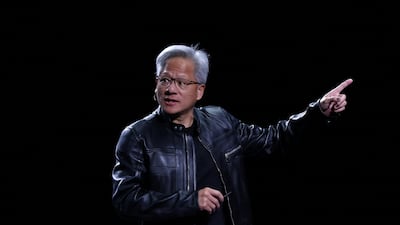

Embattled Nvidia co-founder and chief executive Jensen Huang has resigned, marking a stunning fall from grace for the leader of a vital US computing giant that has long helped to fuel the artificial intelligence boom.
Mr Huang’s departure came days after he admitted to having an affair with a woman suspected of being a Chinese spy.
In a statement, Nvidia's board of directors thanked Mr Jensen for his "profound" contributions to the company.

"The board and the company thank Jensen for his immeasurable contributions to the company and the industry," the statement read.
Colette Kress, current executive vice president and chief financial officer, will serve as interim chief executive, Nvidia announced.

Nvidia stock was closed down 4.44 per cent, much steeper than the Nasdaq's drop of 0.39 per cent.
Harvey Jones, chairman of Nvidia's board of directors, said Ms Kress had helped lead the company through a “period of extraordinary growth and has a deep understanding of our business, customers, operations and financial position”.
“She is supported by an experienced leadership team that has been instrumental in executing Nvidia's strategy and advancing its technology road map."
Political fallout
US President Donald Trump, a long-time ally of Mr Huang, posted about the AI tycoon's departure on Truth Social, the US President's social media platform.
"Now that Nvidia CEO Jensen Huang, who has done a fantastic job, has resigned, there is only one man to take his place: Tim Cook of Apple," Mr Trump wrote. "A legend replaces a legend."
Mr Huang's many meetings with Mr Trump, however, often brought controversy.
He would lobby Mr Trump to try to relax US chip export policies affecting China, which caused an uproar with both Democrats and Republicans.
Democratic senator Elizabeth Warren on Thursday claimed Mr Trump and those he appointed to the Department of Commerce enabled some of the controversies that engulfed Nvidia.
"Secretary Howard Lutnick and undersecretary Jeffrey Kessler must explain why they have not closed export control loopholes and act today to ensure our advanced technology is not fuelling China’s military," she said, referring to reports of Nvidia's dealings with China.
Alice Huang affair
Mr Huang, who co-founded Nvidia in 1993, sparked a crisis this month when he admitted to having an affair with Alice Huang, a technology executive.
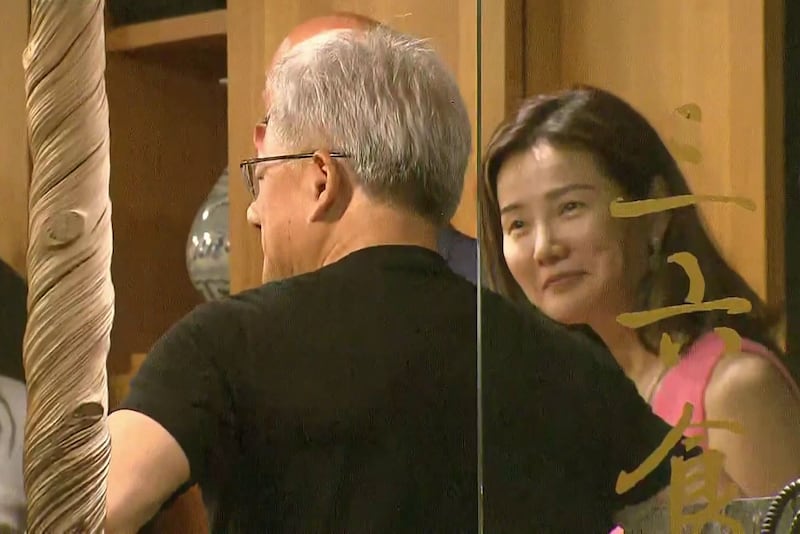
US officials and investigators said they believe Ms Huang, who is not related to Mr Huang, to be a spy working on behalf of China, the top US rival in the tech and AI field.
To maintain its edge in the AI race, the US introduced export policies designed to keep some of the most powerful US-made semiconductors and computers away from adversaries.
But Mr Huang and Nvidia openly opposed the export policies. He said the restrictions hampered US influence and prevented American technology from becoming a global standard.
Proponents of the export policies, however, said they strengthened the US lead and made it difficult for countries such as China to catch up, particularly in the need for computing power to train large language models.
Some of those supporters of the export policies accused Nvidia and Mr Huang of wanting to boost revenue at all costs, even if detrimental to US national security.
As the overall mood towards AI, Big Tech executives and unregulated technology began to sour among US voters, politicians increased scrutiny of Nvidia.
Infidelity
By the time Mr Huang admitted to the affair, media reports had accused his company of ignoring various products entering China.
Mr Huang’s admission of infidelity expedited and amplified calls for further inquiries.
Shortly after his confession, Nvidia’s board of directors announced an independent investigation to address reports of whether he had been the target of a foreign spy operation and what, if anything, had been compromised.
Company representatives initially insisted Mr Huang would remain chief executive but pressure grew.
He founded Nvidia, with Chris Malachowsky and Curtis Priem, in 1993, as the personal computer sector was booming.
A major part of that was gaming but many computers were not designed for gamers and Nvidia saw an opening in the market.
The company designed special graphics cards and video boards that, while popular, did not make Nvidia a household name. As a result, its name was mispronounced by many for a long time.
Profits steadily grew, however, and the company methodically expanded. As progress in AI started to hit its stride, Nvidia soon found its custom graphics processing units and boards in unprecedented demand.
Stuff of legend
Nvidia could hardly build its products fast enough to keep up with demand, yet it knew how to make them to perfection.
Revenue and profits soared, and Mr Huang’s presence became almost impossible to ignore, even among those who had no interest in AI.

His work ethic and management style became famous. At one point, CBS did an interview inside a Denny’s restaurant where he had spent many late nights founding the company.
It was the sort of story that exemplified the American dream, But as Nvidia and Mr Huang enjoyed unprecedented success, some US officials raised concerns that Nvidia’s profits were being generated at the expense of national security, with its products potentially being used by hackers and hostile governments.
Mr Huang’s fuelled more questions about Nvidia’s governance. His exit probably eclipses Apple’s dismissal of Steve Jobs in 1985, which was mainly caused by a boardroom power struggle.
Who is interim chief executive Colette Kress?
Within a few hours of being named Nvidia's chief executive, Ms Kress told the company’s more than 42,000 employees that she believes in Nvidia's future.
"I recognise that this has been an extraordinarily difficult period and I want you to know how grateful we are for your resilience, professionalism and continued dedication," she wrote.
Ms Kress said a company-wide meeting would take place on November 18, where more announcements would be made.
"We play a vital role in building the technology that is powering the Al revolution, and we have important work ahead of us," she wrote.
Ms Kress was previously chief financial officer for US technology company Cisco, and before that was a corporate vice president of Microsoft, from 2006 to 2010.
According to her LinkedIn profile, Ms Kress earned a master's from from the Southern Methodist University's Cox School of Business in Dallas, Texas.
For undergraduate studies, she attended the University of Arizona.

