
Oracle has introduced its new agentic AI applications to take on more complex tasks across industries ranging from supply chains and shipping to restaurants.
The applications are part of Oracle Fusion Claw, a governed agentic execution, the company announced on Monday at Oracle AI World in Las Vegas.
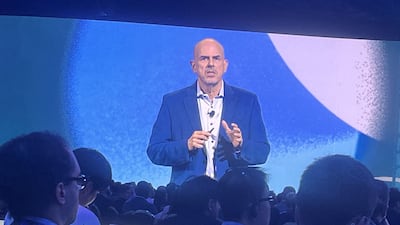
"AI is no longer limited to telling you what's happening in your business, it is actually now telling you what can happen next," Oracle co-chief executive Mike Sicilia told the event.
"AI should allow you to barely think about software at all. So, instead of navigating applications and managing processes, you simply tell the system what you would like to accomplish and, because it understands your business, you figure out how to get the work done."
The new applications are intuitive and work across sectors such as supply chain forecasting, restaurant operations and health care, he said.
"We are giving people more time to be human, and that's the ambition we have for AI; not simply more capable people, people that have more time to think, create, to solve problems and care for one another," Mr Sicilia added.
Oracle's new Fusion Claw agentic apps can help organisations to operate within established governance controls, the company said. They will be able to reason, compute, adapt and execute specialist-grade work, including deep research, computation, simulation, modelling and continuous replanning.
The company displayed an example of how a shipping company using the application can gain transport cost savings of $58,000, thanks to the AI system going through all its data and finding solutions.
Mr Sicilia also gave the example of a customer, a doctor, who said his patients had not realised the colour of his eyes before he introduced the agentic AI system, as he now had more time to speak with them.
"We want to make it dramatically easier for you to generate such outcomes … That means changing not just what our technology can do, but how quickly [it can] get it working in your business," he said.
Before the event, Oracle also announced a $1 billion investment to support its partner ecosystem on increasing customer demand for AI-powered solutions and services.
The investment, spanning the next four years, is aimed at increasing opportunities for partners to develop solutions and build specialised expertise, Oracle said.
It includes new and greater benefits and incentives for partners, including planned investments in training and certification, technical enablement, development, testing and demonstration environments, cloud migration funding, go-to-market collaboration, and commercialisation through Oracle Marketplace.
Oracle's partner ecosystem includes systems integrators, independent software sellers, cloud and managed service providers, value-added distributors, resellers, advisory firms and other partners.
Middle East going beyond ‘AI for the sake of AI’
In the Middle East, there is strong growth in AI introduction with good cases across industries, said Hammad Hussain, senior director of AI and data strategy at Oracle.
The company operates two cloud regions in the UAE, in Abu Dhabi and Dubai. It also has cloud regions in Riyadh and Jeddah in Saudi Arabia.
“Middle East clients are very ambitious when it comes to AI. And I think initially, if I go back one and a half years ago, a lot of my discussions were, 'I need to use AI, tell me how'. But now it has changed,” Mr Hussain told reporters at the Oracle AI World event.
“One of our clients in the airline industry, for example, has started using AI to start negotiating new locations that it opens up. That's a great use of AI. That's a revenue example as well, because the quicker you can launch a new city, the quicker you can start banking in the revenue."
Countries such as the UAE, Saudi Arabia and Qatar in the Gulf are investing heavily in AI. UAE companies and organisations have some of the highest rates of agentic artificial intelligence adoption in the world, a survey this month by data science and AI platform company Dataiku found.
It found that 62 per cent of UAE chief information officers say their companies have more than 50 AI agents working in the organisation, while 15 per cent say they operate more than 500 agents.
Customers in the Middle East are also using AI for conversational analytics, Mr Hussain said. He gave the example of those in the building sector using AI to go through data to understand which projects are delayed and recommendations to reduce the cost.
“AI might say that we can consolidate a lot of your suppliers if we're getting the same product from 10 suppliers … So, these are the kind of things that are reshaping their thinking,” Mr Hussain said.
The use of AI for “AI's sake” is no longer the case in the region, he stressed.
“The truly advanced ones are now saying, ‘OK, how can I change my business? How can I improve my efficiency or do things which I couldn't do before’.”

