
A major issue in the coming US midterm elections is data centre construction – and according to polls, that's good news for Democrats and bad news for Republicans.
President Donald Trump has continued to say that data centre and AI fears are a hoax, but recent polling shows that his decision to double down on unregulated artificial intelligence might cost his party the House and Senate.
Recent surveys show that in the US, concerns about AI causing widespread labour disruption and data centres' high energy needs are growing.
In some parts of the US, data centres have popped up in once-tranquil residential neighbourhoods, causing audible and visual nuisances. Critics have alleged that data centres also have a negative impact on the environment.
These issues have led to protests, anger at town halls and, in some cases, new laws.
Democrats, seen by many voters as being more likely to regulate the private sector, have benefited from the current climate.
About 73 per cent of voters, regardless of party, oppose the building of AI data centres in their community, a recent Quinnipiac University poll indicated. Other surveys have essentially told the same story.
Though most polls have indicated the economy and the cost of living are top concerns as the midterm elections near, that, too, plays into AI and data centre fears, experts say, with the general public seeing technology companies as greedy.
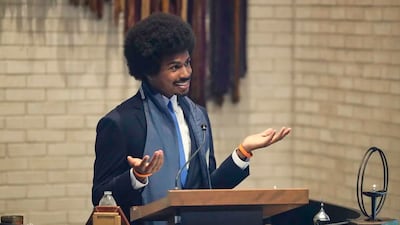
In Tennessee, Democratic state legislator Justin Pearson has made his opposition to data centres a focal point of his campaign for Congress.
Mr Pearson has called out technology tycoon Elon Musk, whose company xAI operates Colossus, one of the largest data centres in Memphis.
Colossus has been the subject of countless community meetings amid allegations of pollution, a sharp rise in electricity bills and an overall disregard for the well-being of residents.
The Democratic politician has been a frequent speaker at public meetings on the issue, demanding more accountability from xAI and pushing for a moratorium on data centre construction.
“Tech oligarchs and Elon Musk are targeting our community because they believe that our community is somehow the path of least resistance,” Mr Pearson says in one of several campaign videos.
Timothy Kneeland, a political scientist and public policy historian at Nazareth University in western New York, says there is plenty of data to suggest there is electoral substance behind the AI and data centre concerns.
“A lot of Americans simply don't think President Trump is taking these concerns seriously,” he said. A backlash against technology executives and a perceived disregard for community concerns is being felt at just about every level of government, he added.
“It's causing quite a stir in the US midterm elections and even in some state legislative races across the US.”
There has been a rise in political adverts portraying a dystopian future in which technology executives call the shots.
Michigan Democratic Senate hopeful Abdul El-Sayed has drawn attention to his Republican opponent Mike Rogers's investments in data centre firms and ties to various technology companies.
“You can't have your privacy violated if you don't know your privacy is violated,” a quote from Mr Rogers plays throughout one of Mr El-Sayed's adverts.
The video also shows headlines covering the growing anger in the US related to Flock cameras, which have come under intense scrutiny over their use of automatic licence plate reading technology, motion and sound sensors, and a vast database aimed at tracking criminals and assisting law enforcement.
But rights groups such as the American Civil Liberties Union say Flock cameras violate privacy laws, are sometimes misused by law enforcement and build a nationwide surveillance network.
“If there are Flock cameras in your city, they are tracking, logging and sharing your movements without a warrant,” ACLU's Flock website awareness message reads.
Mr Kneeland said in some parts of the US, opposition and anger towards Flock cameras is so intense that it is actually causing some elected officials to change their views.
“These concerns are now shaping Republican candidates for the Senate, the House of Representatives and in state races,” he said.
“This is a clear break with the de facto head of the Republican Party, President Donald Trump, who has called for unregulated AI development, the expansion of data centres, and is strong on law and order which Flock cameras are often associated with.”
In Ohio, Democrat Sherrod Brown is trying to return to the US Senate following his 2024 re-election loss, focusing on holding data centre companies more accountable.
“Ohio's electric grid is being treated like a game by gobbling up energy to feed their data centres,” Mr Brown says in one advert targeting incumbent Republican Senator Jon Husted, of whom Mr Brown says has repeatedly sought more data centre construction in the state. “I'm Sherrod Brown and I'll require the data centres to pay the full cost of their electricity, not you.”
Even in Republican states like Texas, as Mr Kneeland points out, the Republican Governor Greg Abbott has shifted his stance on data centres.
“He once suggested Texas should become a hub for AI development and activity, but has since has backed away from this and sponsored a bill to tighten up regulation,” he said.
The midterm elections will take place on November 3.