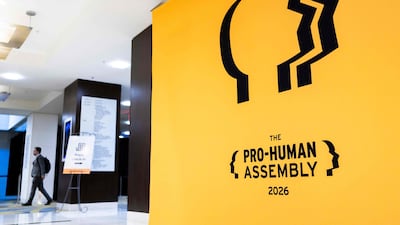

Legislators, celebrities and other public figures voiced growing fears over the rapid development of artificial intelligence during a “pro-human” summit in Washington on Tuesday.
US President Donald Trump this week dismissed warnings of the need to put guardrails on the technology, calling them part of a “hoax” and “sick conspiracy”.
The auditorium hosting the Pro-Human Assembly was packed with Democrats, Republicans, technology experts, economists and academics for the day-long event focused on pushing for regulations on AI development.
Critics of AI have pointed to potential large-scale disruptions to the workforce, the possibility of technology attacking humanity, the risks of environmental harm from data centres and concerns over intellectual property.
“We need to ban AI systems that are too powerful for humans to control,” said Democratic Representative Greg Casar.
Republican Representative Chip Roy, whose district in Texas is next to Mr Casar's, reflected on his fears that AI would lead to a surge in unemployment.

“I believe the dignity of work matters,” he said. “I believe God created us and gave us dominion over this planet and as a result technology is a tool for us, but we’re not supposed to be tools for data collection and AI apps.”
The Pro-Human Assembly was organised by the Future of Life Institute, a non-profit group that has been critical of the path of AI development largely driven by Big Tech companies.
It takes place days after the executives of Anthropic, OpenAI and xAI came out in support of slowing down and putting more guardrails on AI development amid a series of incidents in which models escaped their digital testing facilities and compromised systems.
The event also follows strong words from Microsoft co-founder and philanthropist Bill Gates. He wrote a lengthy essay about his concerns about AI, calling for society to come to an agreement about ensuring that some jobs should be done by “humans only”.
Recent instances of high-profile technology executives speaking out come after months of anxiety over AI building among the wider public.
Mr Trump and other officials have attempted to allay those fears with varying degrees of delicacy. Mr Trump has said that the anger directed towards AI could cause the US to “lose a war” with China over AI dominance.
On Monday afternoon, Mr Trump called Nvidia chief executive Jensen Huang while he was on stage at a business and technology conference. Mr Huang, who has accused people expressing worries about AI of having a “God complex”, put Mr Trump on speakerphone, and the President proceeded to say that the US could not let fears about AI interfere with the battle for AI dominance with China.
Neil Chilson, who was chief technologist for the Federal Trade Commission during the first Trump administration and is now head of AI policy at the Abundance Institute, also recently questioned the motives of those calling for regulation in the US.
“AT&T sought regulation to eliminate their competitors in 1913 and got a 70-year government enforced monopoly,” he posted on X. He was implying that calls from some companies endorsing guardrails were actually attempts to dominate the AI sector through what is known as "regulatory capture", similar to the former telephone monopoly in the US known as the Bell System.
The accusation of regulatory capture has often been lobbed at Anthropic because the company has tended to be more vocal about acknowledging AI concerns.
Mark MacCarthy, a senior fellow at the Institute for Technology Law and Policy at Georgetown University in Washington, has studied antitrust policy for several decades. He says it is not quite accurate to compare the Bell System to the current state of the AI industry.
“There should be government regulation mandating pre-deployment and ongoing safety testing of AI models for cyber risks, risks of developing bio, chemical or nuclear weapons and performing unintended and dangerous actions,” Mr MacCarthy told The National, referring to the unprecedented power and rapid improving of AI models.
“The companies should be liable for harms their AI models cause during testing or after deployment.” Mr MacCarthy said US commerce laws already exist for this sort of enforcement, but they need to be enforced.
He added, however, that it was important to carefully examine how government would regulate AI, adding that “blanket mandates” and vague, non-binding agreements to slow development might do more harm than good.
“They would make sense if the problems were caused by improvements in AI capacity, but they are not,” he explained. “They are caused by careless and negligent product and testing designs.”

