Samsung Electronics has introduced its latest line-up of foldable devices, featuring a new mid-size option, but they come at a higher price because of supply chain challenges stemming from rising manufacturing costs.
The world's biggest mobile phone manufacturer unveiled the line-up at its Unpacked event in London on Wednesday. Headlining the launch was the repackaged Galaxy Z Fold8, which is now about the size of a passport.
The Fold8 is positioned between the clamshell-type Galaxy Z Flip8 and the Galaxy Z Fold8 Ultra, which now takes over as Seoul-based Samsung's largest flagship device.

The bigger story, however, is the pricing: the Flip8's 256GB and 512GB versions now start at Dh4,699 ($1,280) and Dh5,499, respectively, compared to their predecessors' Dh4,299 and Dh4,799.
Compared to the GalaxyZ Fold7's Dh7,599, Dh8,099 and Dh9,349 for the 256GB, 512GB and 1TB models, the Fold8 Ultra's equivalents are now at Dh7,999, Dh8,799 and Dh10,399 – the first time a mainstream Samsung smartphone has topped the Dh10,000 mark, except for the highly-limited Galaxy Z TriFold that was launched in December that cost Dh12,000.
Samsung also introduced the ninth generation of its Galaxy Watch series and the second version of its premium Watch Ultra, both of which promise more robust battery life and health tracking features.
Fadi Abu Shamat, head of Samsung Gulf's mobile experience division, acknowledged the challenges, but noted the company has worked to strike deals with partners in the Middle East to introduce more affordable buying options for consumers.
These include up to 12 months of zero-interest payment options on devices and up to 36 months of plans with telecoms operators, he told The National.
“It's been more challenging,” Mr Abu Shamat said. “We started this year with a lot of constraint on chip shortages that we're all facing, and I'm sure we've seen it across all devices.”
And with the spectre of higher interest rates amid the global economic situation, Mr Abu Shamat said Samsung wanted to use this strategy “as a formula”.
“We're leaning more into affordability … it has to be done. [In all of Samsung's] brand shops, every single device will have an affordability option aimed to reduce the burden [on consumers].”
-
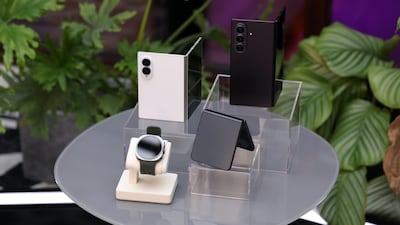
Samsung has unveiled its latest foldable devices, featuring a new mid-sized option. All photos: Chris Whiteoak / The National -
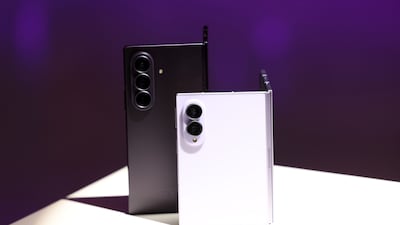
The main displays of the Galaxy Z Fold8 Ultra and Fold8 measure 8 inches and 7.6 inches, respectively -
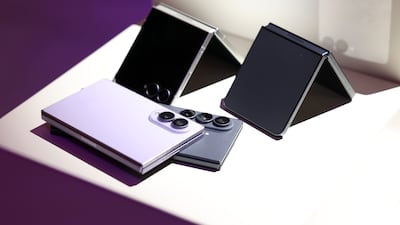
The Galaxy Z Flip8, seen alongside the Fold8, still has a 6.9-inch main screen -
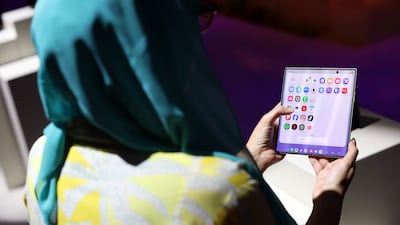
The highest-spec Galaxy Z Fold8 Ultra costs Dh10,399 ($2,830) in the UAE -

Samsung will be introducing more flexible payment options for customers in the UAE
At last year's Galaxy Z Unpacked, Samsung slimmed down its devices as it sought to fight off competition in the foldable market, which is increasingly being flooded by rivals from China.
Now, the Galaxy Z Fold8 comes as consumer technology companies are facing a cost crunch due to the chip shortage and additional challenges presented by the US-Iran war.
Samsung is one of the world's biggest chip makers – its market capitalisation hit the $1 trillion milestone in May amid booming demand – but the conflict has choked supplies of raw materials needed for components.
The chip shortage has been the main drag on the smartphone industry, with global shipments declining 11 per cent annually in the second quarter of 2026 – the lowest levels for that three-month period since 2013, Counterpoint Research said last week.
Even Apple – known to have one of the best supply chain systems in the industry – has not been spared, as it raised the prices of some iPads and MacBooks last month.
The California-based company is expected to unveil its next iPhones in September – possibly including its first and much-anticipated foldable device, which is also rumoured to be the size of a passport.
Smart Analytics Global, a California-based market research firm, predicts the industry will start to bounce back in the second half of next year, with shipments rebounding to the low single digits.

The pace of memory price increases is also expected to moderate over the following quarters, alongside back-to-normal demand from smartphone makers, SAG founder and principal analyst Linda Sui said.
“From the consumer perspective, demand for entry-level smartphones remains,” she told The National. “However, recent component-driven price increases have reduced the supply of affordable devices, suppressing replacement demand.
“As supply gradually normalises and more low-end models become available again, we expect this pent-up demand to be released, most likely beginning in mid 2027 and supporting a broader market recovery.”
'Intelligent eyewear' update
Samsung also unveiled further details of its long-awaited smartglasses, formalising its entry into the niche category regarded as the next battleground for wearables.
The “intelligent eyewear”, developed with South Korea’s Gentle Monster and New York-based Warby Parker, is a “hands-free” extension of Samsung's Galaxy system, it said.
The glasses come with a built-in camera and use artificial intelligence for tasks such as capturing content, live translation, text summarisation and sharing what a user is seeing during a conversation.
Still, details for the product – first teased at Google's I/O conference in May – remain sparse. Samsung did not reveal its release date or pricing, which is expected to be high as the company said it was positioning it as a “premium” device.