

Uber and WeRide will soon begin an autonomous taxi service in Abu Dhabi, marking a key step towards the emirate's goal of making driverless cars mainstream.
The move is part of a small but continuously growing self-driving service in the UAE, especially in Abu Dhabi. WeRide has already partnered with Abu Dhabi Mobility and taxi company Tawasul.
Uber is in talks with Dubai's Roads and Transport Authority, with the rest of the UAE also on the company's radar. The National hopped into one of the AVs to test out the future of transport.
What vehicle is being used?
San Francisco-based Uber will use WeRide's van-type Robotaxi GXR that this year received approval for fully unmanned operations in Beijing, using level 4 autonomous technology.
There are six levels of autonomy, from zero to 5, in which vehicles do not require human intervention under most circumstances. Level 5 requires no human attention and vehicles with that status may not even have steering wheels or pedals.
-
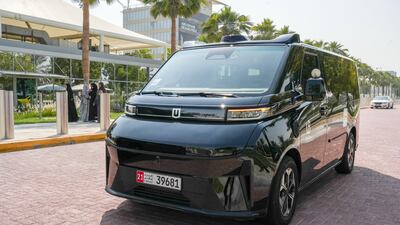
Uber is test-driving WeRide's Robotaxi GXR, which it plans to use for its autonomous Abu Dhabi taxi service. All photos: Pawan Singh for The National -
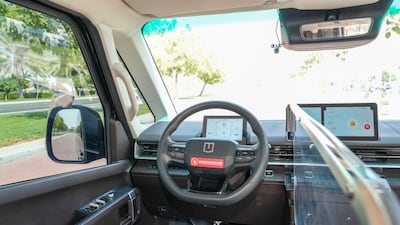
A barrier is installed to the right of the 'driving' seat to protect the vehicle from tampering -
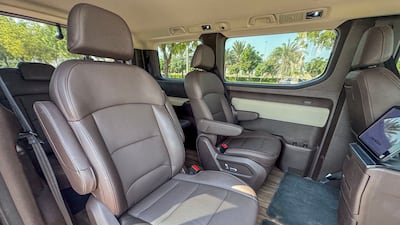
The Robotaxi GXR can accommodate five passengers -
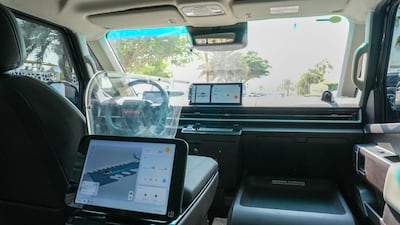
The autonomous taxi features a touchscreen on which details of the journey are displayed -
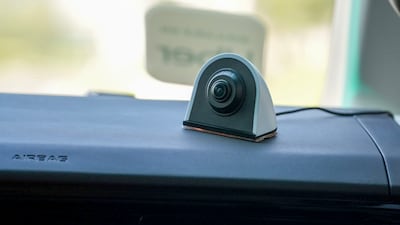
The vehicle is equipped with cameras for monitoring and security purposes -
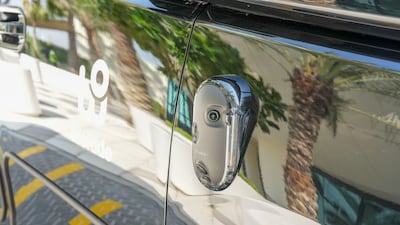
Cameras also feature on the exterior in a bid to boost safety while on the road -
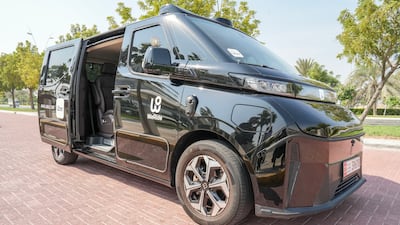
A dedicated team is on standby and ready to be sent to the scene should the driverless taxi encounter problems


WeRide's autonomous vehicles are fitted with LiDAR - light detection and ranging – that uses laser light to measure distances and create precise 3D maps of the surroundings, as well as radar and cameras.
Guangzhou-based WeRide has driverless taxi services in five Chinese cities and has plans to introduce them in Zurich. Its first commercial autonomous taxi services in the Middle East were launched in Abu Dhabi in December 2024.
Starting point
The first step of the driverless ride is, like any ride-hailing service, booking through the Uber app, either by choosing the autonomous option, guaranteeing an AV, or through UberX or Uber Comfort, which could match you with an AV, depending on availability.
Having said that, fares will match the levels of UberX and Uber Comfort, the service's two most affordable tiers.
Robotaxi GXR in Abu Dhabi will operate for journeys to and from Saadiyat Island, Yas Island and Zayed International Airport, Al Maryah Island and Reem Island.
The app showed our ride would reach us in one minute, which took a little longer because it got caught up at a couple of signals. Once the ride arrives, you can't just get into the vehicle straight away – you can only ride after you've unlocked the doors using the app. That safety feature is to ensure the right person gets in it.
What's it like inside?
The Robotaxi GXR features can fit up to five passengers in the middle and back rows. The driver's seat is vacant. As someone who grew up seeing these things only in movies, it's kind of amusing to see the steering wheel moving by itself.
Notably, there's a glass partition to the right of the driver's seat to prevent any goofballs from trying to tamper or mess around with the ride. In an age of attention-hungry social media users, this is a wise choice.
Uber says any tampering attempt can be detected and offenders will be dealt with accordingly. There is currently no defined legal framework for those who tamper with AVs and, at this point, getting barred from using the app is the most likely punishment for such an act.
The ride won't start until all passengers have their seat belts on, which will be indicated on a touchscreen display in front of the middle seats. Once everyone's buckled in, passengers can press "start ride" on the screen.
How was the journey?
It was smooth and at no point did we feel we were actually without a driver. The vehicle accelerated and slowed down consistently and it didn't give us that feel of sudden stopping that can be a feature of regular driving.
The touchscreen shows you information about your ride, including the route, distance and speed, which adheres strictly to the legal limits. When you arrive at your destination, you can get out by again tapping "unlock door" on the display.
In case of an emergency, Uber says its team is always on standby and monitors the vehicle during its journey, ready to send a unit to help out.
The service's safety guidelines are "very rigorous ... tied to global best practices", Mohamad Jardaneh, Uber's head of autonomous mobility in the Middle East, told The National.
That being said, while we look forward to the day level-5 AVs hit the roads, we're even more eager that future modes of transport are a hundred per cent reliable.

