

A couple of weeks was more than enough to make an impression – and that's exactly what Samsung Electronics' latest foldables made on us.
Round two of 2025's Unpacked introduced us to the Galaxy Z Fold7 and Flip7, which we can say are a new era for the devices, and Samsung – still the undisputed ruler of the foldable realm, in this case with two new smartphones – tripling down on their slim game after the S25 Edge.
Both the Fold7 and the Flip7 are the slimmest in their respective classes, with the former also the lightest (the Flip7 missed the cut by a mind-boggling 1 gram). We take a look at the additions (and subtractions) on these new folding gizmos.
Galaxy Z Fold7: Now this is a foldable
The biggest talking point for the Galaxy Z Fold7 is its uber-thin profile: 8.9mm folded and an absurd 4.2mm when unfolded - the latter easily knocking out the Galaxy S25 Edge's 5.8mm.
Here's the caveat: the camera bump is really thick. Throw in a protective case to absorb that and it is still a thick phone.
The displays, meanwhile, have been made even bigger: the main screen measures 8 inches (203.2mm), while its cover is now 6.5 inches (165.1mm).
This phone is so slim that we may even be fine using it folded. But, of course, the meat of this device is on the inside.
We still have the Snapdragon 8 Elite for Galaxy, custom-built for Samsung and which is also found in the Galaxy S25 series. Do not expect any lags from this machine, and even at full, three-app mode – Multi Window, in which up to three apps can be opened and used simultaneously – there isn't a hint of slowing down.
And we're not going to dive that deep into Galaxy AI because, aside from token upgrades – AI Mode on Circle to Search, for example, can now handle "tougher questions" and follow-ups – the platform remains the same. Do remember you'll get a free six-month subscription to Google AI Pro with a Fold7 or Flip7 purchase.
The S Pen is gone
Here's where it gets a little polarising: after three generations, Samsung killed off S Pen support for the Fold7. Now, that's a hit or miss, depending on which side you're on.
On one hand, those who favour using Samsung's stylus – anyone miss the Galaxy Note? – found it convenient to draw or lazily hover over their Folds with the S Pen. Arguably, those who really benefitted from this were those who doodle a lot.
On the other hand, an intelligent guess is that Samsung made the decision to ditch the S Pen in order to achieve the slimness they were looking for: the company removed the digitiser layer that is needed to detect the S Pen's tip, in addition to, now not needing a bulkier protective case to house the S Pen (remember, Folds have never had built-in S Pens, unlike the Notes and the most recent S Ultras).
Fair enough. But, maybe, in the first place, the S Pen isn't needed at all? The Folds' cover screens don't even support it, and it's really more natural to use your fingers on smartphones (tablets have their own argument for a stylus). In any case, it's been reported that Samsung might bring the S Pen back in the future.
But for our money, we believe Samsung made the right decision here, as we'd rather welcome a very sleek, no-nonsense device the way the Fold7 was constructed as is and meant to be.
-

The Samsung Galaxy Z Fold7 and Flip7 at the Unpacked event in Brooklyn. All photos: Alvin R Cabral / The National -

The Galaxy Fold7's main and cover screens are now bigger, at 8 inches and 6.5 inches, respectively. -

The Fold7 is the slimmest and lightest in the series. -

The Galaxy Z Fold7 and Flip7 in their most striking colours – blue shadow and coral red. -

The Galaxy Z Flip7 now has an edge-to-edge cover display, which is called the FlexWindow. -

The Flip7 is also the thinnest and lightest in its series. -

The Galaxy Z Fold7 and Flip7 in their mint variants, which can only be bought on Samsung's website.


Camera and battery
The Fold7's camera now has a 200MP main sensor, at par with that found on the premium Galaxy S25 Ultra – though the Fold7 only has three cameras compared to the S25 Ultra's quad set-up.
Samsung says the Fold7's 200MP sensor should be able to provide up to four times more detail and 56 per cent more brightness, while its 12MP ultra-wide camera adds 56 per cent more brightness, in addition to up to 3x optical zoom. The selfie camera is 17 per cent wider and 2.5 times clearer.
Again, no issues with the camera. We were able to capture shots in their natural state, though you can adjust them to your liking with the various tools in the device's arsenal, in addition to Galaxy AI editing.
There's another feature that's missing. Samsung also got rid of the under-display camera (UDC) on the main display that was, coincidentally, also incorporated, beginning with the Fold3.
Instead, the punch-hole snapper made a triumphant return. Now this might be another design-driven decision yet, again. Samsung is exploring the possibility of the UDC's return in the future with, reportedly, improvements to it. But, objectively, we did not experience anything amiss while using that punch-hole.
Meanwhile, the Fold7's battery, for the fifth Fold in a row, clocks in at 4400mAh. Samsung claims it can last for up to 24 hours of video – one hour better than the Fold6 – and is more energy-efficient.
In our standard one-hour YouTube-at-full-brightness test (no other apps active in the background and updates suspended), the Fold7 lost 5 per cent, at par with the Fold6. We were able to stretch it out from a full charge in the morning to less than 20 per cent past noon the following day, which, curiously, is worse than what we got on the Fold6.
Galaxy Z Flip7: The pocket rocket
While the Fold has always been the main star of the Galaxy Z series, we've always had a soft spot for the Flip – and with what Samsung has done with the Flip7, that's become even more heartfelt.
The Flip7's screens are bigger, with the main display now at 6.9 inches (175.3mm) – that's bigger than the Galaxy S25+ and on par with the S25 Ultra. This bigger digital real estate is added value for a phone you can halve and easily tuck away in tight spaces.
Arguably its biggest change is its bigger cover screen – known as the FlexWindow – which measures 4.1 inches (104.1mm) and, critically, now edge-to-edge, which gives a really sleek look, especially with what Samsung says are its thinnest bezels ever.
The effect is mesmerising: while using the FlexWindow, it feels as if you're holding a borderless display that has a satisfying feel in your hands. Maybe we're looking at what we can expect from the phones of the future.
-

A multimedia board shows the history of Samsung Electronics, stretching more than five decades, at the company's Unpacked event in Brooklyn. All photos: Alvin R Cabral / The National -
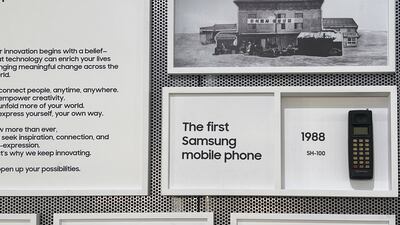
Samsung's first mobile phone, the SH-100, was launched in 1988. -
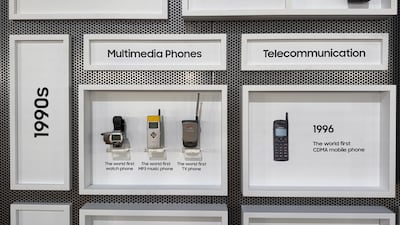
In the 1990s, Samsung started making multimedia phones, including the world's first mobiles with watch, MP3 and TV. -
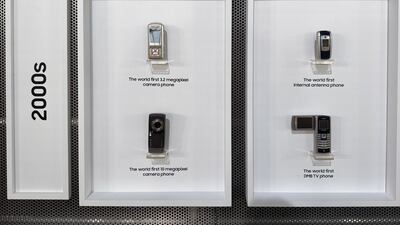
The early 2000s saw Samsung focusing on competitive camera features on its cellular phones. -

The year 2010 would mark a turning point for Samsung with the launch of the original Galaxy S – which would become the main rival of Apple's iPhone. -
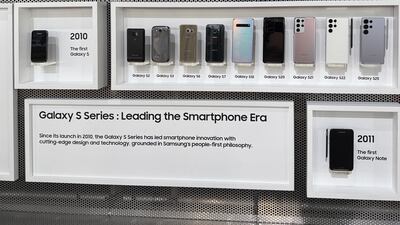
Samsung stepped up its game throughout the 2010s as it improved the Galaxy S line-up and launched the Galaxy Note. -
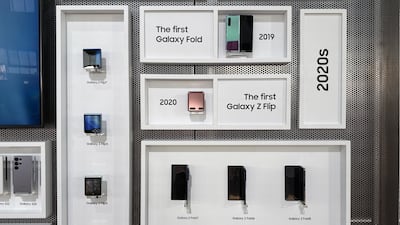
In 2019, Samsung entered the foldable smartphone genre with the first Galaxy Fold, which would soon be followed by the Galaxy Flip.


Battery boost
Breathing down the FlexWindow neck's upgrade is the Flip7's battery, which is now up at 4300mAh and is advertised to last for up to 31 hours of video – eight hours more than the Flip6's.
So we tried to get a sense of that with our YouTube test and the result is that, compared to its predecessor's 8 per cent loss, the Flip7 managed to lower that to 6 per cent.
And as far as it lasts, the new devices have seemed to switch places, as the Flip7 is now the one that lasted well into the afternoon of the following day.
Its dual camera system, however, remains untouched, still donning a 50MP lead sensor, although Samsung says it maintains "flagship-level photography" and its "best selfie camera yet". Our observations for the Flip7's camera are consistent with the Fold7 – although night and low-light shots from the former are somewhat grainier.
For both the Fold7 and Flip7, charging time is billed at up to 50 per cent in half an hour using a 25W charger; our results yielded an average of 47 per cent for both devices, and up at about 85 per cent within an hour.
The verdict
The Samsung Galaxy Z Fold7 gets high marks – S Pen aside – for just about everything, as evidenced by the oohs-and-aahs we got from ourselves, fellow journalists, friends and family, and even some Apple die-hards (who have been eagerly waiting for Cupertino's move on both the slim and foldable fronts).
Functionality, form and productivity assistance are all here – if you're willing to cough up some more hundred dirhams for it, because Samsung hiked the prices of the Fold7, with the top-tier 1TB version now at an eye-watering Dh9,349.
As for our dear (and sometimes overlooked) Galaxy Z Flip7, the improved FlexWindow is just such an eye candy. The general view is that this device is aimed more toward the ladies, which we want to disagree with: don't forget that we've had flip phones before that were hits with everyone.
The Flip7 is a great option for those who want a big screen that saves space wherever you slip it in. If you're not a multi-tasker or are fine with a "small" display, this is your pocket rocket that does everything.
Now where do we go from here? At Unpacked, Samsung did clue The National in on their view on portless smartphones. And there's something else to look forward to: the much-anticipated Samsung tri-fold, which they hope to launch by the end of this year. Here's to hoping that both don't have slim chances.

