


At the World Economic Forum in Davos last week, there was much talk of whether we'll see a light switch moment for artificial intelligence.
You could be forgiven for thinking that AI has been overhyped, not least by marketing execs and journalists – or the elites for that matter, at the annual meeting of high-flyers. Claims that we are on the cusp of an AI revolution may seem distant when the internet keeps crashing and your Bluetooth headphones won't connect.
But AI is fast working its way into our everyday lives, and 2025 will be the year that we'll see something close to that light switch moment – or perhaps more like a dimmer light slowly getting bright and brighter.
To understand more, The National sought one of the top technology minds, Google's senior vice president of research, technology and society, James Manyika. He believes AI is already changing our lives faster than anyone could imagine and the arrival of free or low-cost AI tools is already "democratising" technology.
"We're very excited about where we are with AI", he says from 'Google House', a quaint hotel near the congress centre that the tech giant takes over each year.
And the tool he's most excited about, and uses himself daily, is NotebookLM, which was launched by Google in 2023, but received a major update for Workspace customers last month. If you're not familiar with it already, it works a bit like this:
"Imagine there are 100 reports, each of which is 200 pages long. And I need to engage with them. So, normally, I would have had to go read them," he says.
"Instead, I can just put them all in to Notebook. And then interact with them. By interact, I can say, can you summarise the top ten points in these reports. It'll give you a summary. But the summary is not just a summary, it sets citations, if I want to check them and it takes me to the source material."
These reports can be in any language, and can be summarised into different languages. The opportunities for global companies with offices around the world, and schools and education systems, are endless.
"Imagine I was teaching. I can say, 'create a lesson plan for me with what I've just put in'. So I can do all of that," Mr Manyika says.
Learning by listening

One of the tools Google is particularly excited about is already here. It takes any kind of text-based information and turns it into a podcast in which two AI-generated voices have the most natural conversation you can imagine.
Google uses the same handful for familiarity. And Mr Manyika admits most AI voices that you hear in marketing software or voice-overs are creepy.
"We standardise the voices. It's not trying to mimic your voice, or my voices. These are true AI voices," he says.
As every university student knows, learning by listening and discussion is far more compelling than having your head in a book. But the opportunities are not just for learners.
"Say I'm a PhD computer scientist, so don't give me the generic version. I know a lot about this. I might actually go the other way. I know about quantum computing," Mr Manyika says, and the level of complexity is raised.
Once you understand how you can use multiple AI tools at the same time, and personalise them for you, the possibilities are endless, Mr Manyika adds. Between Google Gemini, Notebook and its assistant tools, suddenly your day can be far more productive.
He's also most excited about "big breakthroughs" in the field of quantum computing and how it intersects with AI. He challenges the suggestion that AI has landed on our laps recently. He uses Google Translate, launched in 2006, as one of the best examples of AI in our every day lives.
-
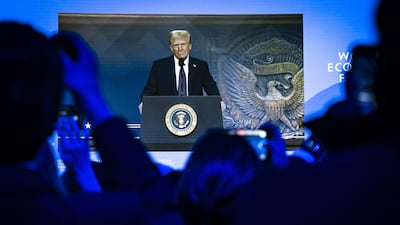
US President Donald Trump is shown on screen as he addresses a plenary session remotely in Davos, Switzerland. EPA -
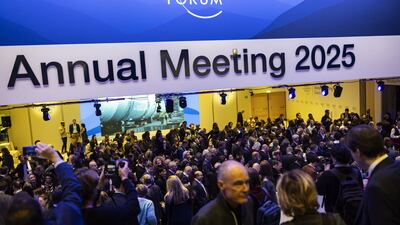
Participants queue to enter the Congress Hall. EPA -
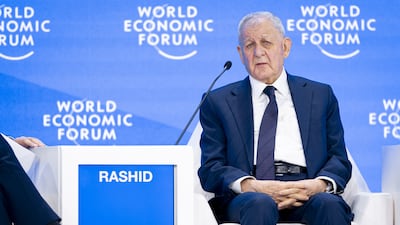
Iraqi President Abdul Latif Rashid. EPA -
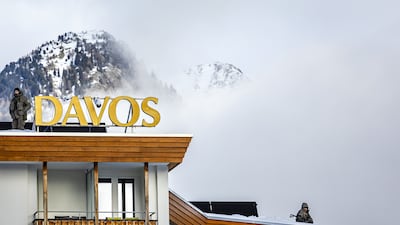
Special police stationed on the roof of the Congress Hotel in Davos. EPA -

Former UK prime minister Tony Blair and Syrian Foreign Minister Asaad Al Shibani at the Annual Meeting of World Economic Forum in Davos. AP -

Javier Milei, Argentina's President, during an interview at Bloomberg House at the event. Bloomberg -
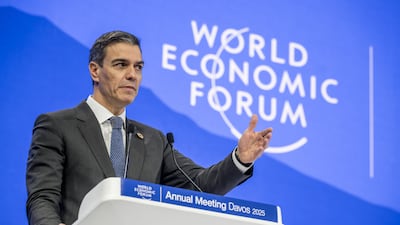
Spain's Prime Minister Pedro Sanchez on the podium. AFP -
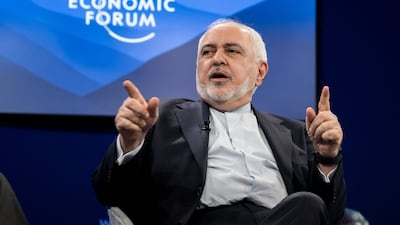
Iran's Vice President for Strategic Affairs Mohammad Zarif addresses the audience. AFP -
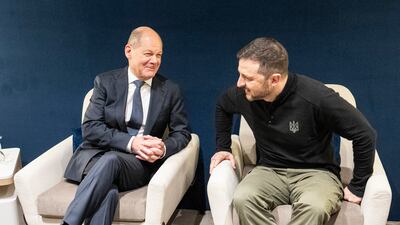
German Chancellor Olaf Scholz, left, and Ukrainian President Volodymyr Zelenskyy. Getty Images -
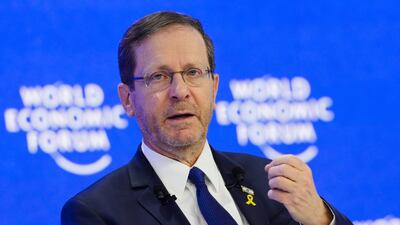
Israel's President Isaac Herzog at the annual meeting in Davos. AP -
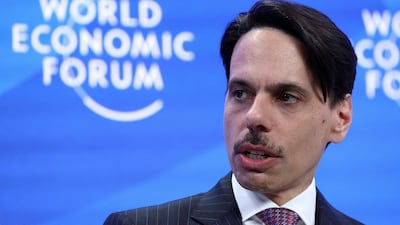
Saudi Arabia's Minister of Foreign Affairs Prince Faisal bin Farhan, during the 55th annual meeting of the World Economic Forum in Davos. Reuters -

The Prime Minister and Foreign Minister of Qatar, Sheikh Mohammed bin Abdulrahman, attends the Annual Meeting of the World Economic Forum in Davos. Reuters -
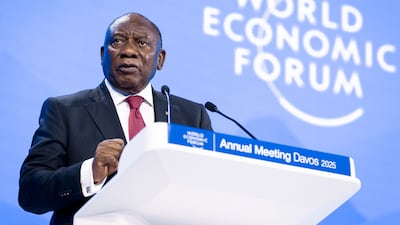
President of South Africa Cyril Ramaphosa speaks at a plenary session. EPA -
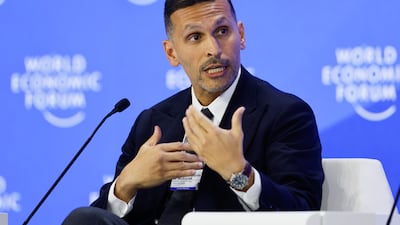
Khaldoon Al Mubarak, chief executive of Mubadala Investment Co, during a panel session in Davos. Bloomberg -
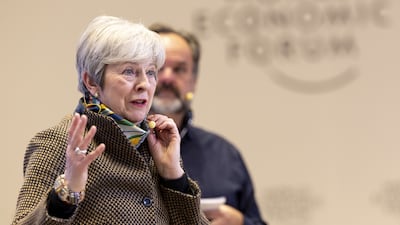
Former British prime minister Theresa May at the 55th annual World Economic Forum. EPA -
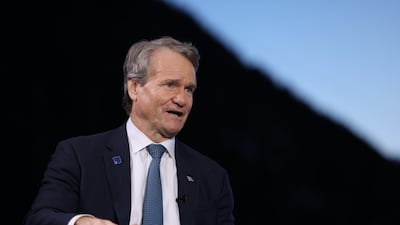
Brian Moynihan, chief executive officer of Bank of America Corp, at the forum. Bloomberg -

Ruth Porat, chief financial officer of Alphabet Inc, at Bloomberg House. Bloomberg -
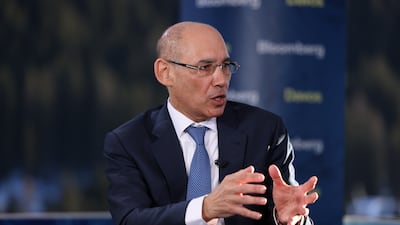
Amir Yaron, governor of Israel's central bank, at the WEF in Davos. Bloomberg -
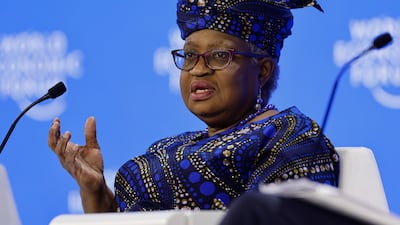
Ngozi Okonjo-Iweala, director general of the World Trade Organisation in Davos. Bloomberg -
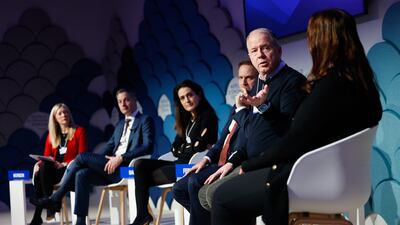
From left, Rachel Morison, editor at Bloomberg News, Belgium's Prime Minister Alexander De Croo, Ester Baiget, chief executive of Novozymes, Marc Ferracci, France's Industry and Energy Minister, Martin Lundstedt, chief executive of Volvo, and Anna Borg, chief executive of Vattenfall AB, during a panel session at the World Economic Forum. Bloomberg -
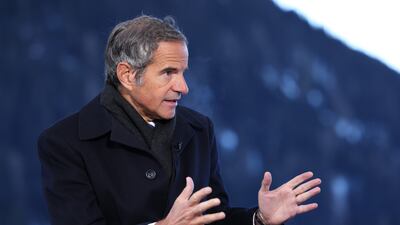
Rafael Grossi, director general of International Atomic Energy Agency, speaks at the WEF. Bloomberg -
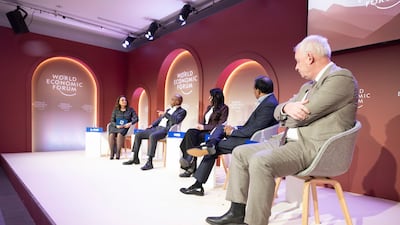
Mina Al-Oraibi, editor-in-chief of The National, left, Mohamed Kande, global chairman of PwC, second left, Ravi Kumar S, chief executive of Cognizant, second right, and Luc Triangle, general secretary of the International Trade Union Confederation, right, during the panel session titled, Who Benefits from Augmentation? Photo: WEF -

Filippo Grandi, UN High Commissioner for Refugees, speaks during the Refugees and Their Olympian Spirit session. Photo: WEF -
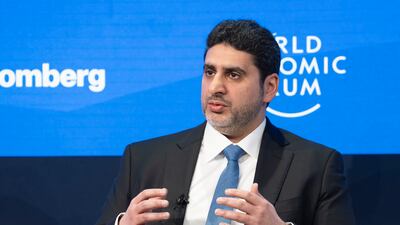
Bandar Bin Mohammed Al Thani, Governor of the Qatar Central Bank, during the session called Banks: Change on All Fronts? Photo: WEF -
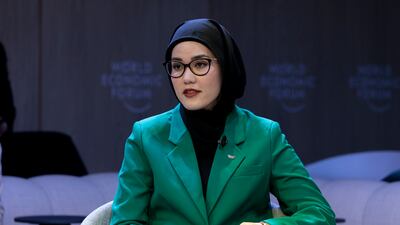
Masomah Ali Zada, chef de mission of the Refugee Olympic Team, France, speaks during the Refugees and Their Olympian Spirit session. Photo: WEF -
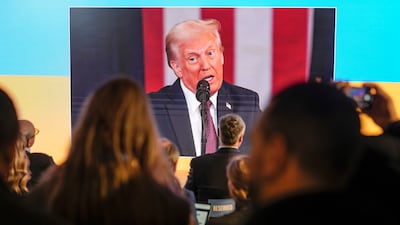
Watching the inauguration of Donald Trump as US President on screens, at the Ukraine House, during the World Economic Forum in Davos. AP -

Waleed Al Muhairi, deputy group chief executive of Mubadala Investment Company, during a Bloomberg Television interview before the WEF. Bloomberg


"And now, because we're using more powerful AI systems, we're able to do many, many more. Languages. So three years ago, we could probably do 50 languages in Google translate. As of now, we're doing 260. We've added 110 in the last six months," Mr Manyika says.
"So it's democratising in that way."
Regulation
Although Google and its rivals all offer paid-for, cutting-edge tools, apps like Google Lens are open to all.
"Remember the old search? You'd have to type what you're searching. So with Lens, you can [point it at the object and say] I don't know how to even name that thing. What is that thing?!," Mr Manyika says.
In Davos, and at the WEF's Global Future Forum event in Dubai in October, few topics dominated more than how to regulate AI.
The world's richest man, Elon Musk, has spoken of his fears that AI is moving too quickly, and faster than regulators can. The UAE, an emerging fast mover in the field of AI, says it is developing legislation to ensure AI can thrive in a safe environment.
But not all companies are as well regulated internally as tech giants like Google, and there is much room for artificial intelligence to be used badly.
"We're trying to be two things: bold and responsible. We've said multiple times that AI is too important not to regulate. It's also too important not to regulate well," Mr Manyika says.

