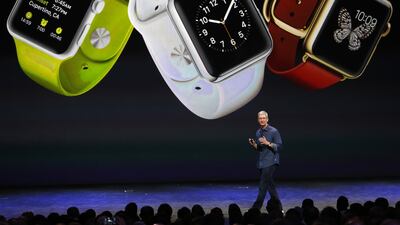
Apple chief executive Tim Cook introduces the first Apple Watch on September 9, 2014. The device has gone on to dominate the smartwatch market. EPA

Apple Watch's 10th birthday: Timed perfectly for another tech disruption


Alvin R Cabral
  • English
  • Arabic

Look closely at a typical Apple user and there's a good chance they are rocking a triumvirate of devices – an iPhone, AirPods and an Apple Watch.

The last one sparked another pivotal moment in technology and watch history. This innovation is characteristic of Apple's disruptive nature, reminiscent of how its iPod, iPhone and iPad disrupted MP3 players, smartphones and tablets, respectively.

Two things may be overlooked or missed when it comes to the Apple Watch. One is that Apple's digital timepiece is the first hardware it developed without the stewardship of Steve Jobs, the legendary Apple co-founder and former chief executive who died in 2011.

So, the next time you glance at your Apple Watch, remember you're not just checking the time – you're also carrying a piece of tech history on your wrist.

The device is also a "tremendous" yet "often forgotten success", a vital cog in Apple's key services unit, said Thomas Husson, vice president and principal analyst at US research company Forrester.

"For many years, pundits have been criticising Apple because it was not able to launch a new product category and a new business model that would replace the iPhone’s cash cow," he told The National. "Putting the fast-growing success of its service business aside, the reality is that Apple has been successful at creating a new product category with the Apple Watch."

Apple, known for refining available tech before releasing it amid much hype, unveiled the very first Apple Watch on September 9, 2014. It was arguably one of the most anticipated editions of the company's signature "one more thing" segments.

You can't blame it for stealing the spotlight from the iPhone 6. Chief executive Tim Cook proudly wore it on stage, fist raised, seemingly saying it's time – pun intended – to upend another product category.

The original Apple Watch was released on April 24, 2015. But its announcement 10 years ago set off another classic Apple disruption, revolutionising communication while also allowing users to track health metrics at any time in more innovative, engaging ways.

Great timing

The Apple Watch is far from the first of its kind. But things were much different before.

The first timepiece to be considered "smart" was the Pulsar, launched by Hamilton Watch Company in 1972. The gold-wrapped prototype donned an LED display and retailed for a whopping $2,100 – nearly $16,000 in today's money.

Japan's Seiko entered the fray in 1983, launching a handful of watches deemed smart. Most notable were the T001, a TV watch that was featured in the James Bond film Octopussy, and the Data 2000, which uses an external keyboard. The RC-1000 arrived in 1984 and was the first watch to connect to a computer, including the Apple II.

The 1990s brought further innovation, starting with the Timex Datalink, co-developed with Microsoft and used in Nasa space missions. It was the first watch that could download data from a computer wirelessly.

In 1999, Samsung Electronics released the SPH-WP10, the first watch capable of making calls. The South Korean company soon ceased production of smartwatches, only to jump back into the sector in the 2010s to become not just the world's biggest mobile phone manufacturer, but also Apple's greatest rival.

The new millennium provided the base for the smartwatches we know today, with the likes of IBM, Microsoft, Fossil and Fitbit in the 2000s, followed by Pebble, Garmin, Sony, everything Android and the return of Samsung.

Sprinkled in between were fitness trackers and screenless bands such as Jawbone, which provided lighter and more affordable options. The trouble is you had to check your smartphone to see your stats.

The 2014 launch of the original Apple Watch seemed to merged all these aspects. Again, Apple brought its "cool" factor, towing the entire industry farther into the mainstream despite joining the game late on.

Apple's rock-solid ecosystem was also cemented by the integration of key Apple technology, such as the Digital Crown and access to Siri, in addition to being able to perform tasks including reading and replying to emails and messages.

"If you take a step back, it took [Apple] only a couple of years to become the leader of a market they did not even compete in," Mr Husson said. "Indeed, as always, Apple did not pioneer the smartwatch market but, like for the iPhone, they boosted the entire category."

When the Apple Watch was launched, it was viewed as something of a luxury accessory – think the really expensive Hermes editions – before becoming more of a fitness and sport accessory. It has now transformed into a health device.

"The core strategy over the past few years has been to work with an ecosystem of brands to install regular usage of the Watch in daily consumer lifestyle. By adding more and more sensors over the years, the Watch is Apple’s Trojan horse in the health industry," Mr Husson said.

More than just bling on your wrist

As always, what happens behind Apple's high-tech doors is tightly guarded. But Wired reported in 2022 that former Adobe executive Kevin Lynch had been hired in 2013 to steer the development of the delayed gadget, under orders from Apple design guru Jony Ive.

The move appeared to have the result Apple wanted. Mr Ive wrote in 2014 that the Apple Watch "blurs the boundary between physical object and user interface".

Apple added more upgrades to its Watch in the following decade, from a heart rate sensor, to an ECG, as well as atrial fibrillation and blood oxygen sensors. The company also added fall detection and exercise coaching. The rugged, meant-for-the-outdoors Ultra versions were also launched later.

But Apple has a disclaimer that states the Watch is not a medical device and that any health metrics it measures should only be used for reference.

"As the market is moving towards premiumisation, Apple Watches are gaining more popularity among consumers due to their focus on safety and health," Anshika Jain, a senior analyst at Counterpoint Research, told The National.

One intriguing aspect of the Apple Watch is its exclusive compatibility with iPhones. You can't get the Watch up and running without one. On the other hand, AirPods can be connected to non-Apple gadgets, but you'll miss out on cool features such as spatial audio.

By keeping the Watch tethered to Apple's ecosystem, the company aims to protect your health data and keep it in-house. And yet it's too simplistic to say the Apple Watch was made just for the iPhone.

The Apple Watch is a sleek gadget that might catch the eye of even non-iPhone users, but that's just Apple's marketing at work – if you want one, you'll end up buying more of their products.

"Over the years, Apple has been able to envision and create a tightly knit ecosystem of products and services like no other brand has been able to. Owning the entire stack from chips to retail, Apple has been able to strongly control the consumer experience," Ms Jain said.

That is one strategy that has pushed Apple ahead in the smartwatch sector. It does not provide sales figures for its Watch, but industry estimates show it's comfortably ahead of its rivals.

As of the first quarter of 2024, the Apple Watch commands a 21.3 per cent market share globally, more than double that of second-placed Indian brand Fire-Boltt's 10.1 per cent, data from ABI Research shows. China's Huawei, India's Noise and Samsung round out the top five.

The Apple Watch's market share is believed to have peaked in 2020, as it accounted for more than half – 51.4 per cent – of the sector, according to industry estimates. And while it has since declined, the device maintains a sizeable lead over the rest of the field.

A resurgence is expected, with a growing iPhone user base, better data-driven health insights, the expected integration of Apple Intelligence and more flexible financing options, Ms Jain said. These factors make it "appropriate for every age group", she added.

And if that's not enough, consider that in the early 2020s, Apple started to sell more watches in volume than the entire Swiss industry. That made the tech giant a "clear leader" in the premium smartwatch market, generating massive revenue, Mr Husson said.

"It is fair to estimate that the Apple Watch probably generated about $15 billion in 2023 alone," he added. "Fast-forward 10 years later, this is not bad for a new business, isn’t it?"

One more thing. Today, Apple will unveil its new iPhones – is it a coincidence that the company picked September 9 for its special event this year, after all the speculation? If Apple releases what we hope will be called the Apple Watch X, then it is – again – perfect timing.


Dhadak

Director: Shashank Khaitan

Starring: Janhvi Kapoor, Ishaan Khattar, Ashutosh Rana

Stars: 3

Tori Amos
Native Invader
Decca

SPECS
%3Cp%3E%3Cstrong%3EEngine%3A%3C%2Fstrong%3E%202-litre%204-cylinder%20turbo%0D%3Cbr%3E%3Cstrong%3EPower%3A%20%3C%2Fstrong%3E268hp%0D%3Cbr%3E%3Cstrong%3ETorque%3A%20%3C%2Fstrong%3E380Nm%0D%3Cbr%3E%3Cstrong%3EPrice%3A%20%3C%2Fstrong%3EFrom%20Dh208%2C000%0D%3Cbr%3E%3Cstrong%3EOn%20sale%3A%20%3C%2Fstrong%3ENow%0D%3Cbr%3E%3C%2Fp%3E%0A
WISH
%3Cp%3E%3Cstrong%3EDirectors%3A%3C%2Fstrong%3E%20Chris%20Buck%2C%20Fawn%20Veerasunthorn%3Cbr%3E%3Cstrong%3EStars%3A%3C%2Fstrong%3E%20Ariana%20DeBose%2C%20Chris%20Pine%2C%20Alan%20Tudyk%3Cbr%3E%3Cstrong%3ERating%3A%3C%2Fstrong%3E%203.5%2F5%3C%2Fp%3E%0A
Gender equality in the workplace still 200 years away

It will take centuries to achieve gender parity in workplaces around the globe, according to a December report from the World Economic Forum.

The WEF study said there had been some improvements in wage equality in 2018 compared to 2017, when the global gender gap widened for the first time in a decade.

But it warned that these were offset by declining representation of women in politics, coupled with greater inequality in their access to health and education.

At current rates, the global gender gap across a range of areas will not close for another 108 years, while it is expected to take 202 years to close the workplace gap, WEF found.

The Geneva-based organisation's annual report tracked disparities between the sexes in 149 countries across four areas: education, health, economic opportunity and political empowerment.

After years of advances in education, health and political representation, women registered setbacks in all three areas this year, WEF said.

Only in the area of economic opportunity did the gender gap narrow somewhat, although there is not much to celebrate, with the global wage gap narrowing to nearly 51 per cent.

And the number of women in leadership roles has risen to 34 per cent globally, WEF said.

At the same time, the report showed there are now proportionately fewer women than men participating in the workforce, suggesting that automation is having a disproportionate impact on jobs traditionally performed by women.

And women are significantly under-represented in growing areas of employment that require science, technology, engineering and mathematics skills, WEF said.

* Agence France Presse

Dubai Women's Tour teams

Agolico BMC
Andy Schleck Cycles-Immo Losch
Aromitalia Basso Bikes Vaiano
Cogeas Mettler Look
Doltcini-Van Eyck Sport
Hitec Products – Birk Sport 
Kazakhstan National Team
Kuwait Cycling Team
Macogep Tornatech Girondins de Bordeaux
Minsk Cycling Club 
Pannonia Regional Team (Fehérvár)
Team Auvergne-Rhône-Alpes
Team Ciclotel
UAE Women’s Team
Under 23 Kazakhstan Team
Wheel Divas Cycling Team

SPECS
%3Cp%3E%3Cstrong%3EEngine%3A%3C%2Fstrong%3E%201.5-litre%204-cylinder%3Cbr%3E%3Cstrong%3EPower%3A%3C%2Fstrong%3E%20101hp%3Cbr%3E%3Cstrong%3ETorque%3A%3C%2Fstrong%3E%20135Nm%3Cbr%3E%3Cstrong%3ETransmission%3C%2Fstrong%3E%3A%20Six-speed%20auto%3Cbr%3E%3Cstrong%3EPrice%3A%3C%2Fstrong%3E%20From%20Dh79%2C900%3Cbr%3E%3Cstrong%3EOn%20sale%3A%3C%2Fstrong%3E%20Now%3C%2Fp%3E%0A
pakistan Test squad

Azhar Ali (capt), Shan Masood, Abid Ali, Imam-ul-Haq, Asad Shafiq, Babar Azam, Fawad Alam, Haris Sohail, Imran Khan, Kashif Bhatti, Mohammad Rizwan (wk), Naseem Shah, Shaheen Shah Afridi, Mohammad Abbas, Yasir Shah, Usman Shinwari

Superliminal%20
%3Cp%3EDeveloper%3A%20Pillow%20Castle%20Games%0D%3Cbr%3EPublisher%3A%20Pillow%20Castle%20Games%0D%3Cbr%3EConsole%3A%20PlayStation%204%26amp%3B5%2C%20Xbox%20Series%20One%20%26amp%3B%20X%2FS%2C%20Nintendo%20Switch%2C%20PC%20and%20Mac%0D%3Cbr%3ERating%3A%204%2F5%3C%2Fp%3E%0A
What vitamins do we know are beneficial for living in the UAE

Vitamin D: Highly relevant in the UAE due to limited sun exposure; supports bone health, immunity and mood.Vitamin B12: Important for nerve health and energy production, especially for vegetarians, vegans and individuals with absorption issues.Iron: Useful only when deficiency or anaemia is confirmed; helps reduce fatigue and support immunity.Omega-3 (EPA/DHA): Supports heart health and reduces inflammation, especially for those who consume little fish.

Diriyah%20project%20at%20a%20glance
%3Cp%3E-%20Diriyah%E2%80%99s%201.9km%20King%20Salman%20Boulevard%2C%20a%20Parisian%20Champs-Elysees-inspired%20avenue%2C%20is%20scheduled%20for%20completion%20in%202028%3Cbr%3E-%20The%20Royal%20Diriyah%20Opera%20House%20is%20expected%20to%20be%20completed%20in%20four%20years%3Cbr%3E-%20Diriyah%E2%80%99s%20first%20of%2042%20hotels%2C%20the%20Bab%20Samhan%20hotel%2C%20will%20open%20in%20the%20first%20quarter%20of%202024%3Cbr%3E-%20On%20completion%20in%202030%2C%20the%20Diriyah%20project%20is%20forecast%20to%20accommodate%20more%20than%20100%2C000%20people%3Cbr%3E-%20The%20%2463.2%20billion%20Diriyah%20project%20will%20contribute%20%247.2%20billion%20to%20the%20kingdom%E2%80%99s%20GDP%3Cbr%3E-%20It%20will%20create%20more%20than%20178%2C000%20jobs%20and%20aims%20to%20attract%20more%20than%2050%20million%20visits%20a%20year%3Cbr%3E-%20About%202%2C000%20people%20work%20for%20the%20Diriyah%20Company%2C%20with%20more%20than%2086%20per%20cent%20being%20Saudi%20citizens%3Cbr%3E%3C%2Fp%3E%0A
Company%20profile%20
%3Cp%3E%3Cstrong%3EName%3A%20%3C%2Fstrong%3EYodawy%3Cbr%3E%3Cstrong%3EBased%3A%3C%2Fstrong%3E%20Egypt%3Cbr%3E%3Cstrong%3EFounders%3A%20%3C%2Fstrong%3EKarim%20Khashaba%2C%20Sherief%20El-Feky%20and%20Yasser%20AbdelGawad%3Cstrong%3E%3Cbr%3ESector%3A%20%3C%2Fstrong%3EHealthTech%3Cbr%3E%3Cstrong%3ETotal%20funding%3A%20%3C%2Fstrong%3E%2424.5%20million%3Cbr%3E%3Cstrong%3EInvestors%3A%20%3C%2Fstrong%3EAlgebra%20Ventures%2C%20Global%20Ventures%2C%20MEVP%20and%20Delivery%20Hero%20Ventures%2C%20among%20others%3Cstrong%3E%3Cbr%3ENumber%20of%20employees%3A%3C%2Fstrong%3E%20500%3Cbr%3E%3C%2Fp%3E%0A
The low down on MPS

What is myofascial pain syndrome?

Myofascial pain syndrome refers to pain and inflammation in the body’s soft tissue. MPS is a chronic condition that affects the fascia (­connective tissue that covers the muscles, which develops knots, also known as trigger points).

What are trigger points?

Trigger points are irritable knots in the soft ­tissue that covers muscle tissue. Through injury or overuse, muscle fibres contract as a reactive and protective measure, creating tension in the form of hard and, palpable nodules. Overuse and ­sustained posture are the main culprits in developing ­trigger points.

What is myofascial or trigger-point release?

Releasing these nodules requires a hands-on technique that involves applying gentle ­sustained pressure to release muscular shortness and tightness. This eliminates restrictions in ­connective tissue in orderto restore motion and alleviate pain. ­Therapy balls have proven effective at causing enough commotion in the tissue, prompting the release of these hard knots.

Ovo's tips to find extra heat
  • Open your curtains when it’s sunny 
  • Keep your oven open after cooking  
  • Have a cuddle with pets and loved ones to help stay cosy 
  • Eat ginger but avoid chilli as it makes you sweat 
  • Put on extra layers  
  • Do a few star jumps  
  • Avoid alcohol   
Results

6.30pm: Maiden Dh165,000 (Dirt) 1,400m. Winner: Rio Angie, Pat Dobbs (jockey), Doug Watson (trainer).

7.05pm: Handicap Dh170,000 (D) 1,600m. Winner: Trenchard, Pat Dobbs, Doug Watson.

7.40pm: Maiden Dh165,000 (D) 1,600m. Winner: Mulfit, Pat Dobbs, Doug Watson.

8.15pm: Handicap Dh210,000 (D) 1,200m. Winner: Waady, Dane O’Neill, Doug Watson.

8.50pm: Handicap Dh210,000 (D) 2,000m. Winner: Tried And True, Pat Dobbs, Doug Watson.

9.25pm:Handicap Dh185,000 (D) 1,400m. Winner: Midnight Sands, Pat Dobbs, Doug Watson.

Mercer, the investment consulting arm of US services company Marsh & McLennan, expects its wealth division to at least double its assets under management (AUM) in the Middle East as wealth in the region continues to grow despite economic headwinds, a company official said.

Mercer Wealth, which globally has $160 billion in AUM, plans to boost its AUM in the region to $2-$3bn in the next 2-3 years from the present $1bn, said Yasir AbuShaban, a Dubai-based principal with Mercer Wealth.

Within the next two to three years, we are looking at reaching $2 to $3 billion as a conservative estimate and we do see an opportunity to do so,” said Mr AbuShaban.

Mercer does not directly make investments, but allocates clients’ money they have discretion to, to professional asset managers. They also provide advice to clients.

“We have buying power. We can negotiate on their (client’s) behalf with asset managers to provide them lower fees than they otherwise would have to get on their own,” he added.

Mercer Wealth’s clients include sovereign wealth funds, family offices, and insurance companies among others.

From its office in Dubai, Mercer also looks after Africa, India and Turkey, where they also see opportunity for growth.

Wealth creation in Middle East and Africa (MEA) grew 8.5 per cent to $8.1 trillion last year from $7.5tn in 2015, higher than last year’s global average of 6 per cent and the second-highest growth in a region after Asia-Pacific which grew 9.9 per cent, according to consultancy Boston Consulting Group (BCG). In the region, where wealth grew just 1.9 per cent in 2015 compared with 2014, a pickup in oil prices has helped in wealth generation.

BCG is forecasting MEA wealth will rise to $12tn by 2021, growing at an annual average of 8 per cent.

Drivers of wealth generation in the region will be split evenly between new wealth creation and growth of performance of existing assets, according to BCG.

Another general trend in the region is clients’ looking for a comprehensive approach to investing, according to Mr AbuShaban.

“Institutional investors or some of the families are seeing a slowdown in the available capital they have to invest and in that sense they are looking at optimizing the way they manage their portfolios and making sure they are not investing haphazardly and different parts of their investment are working together,” said Mr AbuShaban.

Some clients also have a higher appetite for risk, given the low interest-rate environment that does not provide enough yield for some institutional investors. These clients are keen to invest in illiquid assets, such as private equity and infrastructure.

“What we have seen is a desire for higher returns in what has been a low-return environment specifically in various fixed income or bonds,” he said.

“In this environment, we have seen a de facto increase in the risk that clients are taking in things like illiquid investments, private equity investments, infrastructure and private debt, those kind of investments were higher illiquidity results in incrementally higher returns.”

The Abu Dhabi Investment Authority, one of the largest sovereign wealth funds, said in its 2016 report that has gradually increased its exposure in direct private equity and private credit transactions, mainly in Asian markets and especially in China and India. The authority’s private equity department focused on structured equities owing to “their defensive characteristics.”

How to wear a kandura

Dos

  • Wear the right fabric for the right season and occasion 
  • Always ask for the dress code if you don’t know
  • Wear a white kandura, white ghutra / shemagh (headwear) and black shoes for work 
  • Wear 100 per cent cotton under the kandura as most fabrics are polyester

Don’ts 

  • Wear hamdania for work, always wear a ghutra and agal 
  • Buy a kandura only based on how it feels; ask questions about the fabric and understand what you are buying

THE SPECS

GMC Sierra Denali 1500

Engine: 6.2-litre V8

Transmission: 10-speed automatic

Power: 420hp

Torque: 623Nm

Price: Dh232,500

Updated: September 09, 2024, 12:25 PM