Oman’s Etlaq spaceport is positioning itself as a fast-track launch site for start-ups, offering quick access to rocket testing, while plans for construction of a full-scale orbital spaceport are progressing ahead of a scheduled 2027 opening.
Through its Genesis programme, Etlaq has created temporary but fully operational facilities at the coastal desert site in Duqm, allowing companies to plan and execute high-altitude missions in as little as 13 weeks.
The streamlined process is designed to cater to the growing demand from private launch companies, in stark contrast to the practice in countries such the US, where launch approval from the Federal Aviation Administration can take months.
Julanda Al-Riyami, chief commercial officer of Etlaq spaceport, told The National the Genesis programme will continue until commercial operations begin in 2027.
“The facilities for the programme were established to allow launchers to come in, conduct their launch and finish their mission,” he said.
The Genesis operations occupy only about 10 per cent of the total space allocated for the spaceport.
The rest of the site is being reserved for the much larger, permanent orbital-class complex, which will feature three launch complexes and four pads, designed to support small, medium and heavy-lift vehicles.
Construction on the full orbital spaceport is expected to begin next year, with commercial operations scheduled to start at the end of 2027.
Mr Al-Riyami said regulatory frameworks have already been established and the focus has now shifted to implementing them as the detailed designs near completion.
Meanwhile, the Genesis phase is acting as a critical learning curve for the Etlaq team.
The spaceport plans to carry out five test launches this year to gain experience in handling a number of missions and supporting diverse customer needs.
It hosted its first launch in December, when a 6.2-metre rocket blasted off on a high-altitude test flight.
“We're pushing ourselves,” said Mr Al-Riyami. "Each launch tests a different kind of system on the launcher. We're conducting safety analyses, involving the right authorities and catering to mission timelines – all to ensure we have a reliable launch site.
One of those customers is Advanced Rocket Technologies (Art), a start-up based in London preparing for the first flight of its Horus-4 rocket from Etlaq in the coming days.
Seif Eldein Zahran, chief executive of Art, told The National the vehicle is designed to reach 75 metres altitude, primarily to test the rocket’s take-off and descent algorithms, a critical step towards ensuring future reusability.
Reusable rockets are seen as key to cutting the cost of access to space, in a business model popularised by SpaceX.
“Our reusability is key for offering a lower price per kilogram for all international and local clients,” said Mr Zahran.
“This debut launch is a test bed for us to prove that we can successfully take off, land and then scale up to much bigger, higher rockets.”
Mr Zahran said Art had selected Etlaq spaceport because “everything was ready”, such as the launch pad and all necessary regulations. “It's a perfect fit for us because we're catering for the Middle East and Africa,” he said.
The speed and flexibility offered at Etlaq could give start-ups a vital head-start in the global launch market.
While take-offs often capture public attention, Etlaq is also investing in public engagement and workforce development.
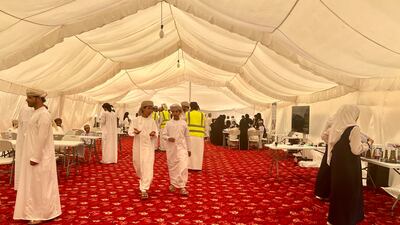
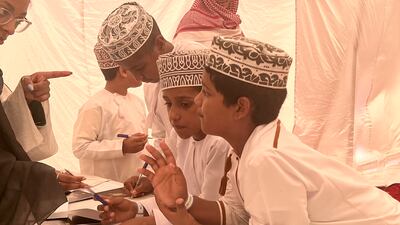
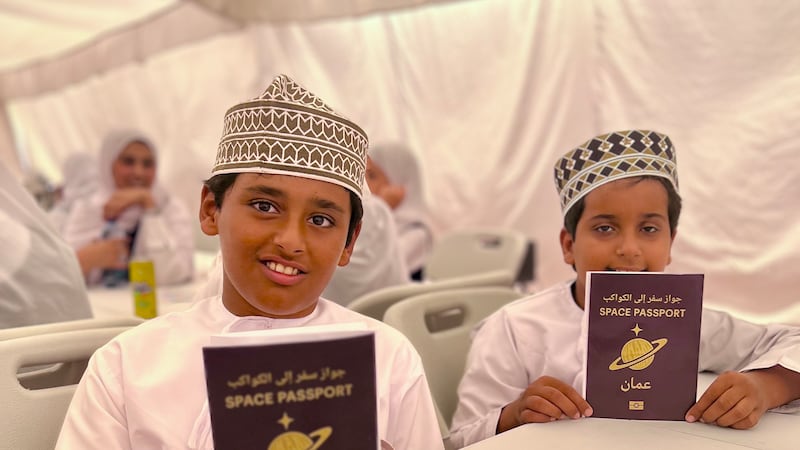
Its first fanzone experience, Etlaq FX, was held alongside the planned launch of Horus-4 this week, bringing in pupils from Omani schools to learn about robotics, satellite building and bottle rocket construction.
Strong winds, however, led to the launch being postponed until next week.
“The idea for the fanzone started after our first launch in December,” said Mr Al-Riyami. "We noticed a lot of interest from the local and regional community.
“The fan zone was designed as a safe and accessible place for people to come, engage and be inspired about the space industry.”
After Horus-4, the next launch from Etlaq is expected at the end of June or in early July, with three more planned for nearer the end of the year.

HEADLINE HERE
- I would recommend writing out the text in the body
- And then copy into this box
- It can be as long as you link
- But I recommend you use the bullet point function (see red square)
- Or try to keep the word count down
- Be wary of other embeds lengthy fact boxes could crash into
- That's about it
Profile of Hala Insurance
Date Started: September 2018
Founders: Walid and Karim Dib
Based: Abu Dhabi
Employees: Nine
Amount raised: $1.2 million
Funders: Oman Technology Fund, AB Accelerator, 500 Startups, private backers
COMPANY%20PROFILE
%3Cp%3E%3Cstrong%3ECompany%20name%3A%3C%2Fstrong%3E%203S%20Money%3Cbr%3E%3Cstrong%3EStarted%3A%3C%2Fstrong%3E%202018%3Cbr%3E%3Cstrong%3EBased%3A%3C%2Fstrong%3E%20London%3Cbr%3E%3Cstrong%3EFounders%3A%3C%2Fstrong%3E%20Ivan%20Zhiznevsky%2C%20Eugene%20Dugaev%20and%20Andrei%20Dikouchine%3Cbr%3E%3Cstrong%3ESector%3A%3C%2Fstrong%3E%20FinTech%3Cbr%3E%3Cstrong%3EInvestment%20stage%3A%3C%2Fstrong%3E%20%245.6%20million%20raised%20in%20total%3C%2Fp%3E%0A
Mercer, the investment consulting arm of US services company Marsh & McLennan, expects its wealth division to at least double its assets under management (AUM) in the Middle East as wealth in the region continues to grow despite economic headwinds, a company official said.
Mercer Wealth, which globally has $160 billion in AUM, plans to boost its AUM in the region to $2-$3bn in the next 2-3 years from the present $1bn, said Yasir AbuShaban, a Dubai-based principal with Mercer Wealth.
“Within the next two to three years, we are looking at reaching $2 to $3 billion as a conservative estimate and we do see an opportunity to do so,” said Mr AbuShaban.
Mercer does not directly make investments, but allocates clients’ money they have discretion to, to professional asset managers. They also provide advice to clients.
“We have buying power. We can negotiate on their (client’s) behalf with asset managers to provide them lower fees than they otherwise would have to get on their own,” he added.
Mercer Wealth’s clients include sovereign wealth funds, family offices, and insurance companies among others.
From its office in Dubai, Mercer also looks after Africa, India and Turkey, where they also see opportunity for growth.
Wealth creation in Middle East and Africa (MEA) grew 8.5 per cent to $8.1 trillion last year from $7.5tn in 2015, higher than last year’s global average of 6 per cent and the second-highest growth in a region after Asia-Pacific which grew 9.9 per cent, according to consultancy Boston Consulting Group (BCG). In the region, where wealth grew just 1.9 per cent in 2015 compared with 2014, a pickup in oil prices has helped in wealth generation.
BCG is forecasting MEA wealth will rise to $12tn by 2021, growing at an annual average of 8 per cent.
Drivers of wealth generation in the region will be split evenly between new wealth creation and growth of performance of existing assets, according to BCG.
Another general trend in the region is clients’ looking for a comprehensive approach to investing, according to Mr AbuShaban.
“Institutional investors or some of the families are seeing a slowdown in the available capital they have to invest and in that sense they are looking at optimizing the way they manage their portfolios and making sure they are not investing haphazardly and different parts of their investment are working together,” said Mr AbuShaban.
Some clients also have a higher appetite for risk, given the low interest-rate environment that does not provide enough yield for some institutional investors. These clients are keen to invest in illiquid assets, such as private equity and infrastructure.
“What we have seen is a desire for higher returns in what has been a low-return environment specifically in various fixed income or bonds,” he said.
“In this environment, we have seen a de facto increase in the risk that clients are taking in things like illiquid investments, private equity investments, infrastructure and private debt, those kind of investments were higher illiquidity results in incrementally higher returns.”
The Abu Dhabi Investment Authority, one of the largest sovereign wealth funds, said in its 2016 report that has gradually increased its exposure in direct private equity and private credit transactions, mainly in Asian markets and especially in China and India. The authority’s private equity department focused on structured equities owing to “their defensive characteristics.”
UAE currency: the story behind the money in your pockets
360Vuz PROFILE
Date started: January 2017
Founder: Khaled Zaatarah
Based: Dubai and Los Angeles
Sector: Technology
Size: 21 employees
Funding: $7 million
Investors: Shorooq Partners, KBW Ventures, Vision Ventures, Hala Ventures, 500Startups, Plug and Play, Magnus Olsson, Samih Toukan, Jonathan Labin
Banthology: Stories from Unwanted Nations
Edited by Sarah Cleave, Comma Press
Islamophobia definition
A widely accepted definition was made by the All Party Parliamentary Group on British Muslims in 2019: “Islamophobia is rooted in racism and is a type of racism that targets expressions of Muslimness or perceived Muslimness.” It further defines it as “inciting hatred or violence against Muslims”.
UAE currency: the story behind the money in your pockets
Gertrude Bell's life in focus
A feature film
At one point, two feature films were in the works, but only German director Werner Herzog’s project starring Nicole Kidman would be made. While there were high hopes he would do a worthy job of directing the biopic, when Queen of the Desert arrived in 2015 it was a disappointment. Critics panned the film, in which Herzog largely glossed over Bell’s political work in favour of her ill-fated romances.
A documentary
A project that did do justice to Bell arrived the next year: Sabine Krayenbuhl and Zeva Oelbaum’s Letters from Baghdad: The Extraordinary Life and Times of Gertrude Bell. Drawing on more than 1,000 pieces of archival footage, 1,700 documents and 1,600 letters, the filmmakers painstakingly pieced together a compelling narrative that managed to convey both the depth of Bell’s experience and her tortured love life.
Books, letters and archives
Two biographies have been written about Bell, and both are worth reading: Georgina Howell’s 2006 book Queen of the Desert and Janet Wallach’s 1996 effort Desert Queen. Bell published several books documenting her travels and there are also several volumes of her letters, although they are hard to find in print. Original documents are housed at the Gertrude Bell Archive at the University of Newcastle, which has an online catalogue.
First Person
Richard Flanagan
Chatto & Windus