


Three astronauts launched to China’s Tiangong Space Station on Thursday for a six-month mission.
It is the seventh mission to the space station, which became operational in 2021.
The Shenzhou-18 mission lifted off aboard a Long March 2F rocket from the Jiuquan spaceport in China at 8.59pm Beijing time (4.59pm UAE time).
China revealed the identities of the crew members on Wednesday.
Ye Guanfu, 43, is the commander, who took part in a mission to the station in 2021.
It is the first space flight for Li Cong, 34, and Li Guangsu, 36.
The crew members will join three astronauts who have been serving a mission since October and are due to land back on April 30.
Tiangong, which translates to “heavenly palace”, is about one fifth of the size of the International Space Station and can accommodate three astronauts, or six people during a short handover.
The T-shaped station includes the Tianhe core module and two laboratory modules, including the Wentian and Mentian.
China has previously said it is open to hosting astronauts from other nations on the station.
The country is quickly emerging as a major space power, having landed three vehicles on the Moon, including the Chang'e-4 mission in 2019, the world's first to touch down on the far side.
Its Zhurong Rover landed on Mars in 2021, where it captured several images of the planet's surface and science data. But it has not woken up from hibernation since 2022.
It also unveiled plans for a station on the Moon's surface, called the International Lunar Research Station.
The US and China are both targeting the same region of the Moon and have a similar timeline, with Washington hoping to land astronauts on the surface by 2026 and China aiming for 2030.
China is developing the Long March 9 rocket to send missions to the Moon.
No human beings have been to the lunar surface since the last Apollo mission in 1972 and new, more advanced, technology is needed to ensure the new era of Moon exploration is safe and sustainable.
The new US-China space race - in pictures
-
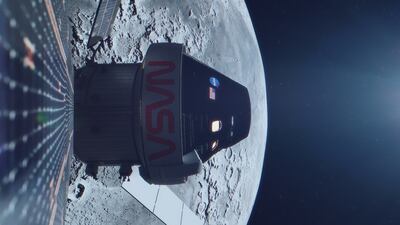
Nasa's Orion spacecraft will carry astronauts to the Moon. It orbited the lunar surface in 2022 as part of an uncrewed test flight. Nasa -
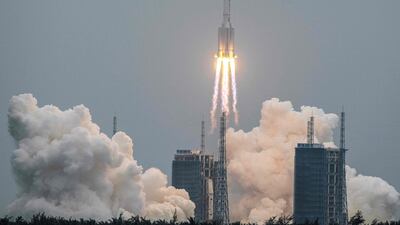
China is developing the Long March 9 rocket, which would be powerful enough for Moon missions. The Long March 5b rocket, pictured, carried China's Tianhe space station module in 2021. AFP -
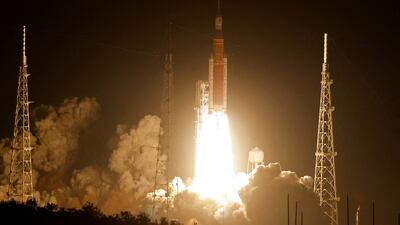
Nasa's Space Launch System, a rocket powerful enough for Moon missions, blasts off on a test flight on November 16, 2022. Reuters -
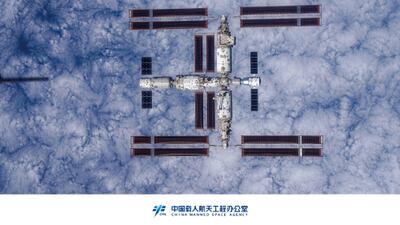
China's Tiangong space station, which is currently hosting astronauts. CMSA -

Chinese astronauts prepare for a flight to the Tiangong space station on May 30, 2023. Getty Images -
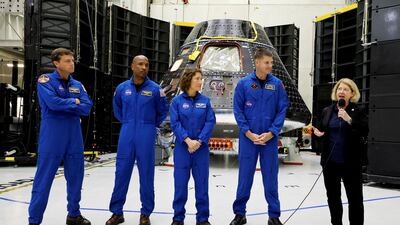
Nasa selected four astronauts to fly around the Moon as part of its Artemis 2 mission, scheduled for 2025. Reuters



