


The first World Cup to grace the Middle East has offered football lovers in the region a golden opportunity to see the thrilling action up close.
Dozens of flights are jetting off from airports across the Gulf each day to offer supporters a flying visit to the tournament.
But that is not the only way to see a match on the very same day you depart.
For those with a sense of adventure, and who don't mind a somewhat longer journey, World Cup 2022 can be an unforgettable road trip.
It is possible to drive from the UAE to Saudi Arabia and hop on a bus to Doha, all on the same day.
The road to the World Cup
I travelled with three friends and we chose to park on the Saudi side of the border. You can park in that specific area for up to 96 hours, free of charge.
To drive the car in Qatar, you would have to pay the much-publicised Dh5,000 fee levied by the authorities to control congestion.
The car park is next to the bus station, police are on patrol and there are cameras that read number plates.
Buses provided by the Saudi government, also free of charge, will take you through to the immigration area on the Qatar side of the border.
Here’s a rundown of what else you can expect on the way from the UAE to Qatar:
0020: We leave Al Shahama in Abu Dhabi on Sunday, November 27, about 20 minutes after midnight. The plan is to arrive in Doha in time for the match between Costa Rica and Japan. It’s not every day that Google Maps tells you to continue driving for 200km.
0240: We drive past Al Ruwais Industrial City. It is home to one of the UAE’s most important industrial complexes.
0310: The Barakah Nuclear Power Plant can be seen a distance from the motorway. The four domes are impressive even at night, with their red lights.
0530: Arrival at Ghuwaifat, the border crossing to Saudi Arabia. Formalities are quick. There are only a few cars and we are lucky to arrive a few minutes before a tour bus carrying passengers to Doha, who will all need their passports stamped at immigration.
0620: We have our fingerprints and other biometrics done on the Saudi side of the border. Our passports are stamped and we pay for short-term car insurance. Once all this is done customs and security officers inspect our luggage and the car. Then we are free to go.
The time difference between the UAE and Saudi Arabia is one hour. It’s 6.30am in the Emirates and 5.30am in Saudi Arabia and Qatar at this point. We gain an hour because of the difference.
0530: We leave the border and begin the drive through Saudi Arabia. Google Maps is handy, but it does get us off-route at one point. Best to have at least one phone that is roaming on data and voice calls.
0730: We arrive at Abu Samra, the border between Saudi Arabia and Qatar. We have not booked parking on the Doha side, but free parking for up to 96 hours is available about 5km from the border in Saudi Arabia. The Saudi authorities are also providing buses, free of cost, to take all travellers to the border with Qatar.
0735: Off the bus and into the immigration offices.
0815: Smile! We have our faces scanned at immigration in Qatar. Outside there are more than 30 buses waiting to carry passengers free of cost to Doha, about 90km away.
0900: We arrive at the Messila Metro Station in Doha, which is a hub for trains and buses travelling across Qatar. We are here four hours before kick-off. We chose to stay at a hotel apartment in Al Wakrah, so we take the Metro there. Ubers are also available, typically within less than five minutes.
World Cup 2022 — in pictures
-

Brazil's Neymar celebrates scoring their second goal with Vinicius Junior, Raphinha and Lucas Paqueta. Reuters -

South Korea's Son Heung-min holds his protective mask after the match. Reuters -

Brazil's Neymar scores their second goal from the penalty spot past South Korea's Kim Seung-gyu. Reuters -

Brazil's Lucas Paqueta in action with South Korea's Son Heung-min. Reuters -

A tribute to Pele by Brazil's fans before the last 16 match against the Republic of Korea. EPA -

A Brazil fan with star player Neymar written on their sunglasses. Reuters -

Fans of Japan show their emotions after their defeat to Croatia. AP Photo -

Japan's Daizen Maeda has been a nuisance for Croatia in the first half. AP -

Japan's Ritsu Doan, right, and Croatia's Josko Gvardiol have been enjoying a solid contest. AFP -

Japan supporters are sliding into the spirit of the World Cup in Qatar. AFP -

Others are finessing their selfie game. Reuters -

When in doubt, dress the whole family in gold. Reuters -
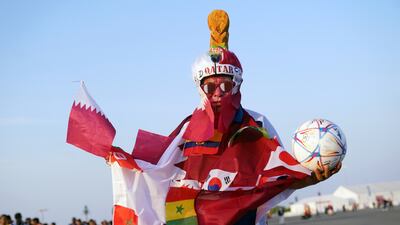
One fan's journey around the world in flag form. AFP -

You won't find someone else wearing the same outfit if you put a boat on your head. Getty Images -

Croatia fans are warming up for the last-16 tie. Reuters -

Lively Croatia supporters are in town. EPA -

Croatia face Japan in the last 16. EPA -
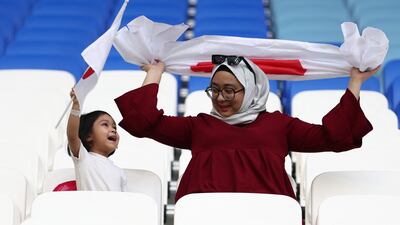
Fans, young and old, are ready for the two teams in the knockout rounds. Reuters -
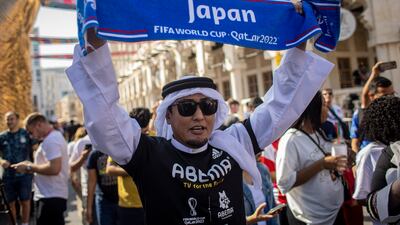
Japan's fans are also at Souq Waqif, Doha. EPA -
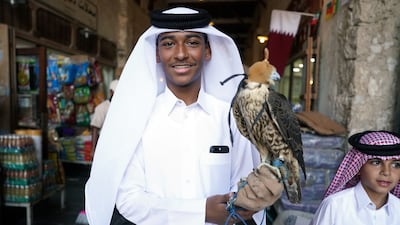
Residents, both with and without feathers, are enjoying the World Cup atmosphere. PA -
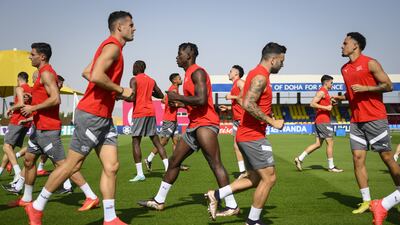
Switzerland's team are preparing for their last-16 tie. EPA -
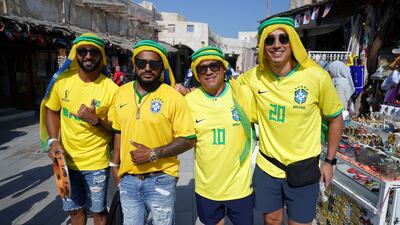
Brazil fans in the Souq area of Doha. PA -

Croatia fans in the Souq area of Doha. PA -
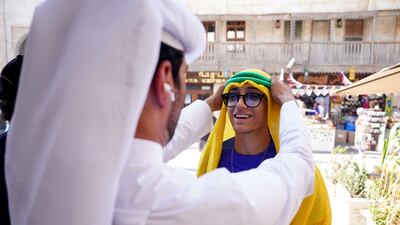
Supporters have been kitted out with themed ghutras in the Souq area of Doha. PA -

Crescent Towers at Lusail, Doha. They have become a beacon of direction for tourists traversing the city. AP Photo



