


Adults in hospital with Covid-19 and the flu at the same time are at much greater risk of severe disease and death compared with patients who have Covid-19 alone or with other viruses, research has shown.
Scientists found that patients who had both Sars-CoV-2, which causes Covid-19, and influenza viruses were more than four times more likely to require ventilation support and 2.4 times more likely to die than if they just had Covid-19.
The study looked at more than 305,000 patients admitted to hospital with Covid-19 and involved researchers from the UK's University of Edinburgh, University of Liverpool, Imperial College London and Leiden University in the Netherlands.
Researchers say the findings show the need for more flu-testing of Covid-19 patients in hospital and highlight the importance of full vaccination against both Covid-19 and the flu.
Kenneth Baillie, professor of experimental medicine at the University of Edinburgh, said: “We found that the combination of Covid-19 and flu viruses is particularly dangerous.
“This will be important as many countries decrease the use of social distancing and containment measures.
“We expect that Covid-19 will circulate with flu, increasing the chance of co-infections. That is why we should change our testing strategy for Covid-19 patients in hospital and test for flu much more widely.”
The team looked at the data of adults who had been admitted to hospital with Covid-19 in the UK between February 6 2020 and December 8 2021.
-

Ukrainians are registered by health workers while waiting to be vaccinated against the coronavirus at their country's embassy in German capital Berlin. EPA -

German Health Minister Karl Lauterbach, who studied medicine, vaccinates a man in the Vaccination Helps tour bus, at the project's launch in Berlin. EPA -

A medical worker holds a syringe containing a shot of the Nuvaxovid vaccine by Novavax at the Tegel vaccination center in Berlin. Getty Images -

A man wearing a face mask walks past the Louvre Pyramid, at the Louvre museum, in French capital Paris. Reuters -
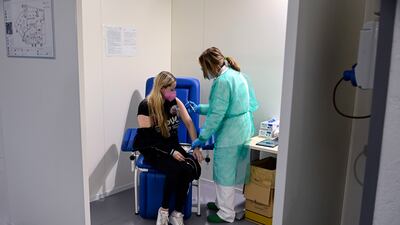
A Ukrainian refugee gets a Covid-19 vaccine at the Acea Hub in Italy's capital Rome. EPA -

Protesters hold torches to burn Covid-19 vaccination passes, during a demonstration at Castello Square, in Turin, Italy. EPA -

Ukrainian mezzosoprano Maria Melnychyn performs with the La Fura dels Baus theatre company at Vall d'Hebron hospital, in Barcelona, Spain, to mark the second anniversary of the beginning of the pandemic. EPA -
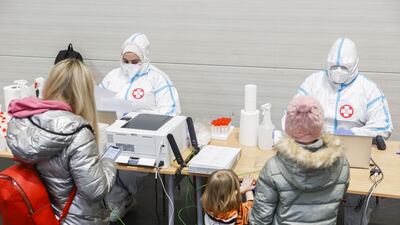
Ukrainian refugees are tested for coronavirus in a reception centre in Vienna, Austria. AFP


Test results for respiratory viral co-infections were recorded for 6,965 patients with Covid-19.
Some 227 of these also had the influenza virus, and they experienced significantly more severe outcomes, researchers found.
Prof Calum Semple, who specialises in child health and outbreak medicine at the University of Liverpool, said: “We are seeing a rise in the usual seasonal respiratory viruses as people return to normal mixing.
“So, we can expect flu to be circulating alongside Covid-19 this winter. We were surprised that the risk of death more than doubled when people were infected by both flu and Covid-19 viruses.
“It is now very important that people get fully vaccinated and boosted against both viruses, and not leave it until it is too late.”
The research, delivered as part of the International Severe Acute Respiratory and Emerging Infection Consortium’s (Isaric) Coronavirus Clinical Characterisation Consortium, is said to be the largest ever study of people with Covid-19 and other endemic respiratory viruses.
Isaric’s study was set up in 2013 in readiness for a pandemic such as this.
Peter Openshaw, professor of experimental medicine at Imperial College London, said: “Being infected with more than one virus is not very common but it’s important to be aware that co-infections do happen.
“The vaccines that protect against Covid-19 and flu are different, and people need both. The way that these two infections are treated is also different so it’s important to test for other viruses even when you have a diagnosis in someone who is hospitalised with a respiratory infection.
“This latest discovery by the Isaric consortium again adds significantly to improving the way we manage patients.”
The findings have been published in a research letter in The Lancet.

