



As it grapples with its worst Covid-19 outbreak so far, Hong Kong has seen its per capita death rate from the coronavirus rise to exceptionally high levels.
After it long maintained a zero-Covid strategy, in which efforts were made to stamp out every outbreak, Hong Kong’s seven-day rolling average of deaths has exceeded 38 per million people — the highest in the world after the Cayman Islands.
Hospitals have overflowed, medical staff have reportedly been working 80 hours a week and healthcare workers have been arriving from mainland China to help with the crisis.
So what has gone wrong in a territory that, until recently, had coped well with the pandemic?
And what does it mean for the continuation of the zero-Covid policy — in both mainland China and Hong Kong?
Why have deaths surged in Hong Kong?
The easily transmissible Omicron variant — first detected in Hong Kong in late December — has proved resistant to the territory’s zero-Covid measures, such as mask wearing, quarantining, contact tracing and border controls.
At the end of last year, Hong Kong had recorded only slightly more than 200 Covid-19 deaths, but now it is experiencing more than that number each day.
In total, more than 4,500 people have died from the coronavirus in Hong Kong, similar to the official figure for mainland China, which has almost 200 times as many people.
As cases surged, the virus swept through the elderly population, with deaths in care homes offering a chilling echo of what was seen in some other nations early in the pandemic.
The elderly have been especially vulnerable because of low vaccination rates.
According to the British Medical Journal, by February 7, around which time case numbers really began to surge, a mere 22.5 per cent of over 80s and 50.9 per cent of 70 to 79-year-olds in Hong Kong were fully vaccinated.
So when case numbers multiplied 300-fold in the month to March 5, Hong Kong’s elderly had little protection against the coronavirus.
“The elderly population has very low vaccination rates. That’s why you’re seeing a lot of elderly infected and a lot of mortality in the elderly population,” said Dr Tun Hein-Min, an assistant professor at the School of Public Health at the University of Hong Kong.

Why were so few elderly people vaccinated?
According to Dr Tun, there may have been a degree of complacency among older people about the need to be vaccinated.
“Because the Hong Kong Covid situation … [was] well controlled, the elderly population had this sense they didn’t really need a vaccination because there’s not much infection spreading,” he said.
“They have these myths about vaccine side effects, anti-vaccine kind of knowledge. They’re not very compliant.”
Professor Yanzhong Huang, from Seton Hall University in the US, who researches public health in China and East Asia, said the low vaccination rates were in part “the fault of the Hong Kong government in not being proactive in promoting vaccination to the elderly”.
“It’s one of the highest death rates in the world because of the low vaccination rate in the elderly,” he said.
The case fatality rate — the proportion of recorded positive cases that results in a fatality — is almost 5 per cent, an extremely high figure due in large part to the poor vaccination rates among the elderly.
Observers have noted that New Zealand’s case numbers has climbed rapidly too in recent weeks, but thanks to high vaccination rates among the elderly, its case fatality rate has been just 0.1 per cent.
Case numbers in Hong Kong have fallen significantly from their peak of more than 50,000 a day in early March, but deaths have yet to decline.
What does this mean for the zero-Covid strategy?
While the Omicron variant makes it harder to have a successful zero-Covid approach, in which huge efforts are made to prevent the virus’s spread, Dr Tun said it was imperative that Hong Kong continued to try to limit case numbers.
“If you have a very large population of unvaccinated people, the most important thing is to control the spread of the virus this time,” he said.
He said it was important to redouble efforts to vaccinate older people, and youngsters too, to offer protection from severe illness and to prevent the spread of the virus.
“We don’t have a lot of vaccination,” he said. “We need to be very cautious … because the unvaccinated people are still quite a lot of the population. We need to make sure these people get vaccinated and have immunity.”
A study in the Dominican Republic, which involved Yale University researchers and was released in January, found that after two doses of Sinovac’s CoronaVac vaccine, which has been widely administered in Hong Kong, people’s antibodies did not have a detectable neutralising effect on the Omicron variant.
However, after a booster of an mRNA vaccine, such as Pfizer and Moderna, a good level of neutralising activity was detected.
This indicates that because of the shots used, vaccination in Hong Kong may not have offered a high level of protection against Omicron, and that an mRNA booster could prove highly beneficial.

What lessons does Hong Kong have for the Chinese mainland?
Estimates suggest that mainland China may face similar problems to Hong Kong, but on a much larger scale. The mainland has an estimated 15 million unvaccinated over-80s — double Hong Kong’s total population of all ages.
Among over-60s, an estimated 50 million were unvaccinated in November 2021, according to Professor Huang, so there are large numbers of people at severe risk should case numbers spiral.
The city of Shenzhen, which is close to Hong Kong, has gone into lockdown, and other control measures are in place elsewhere in the country as the authorities try to prevent a surge.
“This worst-case scenario is an Omicron outbreak [that] is going to overwhelm the healthcare system because the hospitals will be overloaded,” Prof Huang said.
“There’s also this sector of the population who are so vulnerable to the virus and are more likely to become severe cases. Now the government has become more proactive in promoting the booster shots.”
He said booster shots of inactivated virus vaccines, of which the Sinovac jab is one, would have limited effectiveness at strengthening the immunity of elderly people, and said mRNA shots should be used instead.
“It’s imperative to approve the more effective [Pfizer]-BioNTech vaccine and use that with the elderly population, and make available the antiviral drugs … to the people in mainland China,” Prof Huang said.
There has been a months-long wait for the Pfizer-BioNTech vaccine to be approved in China, but in January BioNTech confirmed it remained “committed” to securing the green light.
“I think what is happening in Hong Kong will convince the policymakers in Beijing a laissez-faire approach is not a good idea and they have to cling to a zero-Covid strategy, even double-down on the containment measures in the near term,” Prof Huang added.
Hong Kong culls hamsters and small pets over Covid-19 fears — in pictures
-

A hamster named 'Marshmallow' plays inside a cage before being dropped off at the New Territories South Animal Management Centre in the Shatin area of Hong Kong. Bertha Wang / AFP -
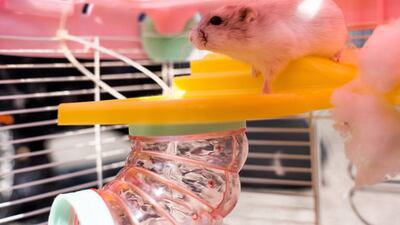
Pet owners were instructed by the government to give up recently purchased hamsters, chinchillas, rabbits and guinea pigs as the city culls thousands of small animals after hamsters in a pet store tested positive for Covid-19. Bertha Wang / AFP -

The hamsters, on sale at the Little Boss pet shop, tested positive for the Delta variant, now rare in Hong Kong. Bertha Wang / AFP -

Workers with Hong Kong's Agriculture, Fisheries and Conservation Department arrive at the Little Boss pet store. Bloomberg -

Hong Kong maintains a zero-Covid policy, stamping out the smallest signs of the virus with contact tracing, mass testing, strict quarantines and prolonged social-distancing rules. Reuters -

Officers in protective suits work inside the pet shop in Hong Kong's Mong Kok district. Reuters -

On Tuesday night, officials dressed in full PPE gear carried garbage bags marked with biohazard warnings out of the shop. Reuters -

Police officers stand guard outside the store, which is now temporarily closed. Reuters -

Authorities on Tuesday said the Covid-positive creatures were believed to be imported from the Netherlands. Reuters / Lam Yik -

Hong Kong's health secretary defended the move as part of 'precautionary measures against any vector of transmission'. Reuters -

The import of small mammals has also been halted. Reuters -

Animal lovers across Hong Kong reacted to the move with alarm, with more than 23,000 signing a Change.org petition in less than a day. Reuters -

A number of pet owners are defiant and resisting the government cull. Reuters



