People wait in line at a Covid-19 testing site in Times Square, New York. AP

Global Covid death toll may be ‘three times higher than official estimates’


Neil Murphy
  • English
  • Arabic

The actual number of global deaths from Covid-19 could be more than three times higher than official records suggest, a study has shown.

It is estimated that more than 18.2 million people may have died from coronavirus through the end of December last year.

This is despite the official Covid death toll indicating that 5.9 million people lost their lives between January 1 2020 and December 31, 2021.

Excess deaths — the difference between total deaths and the number expected based on past trends — are a key measure of the true death toll of the pandemic.

Although experts have made several attempts to estimate excess deaths from Covid, many have been limited by the availability of data.

The new study, published in The Lancet, provides the first peer-reviewed estimates of excess deaths — direct and indirect — due to the pandemic globally and for 191 countries and territories between January 2020 and December 2021.

Lead author Dr Haidong Wang, of the Institute for Health Metrics and Evaluation, said: “Understanding the true death toll from the pandemic is vital for effective public health decision-making.

“Studies from several countries, including Sweden and the Netherlands, suggest Covid-19 was the direct cause of most excess deaths, but we currently don’t have enough evidence for most locations.

“Further research will help to reveal how many deaths were caused directly by Covid-19 and how many occurred as an indirect result of the pandemic.”

Researchers collected weekly or monthly data on deaths from all causes in 2021, 2020 and up to 11 previous years for 74 countries and 266 states and provinces through searches of government websites, the World Mortality Database, the Human Mortality Database and the European Statistical Office.

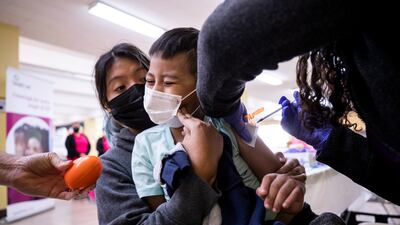
  • A 6-year-old receives a dose of the Pfizer Covid-19 vaccine at a vaccination clinic in Los Angeles. EPA
    A 6-year-old receives a dose of the Pfizer Covid-19 vaccine at a vaccination clinic in Los Angeles. EPA
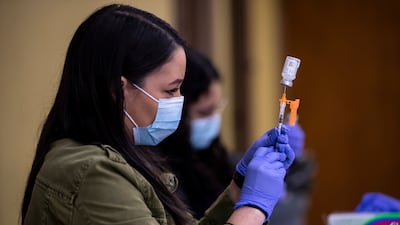
  • Nurses prepare doses of Covid-19 vaccine at a pop-up vaccination clinic in Los Angeles, California. EPA
    Nurses prepare doses of Covid-19 vaccine at a pop-up vaccination clinic in Los Angeles, California. EPA
  • A product stall filled with free N95 respirator masks, provided by the US Department of Health and Human Services, sits outside the pharmacy at a Jackson, Mississippi, Kroger grocery store. AP
    A product stall filled with free N95 respirator masks, provided by the US Department of Health and Human Services, sits outside the pharmacy at a Jackson, Mississippi, Kroger grocery store. AP
  • A hospital sitter provides companionship, observation and surveillance to assigned patients at St Mary Medical Centre in Apple Valley, California. Reuters
    A hospital sitter provides companionship, observation and surveillance to assigned patients at St Mary Medical Centre in Apple Valley, California. Reuters
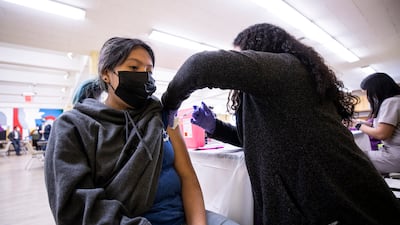
  • A 13-year old receives a dose of the Pfizer Covid-19 vaccine at a clinic in Los Angeles. EPA
    A 13-year old receives a dose of the Pfizer Covid-19 vaccine at a clinic in Los Angeles. EPA
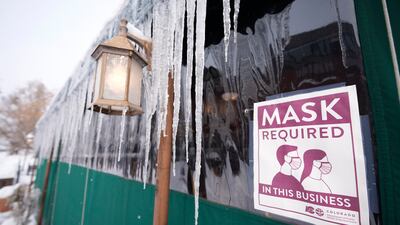
  • A sign advises patrons of a Covid-19 restriction while long icicles grow from an awning outside a restaurant in Denver, Colorado. AP
    A sign advises patrons of a Covid-19 restriction while long icicles grow from an awning outside a restaurant in Denver, Colorado. AP
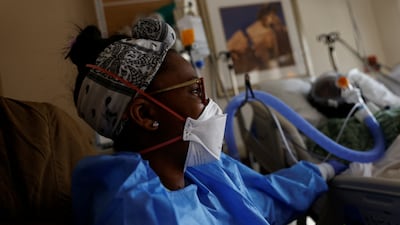
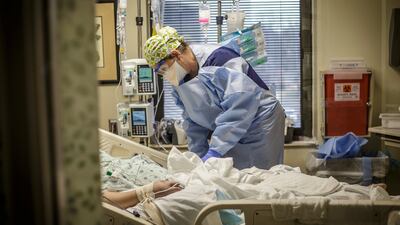
  • A registered nurse works with a Covid-19 patient inside the infectious disease unit (IDU) at Helen Keller Hospital in Sheffield, Alabama. AP
    A registered nurse works with a Covid-19 patient inside the infectious disease unit (IDU) at Helen Keller Hospital in Sheffield, Alabama. AP
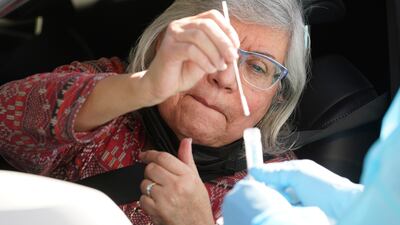
  • A person self-tests for Covid-19 at a free drive-through testing site in Whittier, California. AP
    A person self-tests for Covid-19 at a free drive-through testing site in Whittier, California. AP
  • Workers wear protective equipment at a Covid-19 testing site in the Boyle Heights section of Los Angeles. AP
    Workers wear protective equipment at a Covid-19 testing site in the Boyle Heights section of Los Angeles. AP
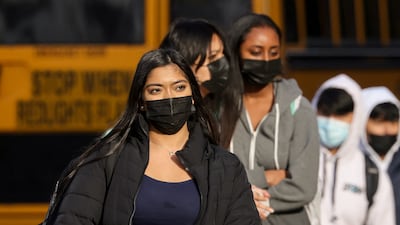
  • Pupils leave a high school in Arlington County, one of several school districts which sued to stop the mask-optional order by Governor Glenn Youngkin, in Arlington, Virginia. Reuters
    Pupils leave a high school in Arlington County, one of several school districts which sued to stop the mask-optional order by Governor Glenn Youngkin, in Arlington, Virginia. Reuters
  • Protesters rally against Covid-19 vaccine mandates in front of the Lincoln Memorial in Washington. AP
    Protesters rally against Covid-19 vaccine mandates in front of the Lincoln Memorial in Washington. AP
  • People wearing face masks walk past a business displaying a sign requiring face coverings in Washington. Reuters
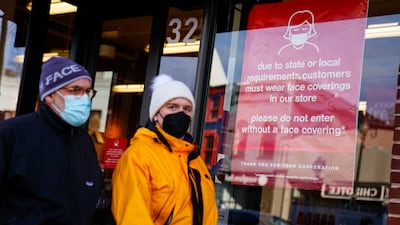
    People wearing face masks walk past a business displaying a sign requiring face coverings in Washington. Reuters

The data were used in models to estimate excess deaths due to Covid-19, including in locations with no weekly or monthly reporting of death data.

The excess death rate is estimated to be 120 deaths per 100,000 people globally, but 21 countries were estimated to have rates of more than 300 excess deaths per 100,000.

The research shows rates of excess death are estimated to have varied significantly by country and region.

The highest estimated excess deaths were in Andean Latin America — 512 deaths per 100,000 people; Eastern Europe — 345 deaths per 100,000; Central Europe — 316 deaths per 100,000; Southern Sub-Saharan Africa — 309 deaths per 100,000; and Central Latin America — 274 deaths per 100,000.

“Studies from several countries, including Sweden and the Netherlands, suggest Covid-19 was the direct cause of most excess deaths, but we currently don’t have enough evidence for most locations
Dr Haidong Wang,
Institute for Health Metrics and Evaluation

Outside these regions, several locations are estimated to have had similarly high rates, including Lebanon, Armenia, Tunisia, Libya, several regions of Italy, and several states in the southern US.

However, in stark contrast, some countries were estimated to have had fewer deaths than expected based on trends in prior years.

These included Iceland, with 48 fewer deaths per 100,000; Australia, with 38 fewer deaths per 100,000; and Singapore, with 16 fewer deaths per 100,000.

South Asia had the highest number of estimated excess deaths from Covid, with 5.3 million excess deaths, followed by North Africa and the Middle East (1.7 million), and Eastern Europe (1.4 million).

At the country level, the highest number of estimated excess deaths occurred in India (4.1 million) and the US and Russia, both with 1.1 million.

Along with Mexico (798,000), Brazil (792,000), Indonesia (736,000) and Pakistan (664,000), these countries may have accounted for more than half of global excess deaths over the 24-month period studied, the research suggests.

Researchers say the large differences between excess deaths and official records may be because of under-diagnosis due to a lack of testing and issues with death data being reported.

They say it is crucial to distinguish between deaths caused directly by Covid and those that occurred as an indirect result of the pandemic.

Evidence from initial studies suggests a significant proportion of excess deaths were a direct result of coronavirus, however deaths may also have occurred indirectly from causes such as suicide or drug use due to behavioural changes or lack of access to health care and other essential services.

To date, only 36 countries have released cause of death data for 2020.

As data from more countries become available, scientists will have a better idea of how many deaths were caused directly by Covid and how many occurred as an indirect result.

The authors acknowledge a number of limitations to their study, including that a statistical model was used to predict excess deaths for countries that did not report weekly or monthly data.


Quick pearls of wisdom

Focus on gratitude: And do so deeply, he says. “Think of one to three things a day that you’re grateful for. It needs to be specific, too, don’t just say ‘air.’ Really think about it. If you’re grateful for, say, what your parents have done for you, that will motivate you to do more for the world.”

Know how to fight: Shetty married his wife, Radhi, three years ago (he met her in a meditation class before he went off and became a monk). He says they’ve had to learn to respect each other’s “fighting styles” – he’s a talk it-out-immediately person, while she needs space to think. “When you’re having an argument, remember, it’s not you against each other. It’s both of you against the problem. When you win, they lose. If you’re on a team you have to win together.” 

Wenger's Arsenal reign in numbers

1,228 - games at the helm, ahead of Sunday's Premier League fixture against West Ham United.
704 - wins to date as Arsenal manager.
3 - Premier League title wins, the last during an unbeaten Invincibles campaign of 2003/04.
1,549 - goals scored in Premier League matches by Wenger's teams.
10 - major trophies won.
473 - Premier League victories.
7 - FA Cup triumphs, with three of those having come the last four seasons.
151 - Premier League losses.
21 - full seasons in charge.
49 - games unbeaten in the Premier League from May 2003 to October 2004.

Farage on Muslim Brotherhood

Nigel Farage told Reform's annual conference that the party will proscribe the Muslim Brotherhood if he becomes Prime Minister.
"We will stop dangerous organisations with links to terrorism operating in our country," he said. "Quite why we've been so gutless about this – both Labour and Conservative – I don't know.
“All across the Middle East, countries have banned and proscribed the Muslim Brotherhood as a dangerous organisation. We will do the very same.”
It is 10 years since a ground-breaking report into the Muslim Brotherhood by Sir John Jenkins.
Among the former diplomat's findings was an assessment that “the use of extreme violence in the pursuit of the perfect Islamic society” has “never been institutionally disowned” by the movement.
The prime minister at the time, David Cameron, who commissioned the report, said membership or association with the Muslim Brotherhood was a "possible indicator of extremism" but it would not be banned.

Profile box

Founders: Michele Ferrario, Nino Ulsamer and Freddy Lim
Started: established in 2016 and launched in July 2017
Based: Singapore, with offices in the UAE, Malaysia, Hong Kong, Thailand
Sector: FinTech, wealth management
Initial investment: $500,000 in seed round 1 in 2016; $2.2m in seed round 2 in 2017; $5m in series A round in 2018; $12m in series B round in 2019; $16m in series C round in 2020 and $25m in series D round in 2021
Current staff: more than 160 employees
Stage: series D 
Investors: EightRoads Ventures, Square Peg Capital, Sequoia Capital India

SCHEDULE

Saturday, April 20: 11am to 7pm - Abu Dhabi World Jiu-Jitsu Festival and Para jiu-jitsu.

Sunday, April 21: 11am to 6pm - Abu Dhabi World Youth (female) Jiu-Jitsu Championship.

Monday, April 22: 11am to 6pm - Abu Dhabi World Youth (male) Jiu-Jitsu Championship.

Tuesday, April 23: 11am-6pm Abu Dhabi World Masters Jiu-Jitsu Championship.

Wednesday, April 24: 11am-6pm Abu Dhabi World Professional Jiu-Jitsu Championship.

Thursday, April 25: 11am-5pm Abu Dhabi World Professional Jiu-Jitsu Championship.

Friday, April 26: 3pm to 6pm Finals of the Abu Dhabi World Professional Jiu-Jitsu Championship.

Saturday, April 27: 4pm and 8pm awards ceremony.

65
%3Cp%3E%3Cstrong%3EDirectors%3A%20%3C%2Fstrong%3EScott%20Beck%2C%20Bryan%20Woods%3C%2Fp%3E%0A%3Cp%3E%3Cstrong%3EStars%3A%20%3C%2Fstrong%3EAdam%20Driver%2C%20Ariana%20Greenblatt%2C%20Chloe%20Coleman%3C%2Fp%3E%0A%3Cp%3E%3Cstrong%3ERating%3A%20%3C%2Fstrong%3E2%2F5%3C%2Fp%3E%0A

Mercer, the investment consulting arm of US services company Marsh & McLennan, expects its wealth division to at least double its assets under management (AUM) in the Middle East as wealth in the region continues to grow despite economic headwinds, a company official said.

Mercer Wealth, which globally has $160 billion in AUM, plans to boost its AUM in the region to $2-$3bn in the next 2-3 years from the present $1bn, said Yasir AbuShaban, a Dubai-based principal with Mercer Wealth.

Within the next two to three years, we are looking at reaching $2 to $3 billion as a conservative estimate and we do see an opportunity to do so,” said Mr AbuShaban.

Mercer does not directly make investments, but allocates clients’ money they have discretion to, to professional asset managers. They also provide advice to clients.

“We have buying power. We can negotiate on their (client’s) behalf with asset managers to provide them lower fees than they otherwise would have to get on their own,” he added.

Mercer Wealth’s clients include sovereign wealth funds, family offices, and insurance companies among others.

From its office in Dubai, Mercer also looks after Africa, India and Turkey, where they also see opportunity for growth.

Wealth creation in Middle East and Africa (MEA) grew 8.5 per cent to $8.1 trillion last year from $7.5tn in 2015, higher than last year’s global average of 6 per cent and the second-highest growth in a region after Asia-Pacific which grew 9.9 per cent, according to consultancy Boston Consulting Group (BCG). In the region, where wealth grew just 1.9 per cent in 2015 compared with 2014, a pickup in oil prices has helped in wealth generation.

BCG is forecasting MEA wealth will rise to $12tn by 2021, growing at an annual average of 8 per cent.

Drivers of wealth generation in the region will be split evenly between new wealth creation and growth of performance of existing assets, according to BCG.

Another general trend in the region is clients’ looking for a comprehensive approach to investing, according to Mr AbuShaban.

“Institutional investors or some of the families are seeing a slowdown in the available capital they have to invest and in that sense they are looking at optimizing the way they manage their portfolios and making sure they are not investing haphazardly and different parts of their investment are working together,” said Mr AbuShaban.

Some clients also have a higher appetite for risk, given the low interest-rate environment that does not provide enough yield for some institutional investors. These clients are keen to invest in illiquid assets, such as private equity and infrastructure.

“What we have seen is a desire for higher returns in what has been a low-return environment specifically in various fixed income or bonds,” he said.

“In this environment, we have seen a de facto increase in the risk that clients are taking in things like illiquid investments, private equity investments, infrastructure and private debt, those kind of investments were higher illiquidity results in incrementally higher returns.”

The Abu Dhabi Investment Authority, one of the largest sovereign wealth funds, said in its 2016 report that has gradually increased its exposure in direct private equity and private credit transactions, mainly in Asian markets and especially in China and India. The authority’s private equity department focused on structured equities owing to “their defensive characteristics.”

Company%20profile
%3Cp%3E%3Cstrong%3EName%3A%3C%2Fstrong%3E%20JustClean%3Cbr%3E%3Cbr%3E%3Cstrong%3EBased%3A%20%3C%2Fstrong%3EDubai%20with%20offices%20in%20other%20GCC%20countries%3Cbr%3E%3Cbr%3E%3Cstrong%3ELaunch%20year%3A%3C%2Fstrong%3E%202016%3Cbr%3E%3Cbr%3E%3Cstrong%3ENumber%20of%20employees%3A%3C%2Fstrong%3E%20160%2B%20with%2021%20nationalities%20in%20eight%20cities%3Cbr%3E%3Cstrong%3E%3Cbr%3ESector%3A%3C%2Fstrong%3E%20online%20laundry%20and%20cleaning%20services%3Cbr%3E%3Cbr%3E%3Cstrong%3EFunding%3A%20%3C%2Fstrong%3E%2430m%20from%20Kuwait-based%20Faith%20Capital%20Holding%20and%20Gulf%20Investment%20Corporation%3C%2Fp%3E%0A
Classification of skills

A worker is categorised as skilled by the MOHRE based on nine levels given in the International Standard Classification of Occupations (ISCO) issued by the International Labour Organisation. 

A skilled worker would be someone at a professional level (levels 1 – 5) which includes managers, professionals, technicians and associate professionals, clerical support workers, and service and sales workers.

The worker must also have an attested educational certificate higher than secondary or an equivalent certification, and earn a monthly salary of at least Dh4,000. 

Results
%3Cp%3E%0D%3Cstrong%3EElite%20men%3C%2Fstrong%3E%0D%3Cbr%3E1.%20Amare%20Hailemichael%20Samson%20(ERI)%202%3A07%3A10%0D%3Cbr%3E2.%20Leornard%20Barsoton%20(KEN)%202%3A09%3A37%0D%3Cbr%3E3.%20Ilham%20Ozbilan%20(TUR)%202%3A10%3A16%0D%3Cbr%3E4.%20Gideon%20Chepkonga%20(KEN)%202%3A11%3A17%0D%3Cbr%3E5.%20Isaac%20Timoi%20(KEN)%202%3A11%3A34%0D%3Cbr%3E%3Cstrong%3EElite%20women%3C%2Fstrong%3E%0D%3Cbr%3E1.%20Brigid%20Kosgei%20(KEN)%202%3A19%3A15%0D%3Cbr%3E2.%20Hawi%20Feysa%20Gejia%20(ETH)%202%3A24%3A03%0D%3Cbr%3E3.%20Sintayehu%20Dessi%20(ETH)%202%3A25%3A36%0D%3Cbr%3E4.%20Aurelia%20Kiptui%20(KEN)%202%3A28%3A59%0D%3Cbr%3E5.%20Emily%20Kipchumba%20(KEN)%202%3A29%3A52%3C%2Fp%3E%0A
Updated: May 31, 2023, 10:34 AM