


The Netherlands will this week lift some of Europe's toughest Covid restrictions, with bars, restaurants and museums allowed to reopen their doors, Prime Minister Mark Rutte said on Tuesday.
Mr Rutte said the move, which takes effect from Wednesday, was in response to "great tensions" with the catering and cultural sectors over restrictions imposed days before Christmas.
"The Netherlands has missed you," he said. "Today we are taking a big step to further unlock the Netherlands.
"That feels contradictory while the contamination figures are going through the roof, and we have to be clear that we are taking a risk."
Anger mounted after Dutch shops, gyms and hairdressers were allowed to resume business on January 15, but other venues had to stay shut.
Cafes in several cities opened in defiance of the restrictions the weekend before last, while dozens of museums opened as beauty salons for a day in protest.
Mr Rutte said that the government was "consciously looking for the limits of what is possible, because of the great tensions and cries for help in recent days".
While new infections are running at about 60,000 a day, fuelled by the Omicron coronavirus variant, intensive care admissions and deaths have been falling in the Netherlands.
-
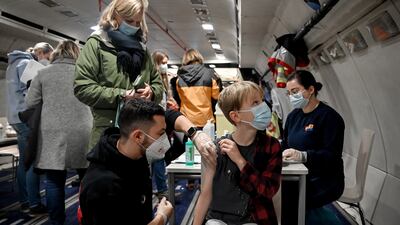
Jannik, 9, gets vaccinated in an airplane at Cologne Bonn Airport in Germany. The city is hosting a special vaccination event for children aged 5 to 11 in a decommissioned Airbus A300 Zero G. EPA -
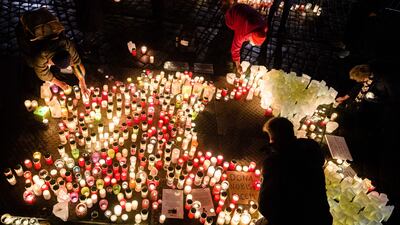
People place candles in Neumarkt Square, Dresden to commemorate the 1,400 lives lost to the coronavirus in the German city. AFP -
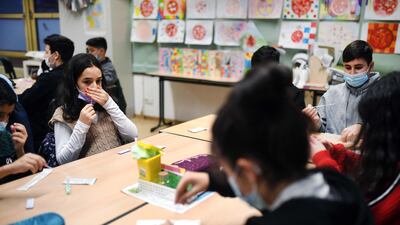
Pupils take a sample for a rapid test during the first lesson after Christmas holidays at the Freiherr-vom-Stein secondary school in Bonn, western Germany. AFP -

Protesters demonstrate against Covid-19 measures and compulsory vaccination in Frankfurt, Germany. AP -
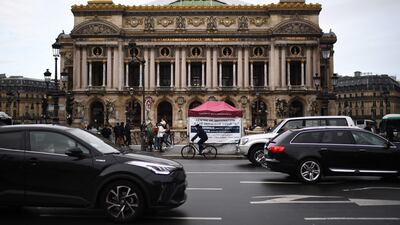
A cyclist rides past a tent where patients are undergoing coronavirus tests, at the Opera square in Paris. AFP -
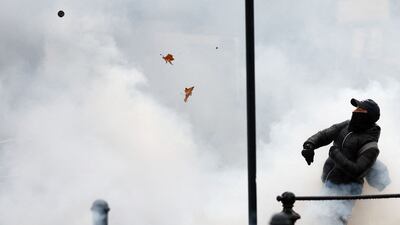
A protestor in Nantes, France throws a tear gas canister during a demonstration against a bill that would transform the country's current coronavirus health pass into a 'vaccine pass'. Reuters -

A group of young students wearing masks disinfect their hands before entering the Luis Amigo school after the Christmas holidays, in Pamplona, northern Spain. AP -
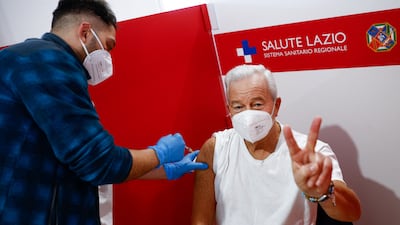
A man receives a dose of a Covid-19 vaccine at a Red Cross centre in Rome. Reuters -
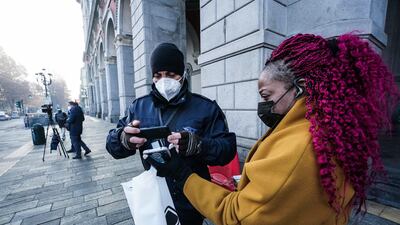
Traffic police check the green pass of public transport passengers in Turin, Italy. EPA -
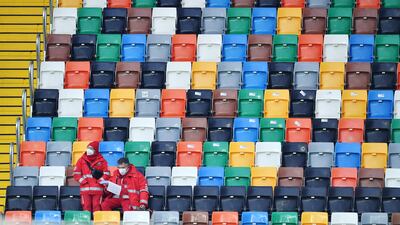
Empty seats inside the stadium before a football match between Udinese and Atalanta, as coronavirus restrictions limit the capacity to 50 percent in Udine, Italy. Reuters -

People sit in a waiting area in case of an immediate reaction after receiving booster shots at a Covid-19 vaccination centre set up in Schiphol Airport in Amsterdam. AFP -
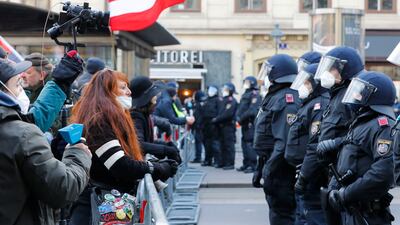
People in Vienna scream at police as officers stop a demonstration against Austria's coronavirus restrictions. AP


Health Minister Ernst Kuipers warned that it was "not the flu" and that the situation remained sensitive, with the number of people requiring hospital treatment rising again this week after a long period of decline.
But Mr Kuipers said relaxing the curbs was important because "living for longer with restrictive measures harms our health and our society".
Cafes bars and restaurants can open again until 10pm from Wednesday, as long as patrons have a Covid pass, wear masks when not seated and capacity is reduced, the government said.
Cinemas, theatres and museums may also welcome back customers, but nightclubs must stay closed for now.
Fans can also return to football matches and other professional sports, but stadium capacity will be limited.
Quarantine rules for schools will also be relaxed, with classes no longer having to shut if three or more cases are confirmed, and children under 18 no longer need to isolate after contact with an infected person.
But the government is still urging people to work at home and limit the number of visitors to four.
The current measures will remain in place until at least March 8.

