People line up outside a pharmacy for Covid-19 swab tests in Milan. AP.

Italy tightens rules for unvaccinated amid Omicron spread


Neil Murphy
  • English
  • Arabic

Italy will impose new restrictions against unvaccinated people to stop the spread of the new Omicron coronavirus variant that has pushed infections to the country’s highest one-day total.

Under the new rules, people who have not been vaccinated will be barred from entering museums, exhibitions, amusement parks, bingo parlours and betting halls – places that until now they could access with a negative test result.

Already barred from seating in restaurants, their dining options have now been completely shut down as they can no longer be served standing at a bar.

“It is important that we present a series of measures to respond to the growth of cases that we see in the last days, due to the arrival in our country in a significant way of the Omicron variant,” Health Minister Roberto Speranza said.

Italians are preparing to celebrate the Christmas holiday weekend, with many planning family gatherings that were barred last year during the surge of the Delta variant.

The government has not ordered any rules for private gatherings, but it has set its sights on New Year’s Eve, banning outdoor events and closing discos until the end of January.

The new regulations will be gradually implemented, starting on Friday.

Long lines formed at testing sites in Milan on Thursday, as people worried about suspected cases sought to be tested alongside those who continue to be tested every 48 hours to have access to workplaces.

And in neighbouring Veneto, some testing sites for PCR swabs posted notices that they had exhausted their available appointments for the next 60 days.

Coronavirus in Europe - in pictures

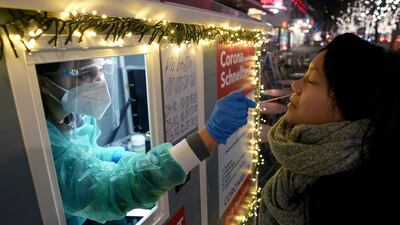
  • A health centre employee performs a coronavirus test in the Kurfuerstendamm shopping street in Berlin, Germany. AP Photo
    A health centre employee performs a coronavirus test in the Kurfuerstendamm shopping street in Berlin, Germany. AP Photo
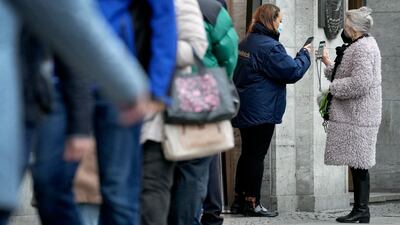
  • People present their vaccination status as they queue in front of the famous department store 'KaDeWe' in Berlin. AP Photo
    People present their vaccination status as they queue in front of the famous department store 'KaDeWe' in Berlin. AP Photo
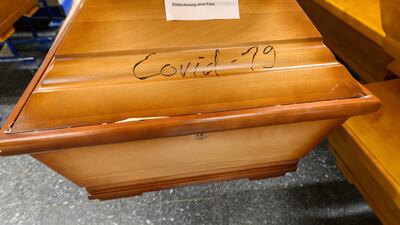
  • A coffin which contains a person who died with the coronavirus, and is labelled "Covid-19", in a crematorium's cold room in Meissen, Germany. AP Photo
    A coffin which contains a person who died with the coronavirus, and is labelled "Covid-19", in a crematorium's cold room in Meissen, Germany. AP Photo
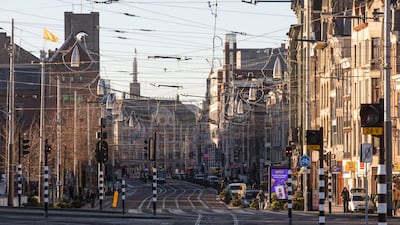
  • A quiet retail precinct during the introduction of lockdown measures in Amsterdam, Netherlands. Bloomberg
    A quiet retail precinct during the introduction of lockdown measures in Amsterdam, Netherlands. Bloomberg
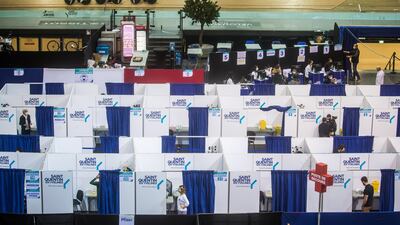
  • A vast Covid-19 vaccination centre set up inside the France's national Velodrome near Paris. EPA
    A vast Covid-19 vaccination centre set up inside the France's national Velodrome near Paris. EPA
  • A medical technician administers nasal swabs at a mobile testing site in Paris. AP Photo
    A medical technician administers nasal swabs at a mobile testing site in Paris. AP Photo
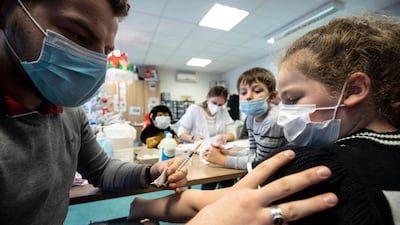
  • Children are vaccinated at a centre in Selestat, eastern France. AP Photo
    Children are vaccinated at a centre in Selestat, eastern France. AP Photo
  • People queue up outside a pharmacy to have swab tests in Turin, Italy. EPA
    People queue up outside a pharmacy to have swab tests in Turin, Italy. EPA
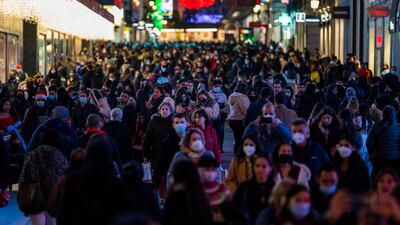
  • A crowd wearing face masks in downtown Madrid, Spain. AP Photo
    A crowd wearing face masks in downtown Madrid, Spain. AP Photo
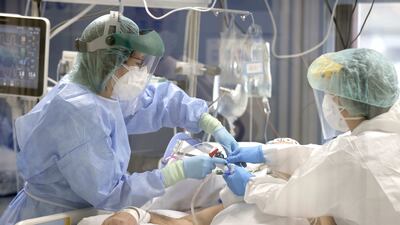
  • Nurses take care of a Covid-19 patient at the Basurto Hospital in Bilbao, Spain. EPA
    Nurses take care of a Covid-19 patient at the Basurto Hospital in Bilbao, Spain. EPA

In the past 24 hours, Italy recorded nearly 44,600 new infections, its highest ever, and 168 deaths.

The Omicron variant of the coronavirus represents nearly one third of the new cases.

The head of Italy’s national health institute, Silvio Brusaferro, said that Omicron would be dominant by next week, with “slow but continuous growth”.

Italy was the first major economy to adopt a health pass to give access to workplaces, but has allowed a negative test every 48 hours instead of full vaccination or proof of recovery from Covid-19.

Mask mandates have remained in place in public indoor settings and public transport.

Now that has been upgraded and only more-protective FFP2 masks may be worn on all public transport, and in cinemas, theatres and stadiums.


Mercer, the investment consulting arm of US services company Marsh & McLennan, expects its wealth division to at least double its assets under management (AUM) in the Middle East as wealth in the region continues to grow despite economic headwinds, a company official said.

Mercer Wealth, which globally has $160 billion in AUM, plans to boost its AUM in the region to $2-$3bn in the next 2-3 years from the present $1bn, said Yasir AbuShaban, a Dubai-based principal with Mercer Wealth.

Within the next two to three years, we are looking at reaching $2 to $3 billion as a conservative estimate and we do see an opportunity to do so,” said Mr AbuShaban.

Mercer does not directly make investments, but allocates clients’ money they have discretion to, to professional asset managers. They also provide advice to clients.

“We have buying power. We can negotiate on their (client’s) behalf with asset managers to provide them lower fees than they otherwise would have to get on their own,” he added.

Mercer Wealth’s clients include sovereign wealth funds, family offices, and insurance companies among others.

From its office in Dubai, Mercer also looks after Africa, India and Turkey, where they also see opportunity for growth.

Wealth creation in Middle East and Africa (MEA) grew 8.5 per cent to $8.1 trillion last year from $7.5tn in 2015, higher than last year’s global average of 6 per cent and the second-highest growth in a region after Asia-Pacific which grew 9.9 per cent, according to consultancy Boston Consulting Group (BCG). In the region, where wealth grew just 1.9 per cent in 2015 compared with 2014, a pickup in oil prices has helped in wealth generation.

BCG is forecasting MEA wealth will rise to $12tn by 2021, growing at an annual average of 8 per cent.

Drivers of wealth generation in the region will be split evenly between new wealth creation and growth of performance of existing assets, according to BCG.

Another general trend in the region is clients’ looking for a comprehensive approach to investing, according to Mr AbuShaban.

“Institutional investors or some of the families are seeing a slowdown in the available capital they have to invest and in that sense they are looking at optimizing the way they manage their portfolios and making sure they are not investing haphazardly and different parts of their investment are working together,” said Mr AbuShaban.

Some clients also have a higher appetite for risk, given the low interest-rate environment that does not provide enough yield for some institutional investors. These clients are keen to invest in illiquid assets, such as private equity and infrastructure.

“What we have seen is a desire for higher returns in what has been a low-return environment specifically in various fixed income or bonds,” he said.

“In this environment, we have seen a de facto increase in the risk that clients are taking in things like illiquid investments, private equity investments, infrastructure and private debt, those kind of investments were higher illiquidity results in incrementally higher returns.”

The Abu Dhabi Investment Authority, one of the largest sovereign wealth funds, said in its 2016 report that has gradually increased its exposure in direct private equity and private credit transactions, mainly in Asian markets and especially in China and India. The authority’s private equity department focused on structured equities owing to “their defensive characteristics.”

The bio

Date of Birth: April 25, 1993
Place of Birth: Dubai, UAE
Marital Status: Single
School: Al Sufouh in Jumeirah, Dubai
University: Emirates Airline National Cadet Programme and Hamdan University
Job Title: Pilot, First Officer
Number of hours flying in a Boeing 777: 1,200
Number of flights: Approximately 300
Hobbies: Exercising
Nicest destination: Milan, New Zealand, Seattle for shopping
Least nice destination: Kabul, but someone has to do it. It’s not scary but at least you can tick the box that you’ve been
Favourite place to visit: Dubai, there’s no place like home

The burning issue

The internal combustion engine is facing a watershed moment – major manufacturer Volvo is to stop producing petroleum-powered vehicles by 2021 and countries in Europe, including the UK, have vowed to ban their sale before 2040. The National takes a look at the story of one of the most successful technologies of the last 100 years and how it has impacted life in the UAE. 

Read part four: an affection for classic cars lives on

Read part three: the age of the electric vehicle begins

Read part one: how cars came to the UAE


TRAINING FOR TOKYO

A typical week's training for Sebastian, who is competing at the ITU Abu Dhabi World Triathlon on March 8-9:

  • Four swim sessions (14km)
  • Three bike sessions (200km)
  • Four run sessions (45km)
  • Two strength and conditioning session (two hours)
  • One session therapy session at DISC Dubai
  • Two-three hours of stretching and self-maintenance of the body

ITU Abu Dhabi World Triathlon

For more information go to www.abudhabi.triathlon.org.

LAST 16

SEEDS

Liverpool, Manchester City, Barcelona, Paris St-Germain, Bayern Munich, RB Leipzig, Valencia, Juventus

PLUS

Real Madrid, Tottenham, Atalanta, Atletico Madrid, Napoli, Borussia Dortmund, Lyon, Chelsea

Dr Afridi's warning signs of digital addiction

Spending an excessive amount of time on the phone.

Neglecting personal, social, or academic responsibilities.

Losing interest in other activities or hobbies that were once enjoyed.

Having withdrawal symptoms like feeling anxious, restless, or upset when the technology is not available.

Experiencing sleep disturbances or changes in sleep patterns.

What are the guidelines?

Under 18 months: Avoid screen time altogether, except for video chatting with family.

Aged 18-24 months: If screens are introduced, it should be high-quality content watched with a caregiver to help the child understand what they are seeing.

Aged 2-5 years: Limit to one-hour per day of high-quality programming, with co-viewing whenever possible.

Aged 6-12 years: Set consistent limits on screen time to ensure it does not interfere with sleep, physical activity, or social interactions.

Teenagers: Encourage a balanced approach – screens should not replace sleep, exercise, or face-to-face socialisation.

Source: American Paediatric Association
The specs: Rolls-Royce Cullinan

Price, base: Dh1 million (estimate)

Engine: 6.75-litre twin-turbo V12

Transmission: Eight-speed automatic

Power: 563hp @ 5,000rpm

Torque: 850Nm @ 1,600rpm

Fuel economy, combined: 15L / 100km

Avatar: Fire and Ash

Director: James Cameron

Starring: Sam Worthington, Sigourney Weaver, Zoe Saldana

Rating: 4.5/5

The specs

Engine: Four electric motors, one at each wheel

Power: 579hp

Torque: 859Nm

Transmission: Single-speed automatic

Price: From Dh825,900

On sale: Now

The burning issue

The internal combustion engine is facing a watershed moment – major manufacturer Volvo is to stop producing petroleum-powered vehicles by 2021 and countries in Europe, including the UK, have vowed to ban their sale before 2040. The National takes a look at the story of one of the most successful technologies of the last 100 years and how it has impacted life in the UAE.

Read part three: the age of the electric vehicle begins

Read part two: how climate change drove the race for an alternative 

Read part one: how cars came to the UAE

COMPANY%20PROFILE%20
%3Cp%3EName%3A%20DarDoc%3Cbr%3EBased%3A%20Abu%20Dhabi%3Cbr%3EFounders%3A%20Samer%20Masri%2C%20Keswin%20Suresh%3Cbr%3ESector%3A%20HealthTech%3Cbr%3ETotal%20funding%3A%20%24800%2C000%3Cbr%3EInvestors%3A%20Flat6Labs%2C%20angel%20investors%20%2B%20Incubated%20by%20Hub71%2C%20Abu%20Dhabi's%20Department%20of%20Health%3Cbr%3ENumber%20of%20employees%3A%2010%3C%2Fp%3E%0A
In-demand jobs and monthly salaries
  • Technology expert in robotics and automation: Dh20,000 to Dh40,000 
  • Energy engineer: Dh25,000 to Dh30,000 
  • Production engineer: Dh30,000 to Dh40,000 
  • Data-driven supply chain management professional: Dh30,000 to Dh50,000 
  • HR leader: Dh40,000 to Dh60,000 
  • Engineering leader: Dh30,000 to Dh55,000 
  • Project manager: Dh55,000 to Dh65,000 
  • Senior reservoir engineer: Dh40,000 to Dh55,000 
  • Senior drilling engineer: Dh38,000 to Dh46,000 
  • Senior process engineer: Dh28,000 to Dh38,000 
  • Senior maintenance engineer: Dh22,000 to Dh34,000 
  • Field engineer: Dh6,500 to Dh7,500
  • Field supervisor: Dh9,000 to Dh12,000
  • Field operator: Dh5,000 to Dh7,000
Key figures in the life of the fort

Sheikh Dhiyab bin Isa (ruled 1761-1793) Built Qasr Al Hosn as a watchtower to guard over the only freshwater well on Abu Dhabi island.

Sheikh Shakhbut bin Dhiyab (ruled 1793-1816) Expanded the tower into a small fort and transferred his ruling place of residence from Liwa Oasis to the fort on the island.

Sheikh Tahnoon bin Shakhbut (ruled 1818-1833) Expanded Qasr Al Hosn further as Abu Dhabi grew from a small village of palm huts to a town of more than 5,000 inhabitants.

Sheikh Khalifa bin Shakhbut (ruled 1833-1845) Repaired and fortified the fort.

Sheikh Saeed bin Tahnoon (ruled 1845-1855) Turned Qasr Al Hosn into a strong two-storied structure.

Sheikh Zayed bin Khalifa (ruled 1855-1909) Expanded Qasr Al Hosn further to reflect the emirate's increasing prominence.

Sheikh Shakhbut bin Sultan (ruled 1928-1966) Renovated and enlarged Qasr Al Hosn, adding a decorative arch and two new villas.

Sheikh Zayed bin Sultan (ruled 1966-2004) Moved the royal residence to Al Manhal palace and kept his diwan at Qasr Al Hosn.

Sources: Jayanti Maitra, www.adach.ae

Updated: December 24, 2021, 1:45 AM