


Britain's city centres could lose billions next year as long-term behavioural changes caused by the coronavirus pandemic continue to hit the hospitality and retail industries.
Research by the University of Sheffield found that businesses could lose £3 billion ($4bn) as people work from home and stop going to coffee shops, buying lunch, or going shopping near their workplaces.
Dr Jesse Matheson, who led the study, said that employees will be working roughly one day a week more at home than they were before the pandemic, with the shift in working habits expected to be permanent.
The phenomenon, which Dr Matheson labelled “zoomshock”, is mainly likely to affect businesses in the most densely populated areas of Britain.
London is expected to be worst hit, with the City financial district expected to suffer a 31 per cent drop in spending, followed by central Birmingham, which could to see an 8 per cent decline.
The study also found that roughly 77,000 people who work in the hospitality and retail industries will be forced to either relocate to jobs in the suburbs or lose their jobs completely.
On Wednesday, England introduced Plan B Covid-19 measures, with workers asked to work from home if they can, leading to fears of further losses for struggling inner-city retailers.
Analysis also found a significant inequality between rich and poor neighbourhoods. Those from more affluent boroughs are likely to continue to work from home, meaning that money being lost in city centres is more likely to be recuperated in higher income suburbs.
“Some of this spending will be realised in the residential areas where these workers live, but some may be lost altogether,” Dr Jesse Matheson said. “As suburban neighbourhoods lack the density of city centres, many retail and hospitality businesses will find it is not profitable to relocate.”
UK coronavirus latest — in pictures
-

British Prime Minister Boris Johnson gives a press conference at 10 Downing Street. He announced that the government will implement its “Plan B” due to the rapid transmission of the Omicron variant. Getty Images -
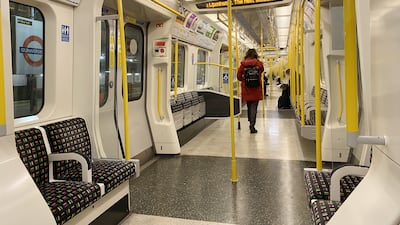
Empty seats on an early morning commuter train on the District Line, in west London, the morning after Mr Johnson announced that work-from-home guidance will return on Monday. PA -
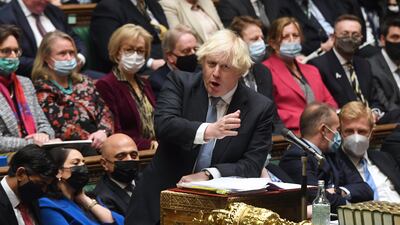
Boris Johnson during the Prime Minister's Questions at the House of Commons. Johnson faced questions amid allegations that Downing Street staff held a Christmas party during the Covid-19 lockdown 2020. EPA -
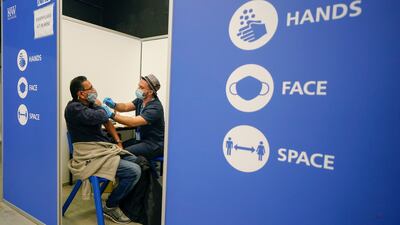
A patient receives the Pfizer vaccine at Swaminarayan School vaccination centre, in London. Britain says it will offer all adults a booster dose of vaccine within two months. AP Photo -
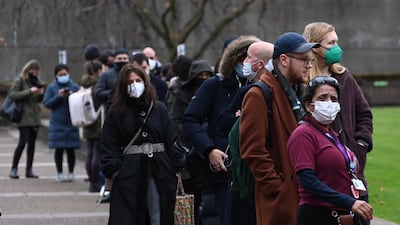
People queue up for Covid-19 booster jabs outside a vaccination centre in London. EPA -
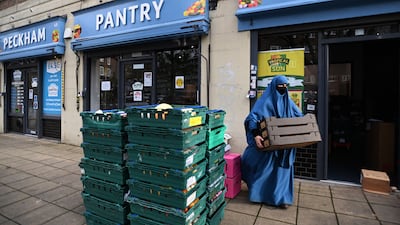
Staff with a new food delivery outside the Peckham Pantry in London. Food banks are braced for a big rise in demand in the run up to Christmas. EPA -
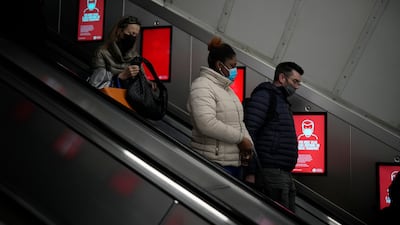
People wearing face masks pass electronic signs telling people they must wear masks on public transport, at Bond Street underground station in London. AP -

Allegra Stratton speaks outside her home in north London. Ms Stratton, a senior aide to Mr Johnson, resigned hours after an investigation began into allegations of a Covid-breaking Christmas party at Downing Street last year. AP -
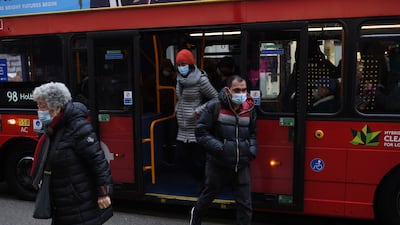
Masked travellers get off a bus in London. According to his official spokesperson in Downing Street, Mr Johnson has told his cabinet that the Omicron variant of coronavirus appears to be more transmissible. EPA -
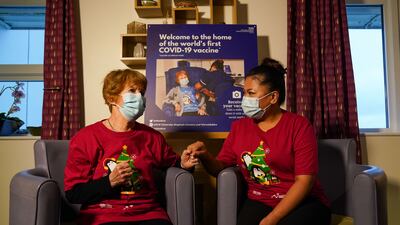
Margaret Keenan and Nurse May Parsons at University Hospital Coventry & Warwickshire, a year after Ms Keenan was the first person in the UK to receive the Pfizer-BioNTech vaccine. PA -
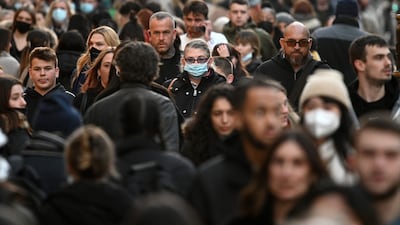
Shoppers, some wearing face-masks, walk along Oxford Street in central London, as compulsory mask wearing in shops is reintroduced in England. AFP


“Workers in retail and hospitality may also find that demand has shifted to locations to which commuting is too difficult, which means that supply may not be able to keep up with demand.”
Dr Matheson says there is work to do in finding out if all of the lost £3 billion will be spent elsewhere or lost altogether.
“This money may be recuperated in the higher income suburbs, but in a lot of places working from home means people are more spread out, which isn’t good business for retail business like coffee shops, who require high density areas for business.
“So there is a risk this revenue could be lost from the hospitality and retail sectors forever.”

