• Crowds of people, some wearing face masks, walk through Covent Garden in central London. Authorities in England are attempting to stem the spread of the new Omicron variant. Reuters
    Crowds of people, some wearing face masks, walk through Covent Garden in central London. Authorities in England are attempting to stem the spread of the new Omicron variant. Reuters
  • A member of the public receives a Covid-19 Moderna booster vaccine jab at a temporary vaccination centre set up inside St John's Church in west London. AFP
    A member of the public receives a Covid-19 Moderna booster vaccine jab at a temporary vaccination centre set up inside St John's Church in west London. AFP
  • People wait outside a Covid-19 testing facility at Heathrow airport's Terminal 5 in west London as new restrictions on travellers are introduced. AFP
    People wait outside a Covid-19 testing facility at Heathrow airport's Terminal 5 in west London as new restrictions on travellers are introduced. AFP
  • A man adds someone's initials to the hearts and names on the National Covid Memorial wall, near St Thomas' Hospital in London. Getty Images
    A man adds someone's initials to the hearts and names on the National Covid Memorial wall, near St Thomas' Hospital in London. Getty Images
  • Parents and teachers from Fulham Boys School sing a hymn during their Christmas carol service in London. Reuters
    Parents and teachers from Fulham Boys School sing a hymn during their Christmas carol service in London. Reuters
  • A member of the public wearing a face mask walks past Selfridge's on Oxford Street, in London. Reuters
    A member of the public wearing a face mask walks past Selfridge's on Oxford Street, in London. Reuters
  • A person puts on a face shield on before entering a shop selling Christmas goods in London. Reuters
    A person puts on a face shield on before entering a shop selling Christmas goods in London. Reuters
  • Scotland's First Minister Nicola Sturgeon prepares to receive a Covid-19 booster vaccination in Glasgow. AFP
    Scotland's First Minister Nicola Sturgeon prepares to receive a Covid-19 booster vaccination in Glasgow. AFP
  • Nurse Ann Craven inoculates Jordan Ward, 12, with his first shot of the Pfizer vaccine at a pop-up vaccination clinic in the Central Fire Station in Belfast, Northern Ireland. Reuters
    Nurse Ann Craven inoculates Jordan Ward, 12, with his first shot of the Pfizer vaccine at a pop-up vaccination clinic in the Central Fire Station in Belfast, Northern Ireland. Reuters
  • Britain's Prime Minister Boris Johnson speaks to members of the public before receiving his booster jab at St Thomas' Hospital in London. AP
    Britain's Prime Minister Boris Johnson speaks to members of the public before receiving his booster jab at St Thomas' Hospital in London. AP
  • Labour Party leader Sir Keir Starmer receives his booster vaccination at a pharmacy in London. PA
    Labour Party leader Sir Keir Starmer receives his booster vaccination at a pharmacy in London. PA

Three Pfizer vaccine doses highly effective against Omicron Covid-19 variant


  • English
  • Arabic

Live updates: follow the latest news on Covid-19 variant Omicron

New data on Covid-19 has found that three doses of the Pfizer vaccine "neutralises" the Omicron variant of the disease, BioNTech and Pfizer said on Wednesday.

The companies said that their initial findings showed that people who had two doses of their vaccine had lower protection from the variant, which some experts fear could be more transmissible than the globally dominant delta variant.

But a third dose of their vaccine increased the neutralising antibodies by a factor of 25, the companies said.

The news came as South African researchers warned that Omicron’s ability to evade vaccine and infection-induced immunity is “robust but not complete." They also said that booster shots are expected to reduce the chances of infection and severe disease.

The data comes from the first reported experiments gauging the effectiveness of Covid-19 inoculations against the new coronavirus strain.

In Queensland, Australia, researchers said they found two different versions of the Omicron strain in travellers who returned to the country.

The new lineage, which has about half the gene variations of the original and cannot be detected with typical screening, was found in a traveller who returned from South Africa and tested positive for the coronavirus on Saturday, the state’s deputy health co-ordinator for Covid-19 operations, Peter Aitkin, told reporters.

The new lineage has enough markers “to be able to classify it as Omicron but we do not know enough about it as to what that means then as far as clinical severity, vaccine effectiveness,” Mr Aitkin said. “We now have Omicron and Omicron-like.”

Meanwhile, New South Wales state said genome sequencing confirmed an additional Omicron case contracted from an outbreak in Sydney’s western suburbs, bringing the locally acquired infections to 21.

Including international arrivals, the state has found 34 cases of the variant, none of which had resulted in hospital admissions, health officials said on Wednesday.

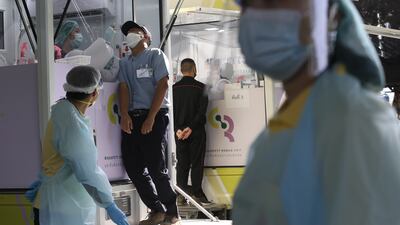
  • Health workers administer Covid-19 nasal swab tests during a mass vaccination drive to prevent the spread of the Omicron variant in Bangkok, Thailand. EPA
    Health workers administer Covid-19 nasal swab tests during a mass vaccination drive to prevent the spread of the Omicron variant in Bangkok, Thailand. EPA
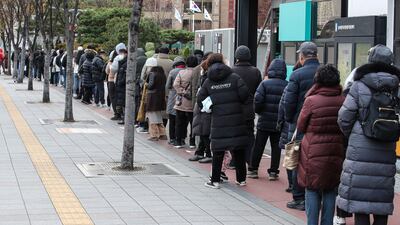
  • People queue outside a Covid-19 testing centre in Seoul's south-eastern district of Songpa. EPA
    People queue outside a Covid-19 testing centre in Seoul's south-eastern district of Songpa. EPA
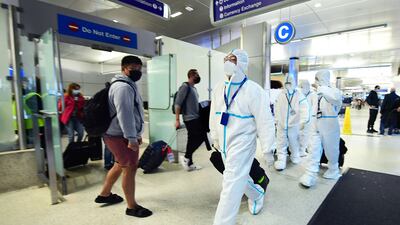
  • Air China crew members arrive at Los Angeles International Airport in hazmat suits after the county reported its first case of the Omicron variant. AFP
    Air China crew members arrive at Los Angeles International Airport in hazmat suits after the county reported its first case of the Omicron variant. AFP
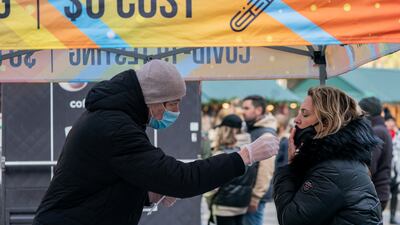
  • A woman has a nasal swab sample collected at a Covid-19 testing centre in New York. Reuters
    A woman has a nasal swab sample collected at a Covid-19 testing centre in New York. Reuters
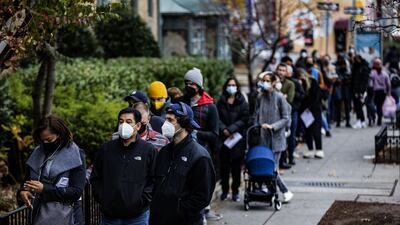
  • People wait outside a health centre in Washington that is offering free coronavirus vaccines. AFP
    People wait outside a health centre in Washington that is offering free coronavirus vaccines. AFP
  • A woman wears a face mask in front of the Brandenburg Gate in Berlin, Germany. EPA
    A woman wears a face mask in front of the Brandenburg Gate in Berlin, Germany. EPA
  • A pedestrian wearing a face mask looks at Christmas window displays in Paris, France. EPA
    A pedestrian wearing a face mask looks at Christmas window displays in Paris, France. EPA
  • Passengers queue outside a Covid-19 testing centre at Cape Town International Airport, South Africa. Bloomberg
    Passengers queue outside a Covid-19 testing centre at Cape Town International Airport, South Africa. Bloomberg
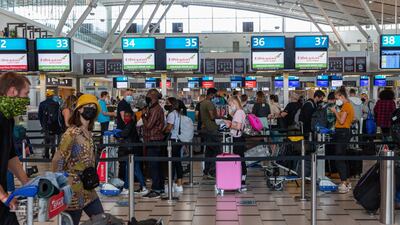
  • Passengers queue at check-in desks at Cape Town International Airport, South Africa. Bloomberg
    Passengers queue at check-in desks at Cape Town International Airport, South Africa. Bloomberg

Pfizer’s vaccine provides less immunity to the Omicron variant than it does with other major coronavirus strains, according to laboratory experiments that still indicated a third dose may help stop the highly mutated strain.

Researchers at the Africa Health Research Institute in Durban, South Africa, found that Omicron resulted in about a 40-fold reduction in levels of neutralising antibodies produced by people who had received two doses of the Pfizer-BioNTech shot, compared with the strain detected in China about two years ago.

China reported 49 domestic infections on Wednesday, including five asymptomatic cases, which were mostly in an Inner Mongolia town on the border with Russia where nine rounds of mass testing have identified about 400 infections.

Meanwhile, Omicron cases continue to spread through Asia. A cluster has emerged in the eastern Chinese province of Zhejiang while Shanghai has reported one infection.

South Korea reported more than 7,000 daily cases for the first time. In Japan, a shortage of hospital beds during the Covid-19 pandemic has led to patients convalescing in hotels, while a surge in cases over the summer resulted in the nation’s economy shrinking faster than first estimated in the third quarter.

Norway is joining the list of countries tightening restrictions again to try to regain control of the spread of the Omicron variant and prevent overloading of a hospital system already struggling with other types of illness as winter sets in.

Covid-19 deaths and hospital admissions will continue to rise in Europe in the coming weeks as vaccination rates remain insufficient to counter the trends, a key European health agency said on Tuesday.

European countries have taken a varying set of measures to combat the spread of the virus, including lockdowns for the unvaccinated and early closing for restaurants and bars. However, Andrea Ammon, the director of the European Centre for Disease Prevention and Control, said the toll is still growing.

“In the coming weeks, there will be increasing parameters of cases, deaths, hospitalisation and ICU admissions,” she told a meeting of EU health ministers in Brussels. “The Omicron variant ... makes the whole situation even more worrying.”

Denmark has the found Omicron in sewage water for the first time and has given up its initial strategy to contain the coronavirus variant, health authorities said.

The country had registered 398 Omicron cases as of Tuesday, up by 137 cases from a day earlier, said SSI, its institute for infectious disease.

Scotland is expected to face a continued and “potentially rapid” rise in coronavirus cases in the coming days amid a surge in the Omicron infections in large parts of the country, First Minister Nicola Sturgeon said.

The UK found 101 new confirmed cases of the Omicron variant, up from 90 the day before, according to a tweet from the Health Security Agency. The number of Omicron cases in the UK now stands at 437.


Mercer, the investment consulting arm of US services company Marsh & McLennan, expects its wealth division to at least double its assets under management (AUM) in the Middle East as wealth in the region continues to grow despite economic headwinds, a company official said.

Mercer Wealth, which globally has $160 billion in AUM, plans to boost its AUM in the region to $2-$3bn in the next 2-3 years from the present $1bn, said Yasir AbuShaban, a Dubai-based principal with Mercer Wealth.

Within the next two to three years, we are looking at reaching $2 to $3 billion as a conservative estimate and we do see an opportunity to do so,” said Mr AbuShaban.

Mercer does not directly make investments, but allocates clients’ money they have discretion to, to professional asset managers. They also provide advice to clients.

“We have buying power. We can negotiate on their (client’s) behalf with asset managers to provide them lower fees than they otherwise would have to get on their own,” he added.

Mercer Wealth’s clients include sovereign wealth funds, family offices, and insurance companies among others.

From its office in Dubai, Mercer also looks after Africa, India and Turkey, where they also see opportunity for growth.

Wealth creation in Middle East and Africa (MEA) grew 8.5 per cent to $8.1 trillion last year from $7.5tn in 2015, higher than last year’s global average of 6 per cent and the second-highest growth in a region after Asia-Pacific which grew 9.9 per cent, according to consultancy Boston Consulting Group (BCG). In the region, where wealth grew just 1.9 per cent in 2015 compared with 2014, a pickup in oil prices has helped in wealth generation.

BCG is forecasting MEA wealth will rise to $12tn by 2021, growing at an annual average of 8 per cent.

Drivers of wealth generation in the region will be split evenly between new wealth creation and growth of performance of existing assets, according to BCG.

Another general trend in the region is clients’ looking for a comprehensive approach to investing, according to Mr AbuShaban.

“Institutional investors or some of the families are seeing a slowdown in the available capital they have to invest and in that sense they are looking at optimizing the way they manage their portfolios and making sure they are not investing haphazardly and different parts of their investment are working together,” said Mr AbuShaban.

Some clients also have a higher appetite for risk, given the low interest-rate environment that does not provide enough yield for some institutional investors. These clients are keen to invest in illiquid assets, such as private equity and infrastructure.

“What we have seen is a desire for higher returns in what has been a low-return environment specifically in various fixed income or bonds,” he said.

“In this environment, we have seen a de facto increase in the risk that clients are taking in things like illiquid investments, private equity investments, infrastructure and private debt, those kind of investments were higher illiquidity results in incrementally higher returns.”

The Abu Dhabi Investment Authority, one of the largest sovereign wealth funds, said in its 2016 report that has gradually increased its exposure in direct private equity and private credit transactions, mainly in Asian markets and especially in China and India. The authority’s private equity department focused on structured equities owing to “their defensive characteristics.”

Updated: December 09, 2021, 6:12 AM