



Efforts to combat Covid-19 have taken another step forward with the UK’s recent announcement that it has approved the first pill to treat people with Covid-19.
Molnupiravir is an antiviral drug that can be taken twice a day for five days at the onset of infection by people who are vulnerable to developing severe disease, perhaps because of age or underlying health conditions.
Authorisation for the drug, which is produced by Merck, the US pharmaceutical giant, and Ridgeback Biotherapeutics, was granted this month by the UK’s Medicines and Healthcare products Regulatory Agency (MHRA).
The National explains the drug’s significance in the context of other Covid-19 treatments.
How effective is it?
Trials found that it cut the risk of illness requiring hospital admission by half, and the hope is that by preventing more people from falling seriously ill, the drug will ease pressure on under-pressure health systems. It may also reduce transmission.
“There are not so many [drugs] that have been approved as direct antivirals – that’s the significance of this,” said Prof Ian Jones, Professor of Virology at the University of Reading in the UK.
University of Reading
“The clinical trial data seemed to show a clear usefulness. But there’s one big caveat – it must be given early in the infection. It’s not going to do much good if you’re already in hospital.”
This means that the people who are likely to be taking molnupiravir are individuals with “mild to moderate” symptoms and who are vulnerable to Covid-19 because of age or underlying health conditions.
Trials in India involving people with more severe illness indicated that the drug was ineffective at that stage, emphasising the need to take it early.
“We can use it early and stop it doing harm [before] the disease becomes fully developed,” said Prof David Taylor, Professor Emeritus of Pharmaceutical and Public Health Policy at University College London.
“There’s every reason to suppose it has an important [contribution] alongside vaccination and the late-stage drug treatments we already have.”
How does it work?
Molnupiravir disrupts the replication of the virus’s genetic material (ribonucleic acid or RNA) and in doing so, can stop the pathogen multiplying.
It incorporates itself into the strands of RNA the virus is producing, creating mutations that eventually cause the number of virus particles in an infected person to fall. It has been described as causing the virus to mutate itself to death.
“This is a drug which attacks the replication of the virus, the ability of the virus to make more of itself,” Prof Jones said.
Its mode of action has raised concerns, however, that the drug may cause mutations in human genetic material, potentially leading to tumours.
Merck said that trial data shows the drug is safe.
Molnupiravir was originally tested as a treatment for a disease in horses before interest turned to its potential effects against influenza in people.
After Covid-19 emerged, Ridgeback Therapeutics secured a licence for the drug, leading to its eventual approval for use against the coronavirus.
How does molnupiravir compare with other Covid-19 drug treatments?
Other drug treatments for Covid-19 are given intravenously or by injection, making them difficult to administer unless a person is in hospital, which is a particular drawback for drugs that should be taken early on in infection.
Molnupiravir stands out for being taken as a pill.
Other drug companies are working on their own pill treatments for Covid-19.
Among the Covid-19 treatments already available is one from Regeneron Pharmaceuticals and Roche that is made up of two monoclonal antibodies (identical antibodies produced artificially in large numbers).
-
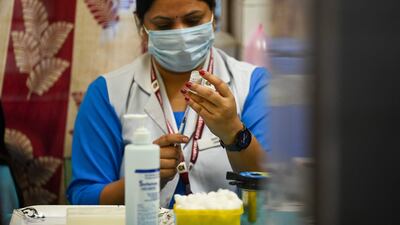
India administered its billionth Covid-19 vaccine dose on October 21, according to the health ministry, half a year after a devastating surge in cases brought the health system close to collapse. Prakash Singh / AFP -
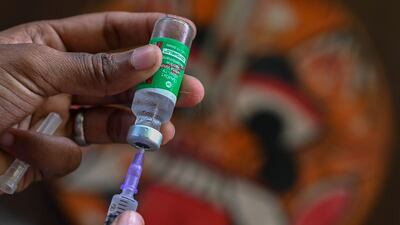
A health worker prepares to administer a Covishield vaccine in Chennai. Arun Sankar / AFP -
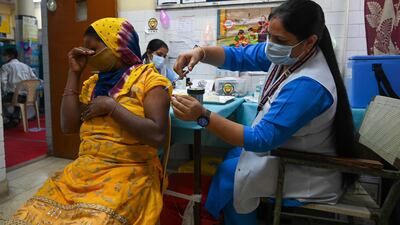
A health worker inoculates a woman with a dose of the Covaxin vaccine in New Delhi. Prakash Singh / AFP -

A health worker, left, registers a man for a dose of the Covaxin vaccine in New Delhi. Prakash Singh / AFP -
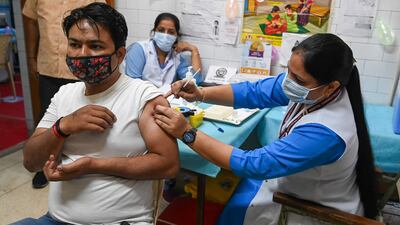
A health worker inoculates a man with a dose of the Covaxin vaccine in New Delhi. Prakash Singh/ AFP -

Volunteers decorate a vaccination centre to celebrate India administering its billionth Covid-19 vaccine. Prakash Singh / AFP


Administered early on, this treatment can prevent the coronavirus from attaching itself to cells in the respiratory system.
Some other monoclonal antibodies have similar effects, among them sotrovimab, which has been used in the UAE.
The US Food and Drug Administration gave emergency approval for sotrovimab in May, saying the drug was suitable for people at risk of serious illness, such as those aged 65 and above or with certain medical conditions.
Further monoclonal antibodies work in a different way and are given later on during serious infections to stop the “cytokine storm” in which the immune system overreacts to coronavirus infection, releasing excessive amounts of chemicals called cytokines. This can result in organ failure and death.
A corticosteroid called dexamethasone is another later-stage treatment administered to seriously ill patients to curtail the cytokine storm.
Where will molnupiravir be used?
As well as the UK, which has ordered 480,000 doses, several other nations, including Australia, Singapore, South Korea and the US, have struck advance-purchase agreements for molnupiravir.
One place where the drug may prove particularly useful is in care homes, as it could be given to numerous residents in the event of an outbreak.
The US is paying about $1.2 billion for 1.7 million five-day courses of treatment, which works out at about $700 per patient.
At this price, the drug is likely to be too expensive for many lower-income nations.
But Merck, the US-based pharmaceutical company that, along with Ridgeback Biotherapeutics, is behind the pill, has licensed several Indian manufacturers to produce generic versions.
This is likely to lead to the drug being available for a far lower price than developed nations are paying.
Reports indicate these cheaper versions could be distributed in about 100 low and middle-income countries.

