



Latest: UK government under pressure for Plan B as new Delta strain spreads
A new variant of the Delta coronavirus strain thought to account for 6 per cent of all new UK cases is being closely monitored by scientists.
Sub-variant AY. 4.2 could be 10 to 15 per cent more infectious than the original Delta variant that was first spotted in India in December and has become the dominant Covid-19 strain.
Francois Balloux, director of the University College London Genetics Institute, published an analysis on Twitter suggesting that the data implied it was “intrinsically more transmissible”.
He said that research showed AY. 4.2 could be the most infectious variant of the virus to date. It is expected to be placed under investigation by the World Health Organisation.
An NHS document published on Tuesday revealed the sub-variant was one of four being monitored by scientists working for the UK Health Security Agency.
“A Delta sublineage newly designated as AY. 4.2 is noted to be expanding in England. It is now a signal in monitoring and assessment has commenced,” it said.
“New sublineages of Delta are regularly identified and designated. One recently designated sublineage, AY. 4.2, is not yet assigned by the Pangolin tool and therefore is not represented in Figure 10.
“This sublineage is currently increasing in frequency. It includes spike mutations A222V and Y145H. In the week beginning 27 September 2021 (the last week with complete sequencing data), this sublineage accounted for approximately 6 per cent of all sequences generated, on an increasing trajectory.”
Full WHO investigations could lead to it being assigned a Greek letter under its naming system, in the same way other variants of Covid-19 have been up to now.
More work was needed to fully understand its potential for disruption.
“It's good that we are aware. It's excellent that we have the facilities and infrastructure in place to see anything that might be a bit suspicious,” Mr Balloux said. “At this stage, I would say wait and see, don't panic. It might be slightly, subtly more transmissible but it is not something absolutely disastrous like we saw previously.”
Cases of Covid-19 in the UK are higher now that at the same time in 2020, when England still enforced local lockdowns.
On Tuesday, the UK Department of Health recorded 223 deaths, the highest level since March 9. However, infections had dropped to 43,738 after reaching almost 50,000 a day previously.
-

Arriving passengers queue at Terminal 5 of Heathrow Airport, in London. Hannah McKay / Reuters -

Tourists from Britain arrive at the airport in Mallorca, Spain, after England lifted quarantine requirements for travellers returning from the Balearic Islands. -

A woman reads a book while sitting between social distancing markers in Liverpool. -
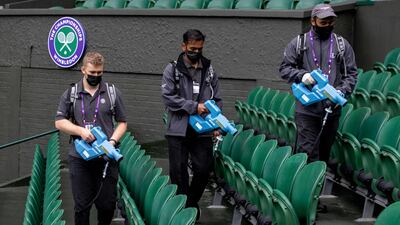
Workers disinfect seats in the Centre Court at The All England Tennis Club, in Wimbledon. -

Spectators, some wearing face masks, queue to enter the grounds at the 2021 Wimbledon Championships. -

People gather near Parliament in central London during a '#FreedomToDance' march organised by Save Our Scene, calling for an easing of restrictions for music events. -

People queue at a vaccination centre at Arsenal's Emirates Stadium, in London. -

People receive their vaccine doses at the Emirates Stadium.


Recorded cases of new infections are outstripping some European countries and causing concern as winter approaches.
Experts said the UK’s steep rise in Covid infections could be a result of waning protection from vaccines.
The UK had one of the earliest and fastest immunisation campaigns, with protection of 90 per cent to 95 per cent from the AstraZeneca and Pfizer vaccines thought to last for about 20 weeks before antibodies begin to drop-off.
The number of people who have tested positive in the UK has steadily risen from a seven-day average of about 25,000 in early August to more than 40,000 cases a day in mid-October.
However, hospital admission rates remain considerably lower than a year ago.
Fewer than 1,000 daily cases end up in hospital now, compared to more than four times that figure 12 months ago, thanks mainly to a widespread vaccination programme through 67 per cent of the population is fully protected.

