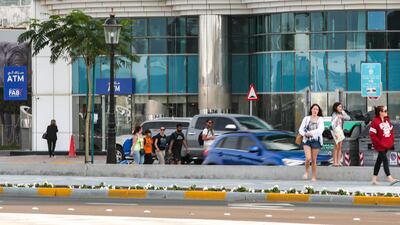
FAB Bank. The global sustainable finance market is projected to hit $22.48 trillion by 2031. Victor Besa / The National

UAE's green and sustainable finance issuance grows 32% amid rising participation


  • English
  • Arabic

Green and sustainable finance issuance, aimed at environmentally friendly projects, grew 32 per cent in the UAE last year, compared with 2021, according to Arthur D Little.

Major public and private institutions in the UAE, including the Dubai Financial Market, the Ministry of Climate Change and Environment, and publicly listed companies in the Securities and Commodities Authority, have shown an increase in environmental, social and governance standards (ESG) reporting, the consultancy said in a report on Monday.

“Green issuances from countries in the Middle East and North Africa are not standing still but are, in fact, outpacing global growth,” said Andreas Buelow, a partner at Arthur D Little.

“With new reporting requirements taking effect, banks are facing an urgent need to kick-start their strategies and execute concepts throughout their organisations.”

Less than two weeks ago, Dubai Islamic Bank, the UAE’s biggest Sharia-compliant lender by assets, raised $1 billion from its second sustainable sukuk as it continues to diversify its financing base.

In September, Abu Dhabi Commercial Bank, the country's third-largest lender, priced its debut $500 million green bond that will help it finance projects following ESG standards.

Last year, First Abu Dhabi Bank, the UAE's largest lender by assets, provided a multimillion-dollar green trade credit line to wind turbine maker Senvion India, as part of the bank's efforts to advance its net-zero ambitions.

The global sustainable finance market, which was valued at $3.65 trillion in 2021, is projected to hit $22.48 trillion by 2031, growing at a compound annual rate of more than 20 per cent between 2022 and 2031, according to Allied Market Research.

Green bond and sukuk issuances from the GCC hit a record in 2022 at $8.5 billion from 15 deals, compared with $605 million from six deals in 2021, data from Bloomberg’s Capital Markets League Tables showed last month.

“Many financial institutions in the Middle East have designed comprehensive ESG strategies that open the door to new pathways to top-line growth, business opportunities, cost reductions, regulatory compliance and employee satisfaction,” said Nael Amin, senior manager in the financial services practice at Arthur D Little.

“This growing trend demonstrates the momentum that ESG is gathering in financial institutions, as the world’s banks increasingly emphasise ESG and infuse it into their business models.”

The issuance of green bonds in the Middle East region grew by 38 per cent between 2016 and 2020, and in 2020 alone, Middle Eastern governments drove 97 per cent of green bond issuances, compared with 13 per cent four years earlier, according to the Boston Consulting Group.

“Banks in the Middle East have embraced the importance of a well-defined ESG strategy. During the next step, implementation, frameworks such as data governance are vitally necessary,” said Mr Amin.

Arthur D Little said that $24.55 billion in green and sustainable finance was generated by the Mena region in 2021, a more than sixfold increase from $3.8 billion in 2020.

The Emirates is investing Dh600 billion in clean and renewable energy projects over the next three decades as it aims to achieve net-zero emissions by 2050.

It is building the Mohammed bin Rashid Solar Park in Dubai with a capacity of five gigawatts.

Abu Dhabi, which is developing a two-gigawatt solar plant in its Al Dhafra region, has set a target of 5.6 gigawatts of solar PV capacity by 2026.

Kandahar%20
%3Cp%3E%3Cstrong%3EDirector%3A%3C%2Fstrong%3E%20Ric%20Roman%20Waugh%3C%2Fp%3E%0A%3Cp%3E%3Cstrong%3EStars%3A%C2%A0%3C%2Fstrong%3EGerard%20Butler%2C%20Navid%20Negahban%2C%20Ali%20Fazal%3C%2Fp%3E%0A%3Cp%3E%3Cstrong%3ERating%3A%3C%2Fstrong%3E%202.5%2F5%3C%2Fp%3E%0A

Mercer, the investment consulting arm of US services company Marsh & McLennan, expects its wealth division to at least double its assets under management (AUM) in the Middle East as wealth in the region continues to grow despite economic headwinds, a company official said.

Mercer Wealth, which globally has $160 billion in AUM, plans to boost its AUM in the region to $2-$3bn in the next 2-3 years from the present $1bn, said Yasir AbuShaban, a Dubai-based principal with Mercer Wealth.

Within the next two to three years, we are looking at reaching $2 to $3 billion as a conservative estimate and we do see an opportunity to do so,” said Mr AbuShaban.

Mercer does not directly make investments, but allocates clients’ money they have discretion to, to professional asset managers. They also provide advice to clients.

“We have buying power. We can negotiate on their (client’s) behalf with asset managers to provide them lower fees than they otherwise would have to get on their own,” he added.

Mercer Wealth’s clients include sovereign wealth funds, family offices, and insurance companies among others.

From its office in Dubai, Mercer also looks after Africa, India and Turkey, where they also see opportunity for growth.

Wealth creation in Middle East and Africa (MEA) grew 8.5 per cent to $8.1 trillion last year from $7.5tn in 2015, higher than last year’s global average of 6 per cent and the second-highest growth in a region after Asia-Pacific which grew 9.9 per cent, according to consultancy Boston Consulting Group (BCG). In the region, where wealth grew just 1.9 per cent in 2015 compared with 2014, a pickup in oil prices has helped in wealth generation.

BCG is forecasting MEA wealth will rise to $12tn by 2021, growing at an annual average of 8 per cent.

Drivers of wealth generation in the region will be split evenly between new wealth creation and growth of performance of existing assets, according to BCG.

Another general trend in the region is clients’ looking for a comprehensive approach to investing, according to Mr AbuShaban.

“Institutional investors or some of the families are seeing a slowdown in the available capital they have to invest and in that sense they are looking at optimizing the way they manage their portfolios and making sure they are not investing haphazardly and different parts of their investment are working together,” said Mr AbuShaban.

Some clients also have a higher appetite for risk, given the low interest-rate environment that does not provide enough yield for some institutional investors. These clients are keen to invest in illiquid assets, such as private equity and infrastructure.

“What we have seen is a desire for higher returns in what has been a low-return environment specifically in various fixed income or bonds,” he said.

“In this environment, we have seen a de facto increase in the risk that clients are taking in things like illiquid investments, private equity investments, infrastructure and private debt, those kind of investments were higher illiquidity results in incrementally higher returns.”

The Abu Dhabi Investment Authority, one of the largest sovereign wealth funds, said in its 2016 report that has gradually increased its exposure in direct private equity and private credit transactions, mainly in Asian markets and especially in China and India. The authority’s private equity department focused on structured equities owing to “their defensive characteristics.”

MANDOOB
%3Cp%3EDirector%3A%20Ali%20Kalthami%3C%2Fp%3E%0A%3Cp%3EStarring%3A%20Mohammed%20Dokhei%2C%20Sarah%20Taibah%2C%20Hajar%20Alshammari%3C%2Fp%3E%0A%3Cp%3ERating%3A%204%2F5%3C%2Fp%3E%0A%3Cp%3E%3C%2Fp%3E%0A
Scoreline

Arsenal 0 Manchester City 3

  • Agüero 18'
  • Kompany 58'
  • Silva 65'
What vitamins do we know are beneficial for living in the UAE

Vitamin D: Highly relevant in the UAE due to limited sun exposure; supports bone health, immunity and mood.Vitamin B12: Important for nerve health and energy production, especially for vegetarians, vegans and individuals with absorption issues.Iron: Useful only when deficiency or anaemia is confirmed; helps reduce fatigue and support immunity.Omega-3 (EPA/DHA): Supports heart health and reduces inflammation, especially for those who consume little fish.

Updated: February 28, 2023, 1:33 PM